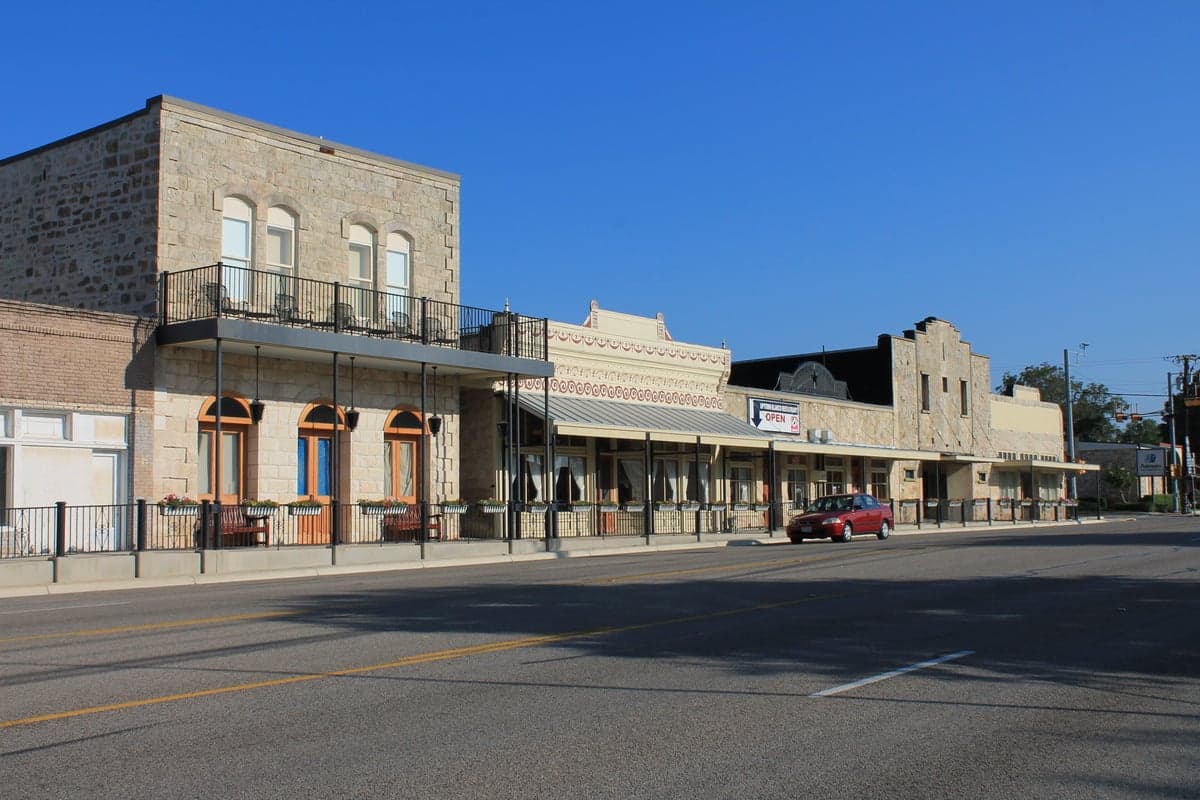
Photo: Wikipedia
Strategic Assessment of Blanco, TX
Meaningful friction. Expect exposure to either population pressure, blast zones, or natural disaster risk. Consider buying a retreat property.
What does the Strategic Assessment tell us?
Our Strategic Assessment grades tactical survivability of an area. Major population centers, military targets, fallout zones, natural disasters, and border exposure all drive risk — lower exposure means a more defensible position in a crisis.
This is heavily inspired by Joel Skousen's Strategic Relocation book. Highly recommended you checkout the book ($)What does this tell us?
Our Strategic Assessment grades tactical survivability of an area. Major population centers, military targets, fallout zones, natural disasters, and border exposure all drive risk — lower exposure means a more defensible position in a crisis.
This is heavily inspired by Joel Skousen's Strategic Relocation book. Highly recommended you checkout the book ($)Strategic Pillars

Key Distances
Regional Safe Places
Below is our recommended "safe zones" in Texas and the surrounding area based on our strategic heuristics. For most people, it's unrealistic to live in a “safe zone” full-time due to work, family or other personal reasons. They tend to be more rural. However, many of these areas are perfect for second homes and retreat properties that double as a vacation home or even a short-term rental.

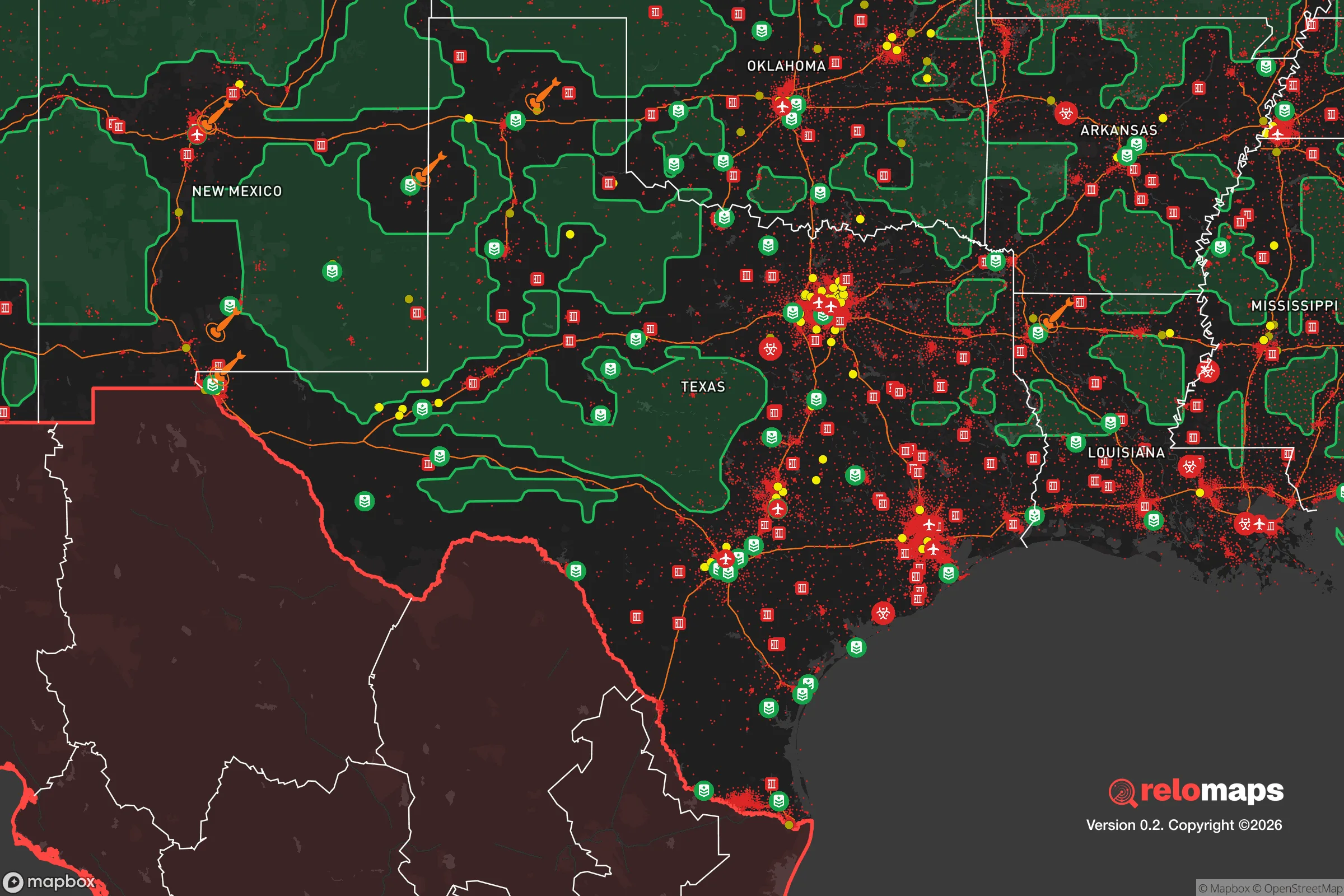


Important Note: For informational purposes only. This does not mean nothing bad ever happens in the green zones. Please use common sense. This is based on public data and modeled with AI. We tried to take a conservative approach but mistakes happen. We update this regularly as new information becomes available.
Solar Generator Recommendations
Backup power matters more here than in safer locations. We've picked three solar generators across budgets and capacity tiers — start with the budget unit if you only need a few essentials, or step up if you want to run a fridge and HVAC for days at a time.

Jackery Portable Power Station Explorer 300
Budget OptionPower on the Go: Weighing only 11 lbs, it's convenient to set up and store with book-sized foldable solar panels

BLUETTI Portable Power Station AC180
Designed for both indoor and outdoor scenarios, AC180 is highly capable as it has a robost capacity and continuous output power.

EF ECOFLOW DELTA Pro Ultra Power Station
Upgraded PickEcoFlow DELTA Pro Ultra is a whole-home energy system designed to grow with your family. Integrated with the Smart Home Panel 2, it scales to meet your evolving energy needs — keeping your home powered, intelligent, and secure through every stage of life.
We earn a commission, at no additional cost to you.
Strategic Assessment Analysis
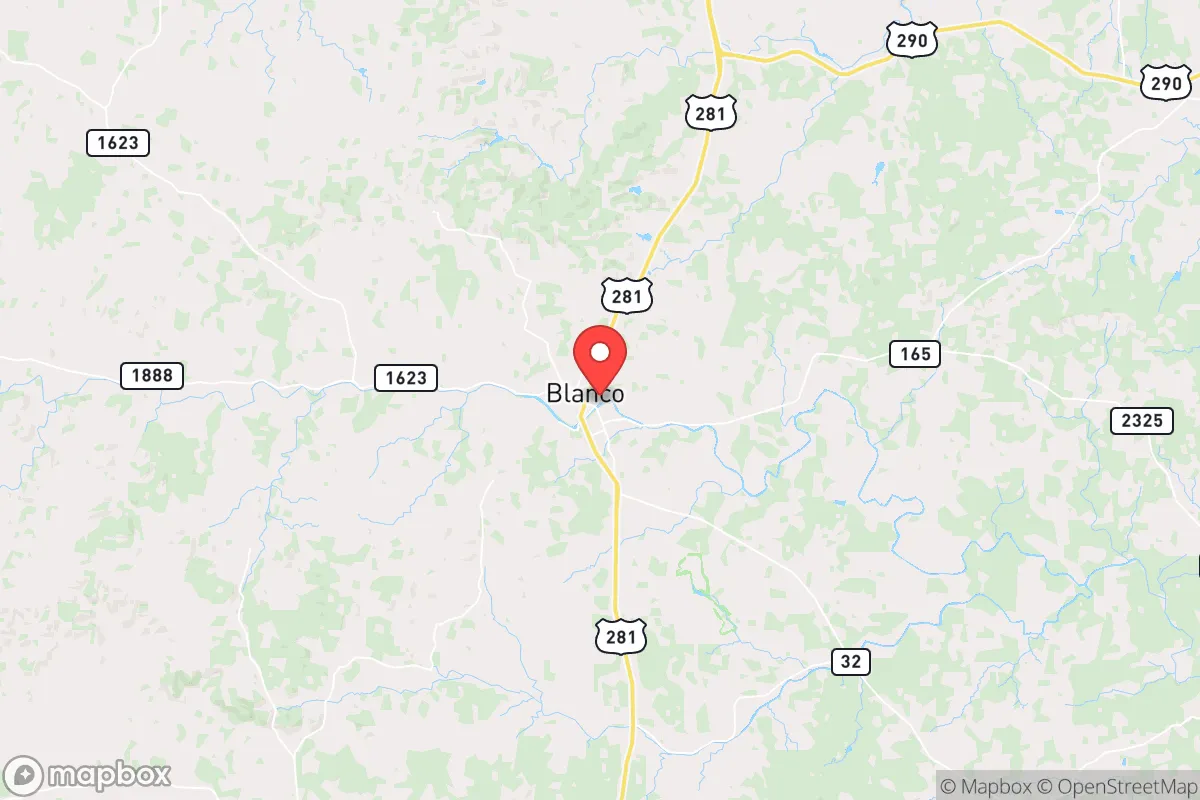
Blanco, Texas, offers a compelling mix of remoteness and accessibility that makes it a serious candidate for anyone thinking long-term about strategic relocation. Sitting roughly 50 miles north of San Antonio and 90 miles west of Austin, this Hill Country town of about 2,000 people is far enough from major metro centers to avoid the worst of urban collapse scenarios, yet close enough to reach those cities for supplies or medical care if conditions allow. The area’s low population density, limited through-traffic, and natural terrain provide a baseline of resilience that many suburban or exurban locations simply cannot match. For a conservative-leaning individual or family weighing the risks of civic unrest, supply-chain disruptions, or larger-scale disasters, Blanco deserves a hard look — but only with eyes wide open about its real vulnerabilities.
Geographic position and natural advantages for long-term security
Blanco sits in the heart of the Texas Hill Country, a region defined by limestone hills, spring-fed creeks, and the Balcones Escarpment. This topography offers genuine defensive value: the rolling terrain and narrow, winding roads create natural chokepoints that would slow any large-scale movement, whether from a fleeing population or organized threats. The town itself is tucked off the main interstate corridors — I-10 runs about 20 miles south, and I-35 is roughly 40 miles east — meaning Blanco is not a primary evacuation route or a likely target for civil unrest spillover. The Blanco River runs through town, and the area sits atop the Edwards Aquifer recharge zone, giving residents access to groundwater that many parts of Texas lack. The climate is semi-arid but with enough annual rainfall (around 35 inches) to support small-scale agriculture, and the growing season stretches nearly 300 days. For a prepper, these are not abstract advantages; they translate directly into the ability to grow food, collect water, and hold ground if the grid falters.
Risks, exposures, and proximity to fallout-relevant landmarks
No location is a fortress, and Blanco has its share of exposure points that a strategic relocator must weigh. The most immediate concern is its position relative to major population centers. San Antonio and Austin together hold over 4 million people, and in a mass-evacuation event, the highways connecting those cities to the Hill Country — especially US-281 and TX-46 — could become clogged or dangerous. Blanco sits directly on US-281, a north-south artery that runs from the border to the Dallas-Fort Worth area. That same road that brings you convenience in normal times becomes a liability in a crisis, funneling displaced populations through the town’s core. Additionally, the area is within 100 miles of two major military installations: Fort Sam Houston in San Antonio and Camp Bullis. While these are not primary nuclear targets (those are more likely to be strategic bomber bases or missile fields), any large-scale conflict could make the I-35 corridor a secondary target or a staging area. The nearby city of San Marcos, home to a major interstate junction and a growing population, could become a flashpoint. On the natural-disaster side, Blanco is in a flash-flood zone; the Blanco River has a history of catastrophic flooding (notably 2015), and low-lying properties near the river are at real risk. Wildfire risk is moderate but increases during drought years, and the town’s volunteer fire department has limited capacity for a large-scale event.
Practical resilience for a relocator: food, water, energy, and defensibility
For someone serious about self-sufficiency, Blanco offers a mixed bag. Water is the strongest asset: the Edwards Aquifer provides reliable groundwater, and many rural properties have existing wells. The Blanco River and its tributaries offer surface water, though treatment would be necessary. Rainwater catchment is viable here, with average annual rainfall sufficient to support a household if storage is adequate. Food production is feasible but not effortless. The local soil is thin and rocky in many areas, requiring raised beds or imported topsoil for serious gardening. However, the surrounding county (Blanco County) has a strong ranching tradition, and there are local sources for grass-fed beef, poultry, and eggs. The town has a small grocery store (Blanco H-E-B) but it would be overwhelmed quickly in a crisis; a relocator should plan for at least a 90-day supply of staples. Energy is the weakest link. The local grid is served by Pedernales Electric Cooperative, which has improved reliability but is still vulnerable to weather events and cyber attacks. Solar is a strong option — the Hill Country gets over 220 sunny days per year — but battery storage is essential for nighttime and cloudy periods. Natural gas is available in town but not in outlying areas; propane tanks are common. Defensibility is moderate. The town itself is compact, with a few main roads and limited cover, but rural properties on larger acreage (10+ acres) can create a perimeter with natural terrain and distance. The local law enforcement presence is small (Blanco County Sheriff’s Office has about 20 deputies), so in a prolonged breakdown, residents would largely be on their own. The community is tight-knit and conservative, which can be a double-edged sword: it fosters mutual aid but also means everyone knows everyone’s business. For a relocator seeking low profile, that’s something to consider.
Overall, Blanco presents a viable but not perfect option for the strategic relocator with a survivalist mindset. Its strengths — water availability, low population density, natural terrain, and distance from primary targets — are real and significant. Its weaknesses — proximity to major evacuation corridors, flood risk, limited local infrastructure, and dependence on a fragile grid — require honest planning and mitigation. For a single individual or a family willing to invest in off-grid water, solar, and food storage, Blanco offers a base that could hold through a range of scenarios short of a direct nuclear strike on San Antonio or Austin. It is not a bug-out location; it is a live-in location that demands preparation but rewards it with genuine resilience. If you are looking for a place that balances isolation with access, and where the neighbors are more likely to share a deer roast than a political argument, Blanco deserves a spot on your short list.

* Values derived from national, state, county, city and local statistics and may differ in a specific area. Last updated: 2026-05-14T18:31:56.000Z
Narrative content on this page is AI-generated and may contain mistakes. Verify any details that matter before acting on them.
ReloMaps may earn a commission from affiliate links at no extra cost to you.

