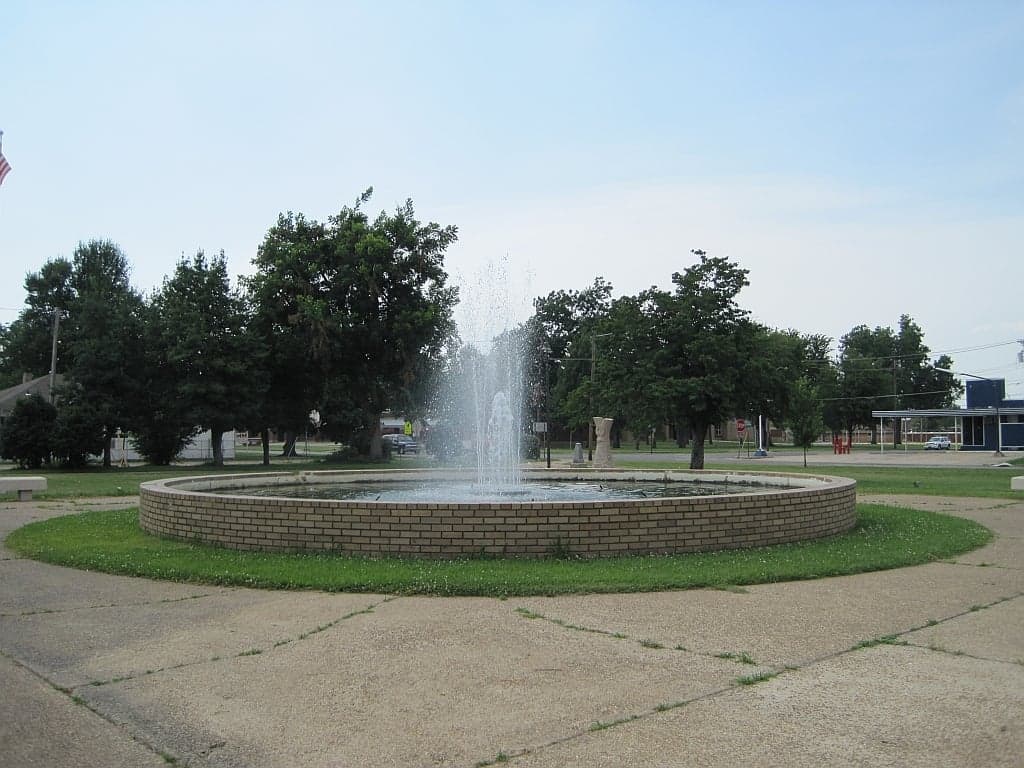
Photo: Wikipedia
Demographics of Blytheville, AR
Affluence Level in Blytheville, AR
A below-average socioeconomic profile. Incomes, home values, and educational attainment trail the U.S., with higher poverty and unemployment.
People of Blytheville, AR
The people of Blytheville, Arkansas today number 13,026, forming a majority-Black city (58.2%) with a significant White minority (34.7%) and small Hispanic (4.8%) and foreign-born (1.4%) populations. The city is notably less diverse than the national average, with a college attainment rate of just 15.7% and a population density that reflects its rural Mississippi Delta location. Blytheville’s identity is shaped by its history as a cotton and steel town, with a population that has shifted dramatically from majority-White to majority-Black over the past six decades.
How the city was settled and grew
Blytheville was founded in the late 19th century as a railroad stop on the St. Louis–San Francisco Railway, with its first settlers arriving around 1890. The original population was overwhelmingly White, drawn by the promise of rich Delta farmland for cotton cultivation. The city was incorporated in 1905, and its early growth was fueled by the cotton economy, which relied on sharecropping and tenant farming. The first Black residents arrived as part of the Great Migration from the Deep South, settling in what became known as the East Side neighborhood, a historically Black district east of the railroad tracks that remains the core of the African American community today. White settlers concentrated in the West End and Downtown areas, where the commercial and civic life centered. By 1950, Blytheville’s population was roughly 70% White and 30% Black, with the city serving as a regional hub for cotton ginning and later for the Eaker Air Force Base, which opened in 1942 and brought a transient military population.
Modern era (post-1965)
The post-1965 era brought profound demographic change. The closure of Eaker Air Force Base in 1992 was a pivotal event, removing a major employer and a significant White middle-class presence. Simultaneously, the decline of the cotton industry and the rise of manufacturing—particularly the Nucor steel mill in nearby Armorel—shifted the economic base. The Black population grew steadily through the 1970s and 1980s as White families left for suburban areas like Blytheville Heights and Southside, neighborhoods that developed as predominantly White enclaves with newer housing stock. The North Main corridor, once a thriving commercial strip, saw disinvestment as retail moved to the Highway 18 bypass. By 2020, the city had flipped to a 58% Black majority, with the White population concentrated in the Blytheville Heights and Westwood subdivisions. The Hispanic population, now 4.8%, began arriving in the 2000s, drawn by agricultural and construction jobs, and settled primarily in the East Side and Downtown areas, where housing is more affordable. The foreign-born share remains very low at 1.4%, and East/Southeast Asian and Indian communities are virtually absent (0.0% and 0.2%, respectively).
The future
Blytheville’s population is likely to continue its gradual decline, mirroring trends across the Mississippi Delta. The city has lost roughly 15% of its population since 2000, and the lack of college-educated residents (15.7%) and limited job growth outside of manufacturing suggest continued outmigration of younger adults. The Black majority is expected to persist, with the White population aging in place in the Blytheville Heights and Westwood neighborhoods. The Hispanic community, while small, may grow modestly as agricultural labor demand continues, but it is unlikely to reach a critical mass that reshapes the city’s identity. The city is not tribalizing into distinct ethnic enclaves so much as consolidating along economic lines: the East Side remains the poorest and most heavily Black area, while the West End and Blytheville Heights retain a middle-class White presence. No major immigrant-driven growth is expected, and the city’s demographic future is one of slow homogenization as the population becomes increasingly Black and older.
For someone moving in now, Blytheville is a small, majority-Black Delta city with a shrinking population and limited economic diversity. The city’s character is defined by its industrial past and racial transition, with distinct neighborhoods reflecting that history. New residents will find a community that is affordable and quiet, but with few opportunities for professional growth and a population that is not becoming more diverse in the near term.

* Values derived from national, state, county, city and local statistics and may differ in a specific area. Last updated: 2026-04-20T11:00:16.000Z
Narrative content on this page is AI-generated and may contain mistakes. Verify any details that matter before acting on them.
ReloMaps may earn a commission from affiliate links at no extra cost to you.

