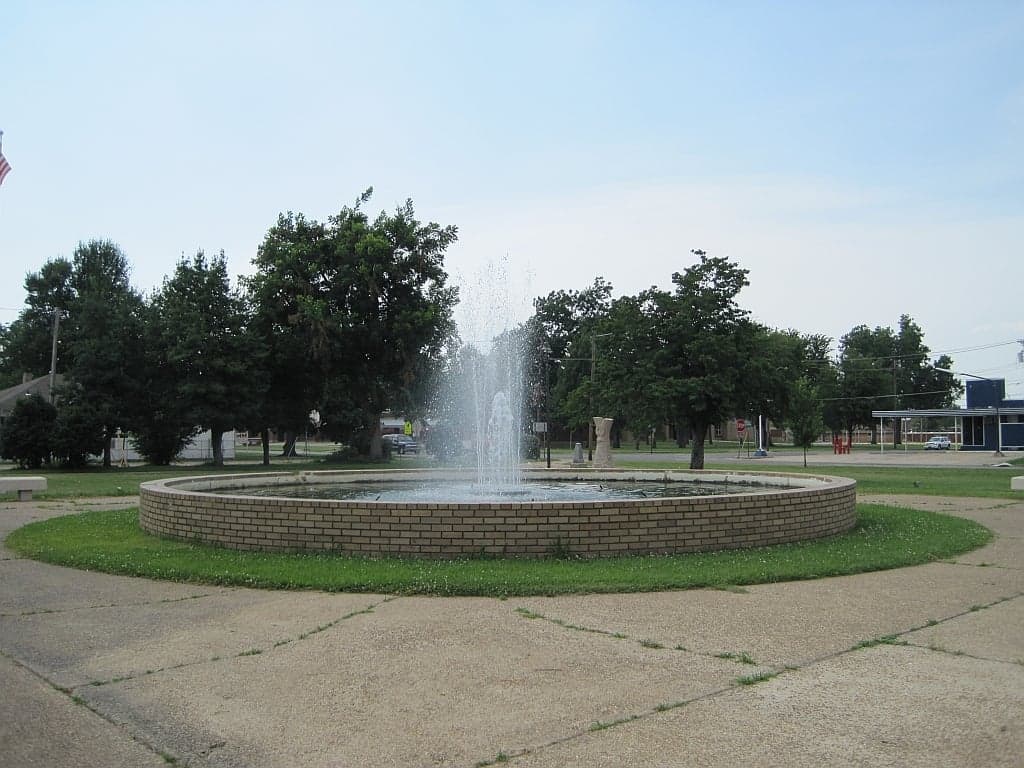
Photo: Wikipedia
Strategic Assessment of Blytheville, AR
Workable tactical position. Some exposure to population density or targets, but generally defensible in a crisis.
What does the Strategic Assessment tell us?
Our Strategic Assessment grades tactical survivability of an area. Major population centers, military targets, fallout zones, natural disasters, and border exposure all drive risk — lower exposure means a more defensible position in a crisis.
This is heavily inspired by Joel Skousen's Strategic Relocation book. Highly recommended you checkout the book ($)What does this tell us?
Our Strategic Assessment grades tactical survivability of an area. Major population centers, military targets, fallout zones, natural disasters, and border exposure all drive risk — lower exposure means a more defensible position in a crisis.
This is heavily inspired by Joel Skousen's Strategic Relocation book. Highly recommended you checkout the book ($)Strategic Pillars

Key Distances
Regional Safe Places
Below is our recommended "safe zones" in Arkansas and the surrounding area based on our strategic heuristics. For most people, it's unrealistic to live in a “safe zone” full-time due to work, family or other personal reasons. They tend to be more rural. However, many of these areas are perfect for second homes and retreat properties that double as a vacation home or even a short-term rental.
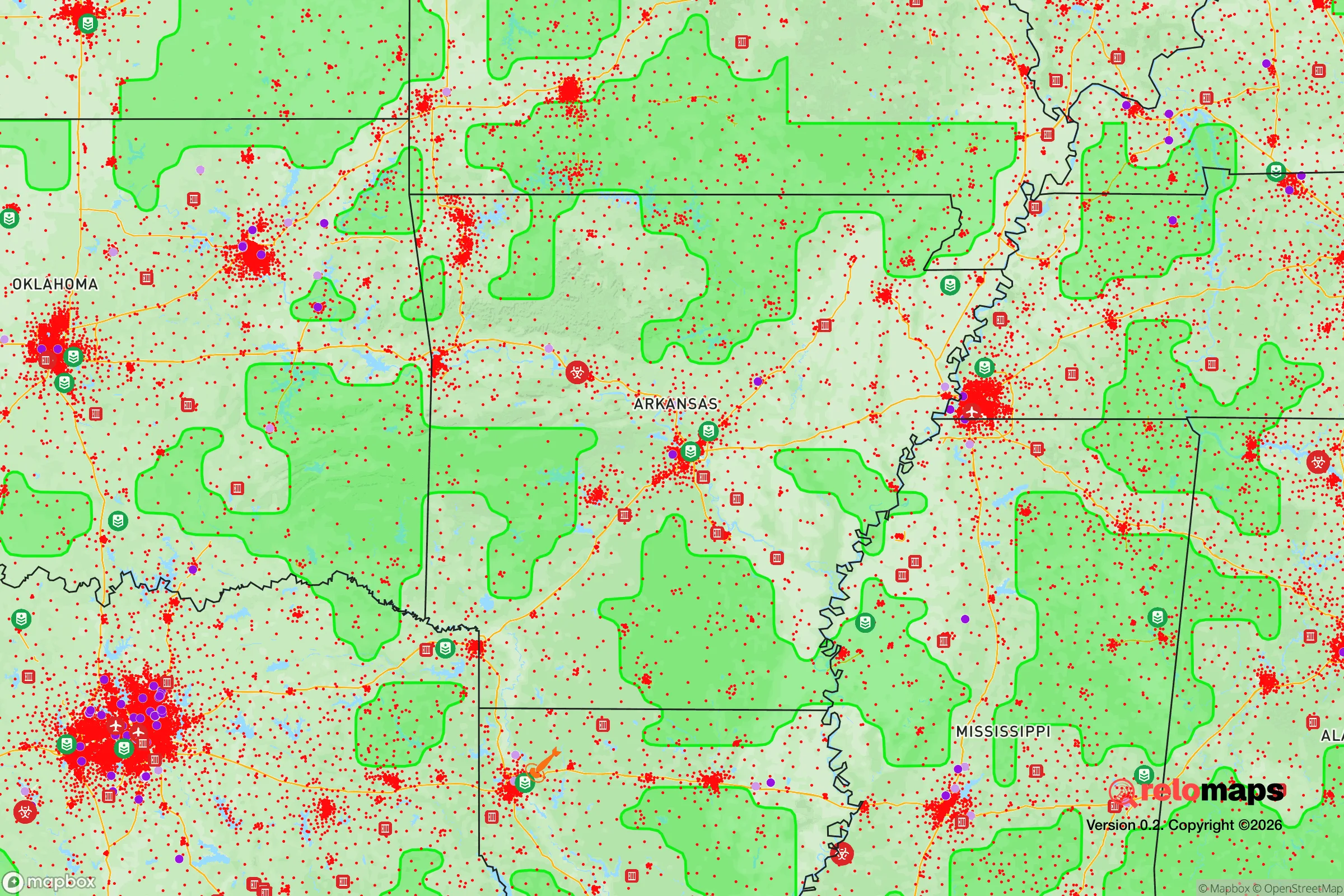
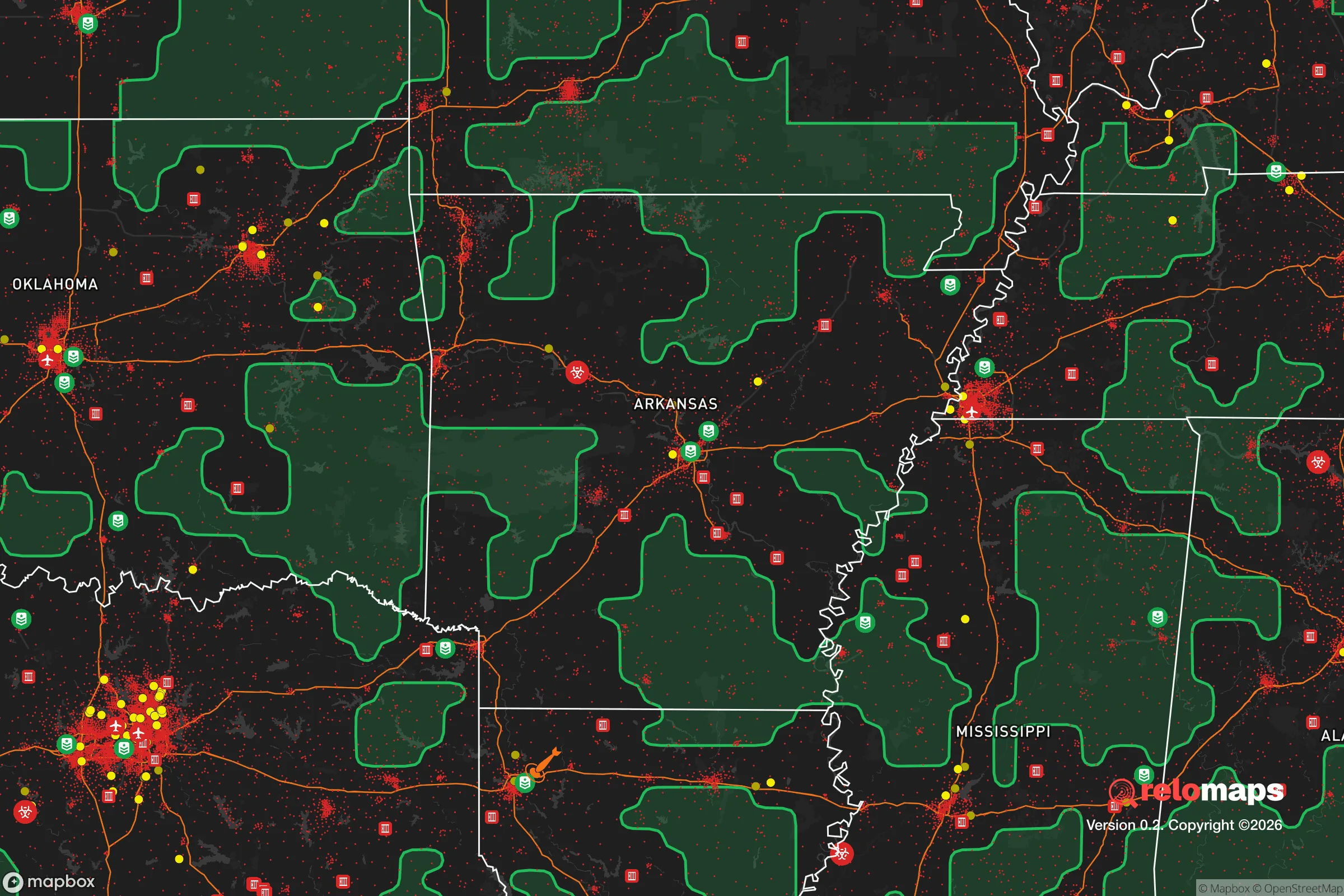


Important Note: For informational purposes only. This does not mean nothing bad ever happens in the green zones. Please use common sense. This is based on public data and modeled with AI. We tried to take a conservative approach but mistakes happen. We update this regularly as new information becomes available.
Solar Generator Recommendations
Backup power matters more here than in safer locations. We've picked three solar generators across budgets and capacity tiers — start with the budget unit if you only need a few essentials, or step up if you want to run a fridge and HVAC for days at a time.

Jackery Portable Power Station Explorer 300
Budget OptionPower on the Go: Weighing only 11 lbs, it's convenient to set up and store with book-sized foldable solar panels

BLUETTI Portable Power Station AC180
Designed for both indoor and outdoor scenarios, AC180 is highly capable as it has a robost capacity and continuous output power.

EF ECOFLOW DELTA Pro Ultra Power Station
Upgraded PickEcoFlow DELTA Pro Ultra is a whole-home energy system designed to grow with your family. Integrated with the Smart Home Panel 2, it scales to meet your evolving energy needs — keeping your home powered, intelligent, and secure through every stage of life.
We earn a commission, at no additional cost to you.
Strategic Assessment Analysis
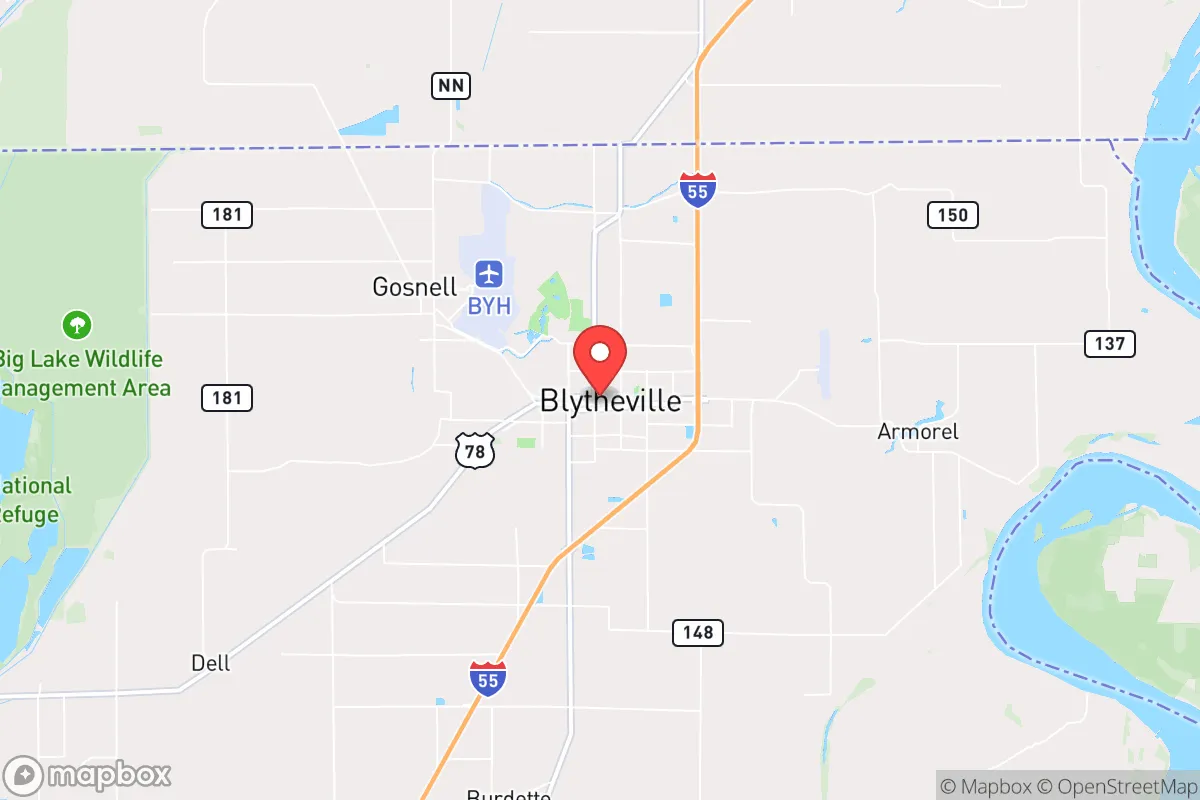
Blytheville, Arkansas, sits in the far northeastern corner of the state, a position that offers a mix of genuine strategic advantages and serious liabilities for someone thinking long-term about resilience. Its location near the Mississippi River and the Missouri bootheel places it within striking distance of major infrastructure, but also within the shadow of potential fallout zones. For a relocator concerned with civic unrest, mass casualty events, or large-scale disasters, Blytheville presents a nuanced picture—one where isolation from major population centers is partially offset by proximity to high-value targets like the nearby Air Force base and industrial corridors. The key question is whether the area’s agricultural self-sufficiency and low population density can outweigh the risks inherent in its geography.
Geographic position and natural advantages for long-term survival
Blytheville’s primary asset is its location within the Mississippi Alluvial Plain, one of the most fertile agricultural regions in the United States. This means local food production is not just possible but dominant—row crops like soybeans, rice, and cotton cover the landscape, and the Mississippi River provides an immense freshwater resource. For a prepper, this translates into a built-in food security buffer: even if supply chains falter, the surrounding farmland can sustain a local population far beyond what typical suburban or urban areas can manage. The area’s flat terrain and extensive network of levees and drainage canals also offer defensible chokepoints if you know how to read the land. However, the same flatness that makes farming easy also makes the area vulnerable to flooding—the Mississippi and its tributaries have a history of catastrophic overflows, and any long-term plan must account for elevated ground or structural flood protection. The climate is humid subtropical, with hot summers and cold winters, meaning you’ll need to prepare for both extremes, but the growing season is long enough for multiple crop cycles, a clear plus for self-sufficiency.
Risks, exposures, and proximity to fallout-relevant landmarks
The most significant risk factor for Blytheville is its proximity to Eaker Air Force Base, a former Strategic Air Command installation that remains a major industrial and logistics hub, now home to a large steel mill and other heavy industry. While the base itself is no longer active for nuclear bombers, the concentration of industrial infrastructure—including a massive steel plant and rail yards—makes it a potential target in a conflict scenario. Additionally, Blytheville lies roughly 60 miles from Memphis, Tennessee, a major population center and transportation nexus that would be a high-priority target in any large-scale disruption. The Interstate 55 corridor running through town connects directly to Memphis, meaning any unrest or evacuation from that city would funnel through Blytheville, potentially bringing chaos with it. On the plus side, the area is far from nuclear power plants (the nearest is about 150 miles away) and major military command centers, reducing the risk of direct blast or fallout exposure. But the combination of a former air base, heavy industry, and a major highway corridor means this is not a “hide in the woods” location—it’s a place where you’ll need to be aware of your surroundings and have a plan for movement if things go sideways.
Practical resilience for a relocator: food, water, energy, and defensibility
For someone serious about self-reliance, Blytheville offers a mixed bag. Water is abundant—the Mississippi River and the underlying Alluvial Aquifer provide virtually unlimited freshwater, though you’ll need filtration or treatment given agricultural runoff and industrial contaminants. Well drilling is common and relatively inexpensive in the region, and many rural properties already have private wells. Food production is the standout advantage: the growing season runs from April to October, and the soil is rich enough to support large gardens, orchards, and small livestock operations. Local farmers’ markets and bulk grain suppliers are accessible, and the area’s agricultural economy means you can barter or trade for staples if needed. Energy independence is more challenging—the grid is reliable in normal times but vulnerable to ice storms and tornadoes, which are common. Solar is viable given the region’s sun exposure, but you’ll need battery storage to handle the overcast days that come with the humid climate. Wood heating is an option, as timber is available from nearby bottomland forests, but it’s not as abundant as in the Ozarks to the west. Defensibility is the weak point: the flat, open terrain offers little natural cover, and the area’s population is sparse enough that you can find privacy, but not so remote that you’re invisible. A rural property with a good perimeter, a well, and a garden is achievable, but you’ll need to invest in security measures—fencing, cameras, and a reliable vehicle for quick movement—since the nearest law enforcement is in Blytheville itself, which has a population of about 13,000 and limited resources. The local community is predominantly conservative and self-reliant, which aligns with a prepper mindset, but the area also has pockets of poverty and drug-related crime that require situational awareness.
The overall strategic picture for Blytheville is one of calculated trade-offs. It is not a bug-out location in the classic sense—it’s too close to major infrastructure and potential fallout zones for that. But for a relocator who wants to be part of a working agricultural community with access to abundant water and food, and who is willing to accept the risks of being near a former air base and a major highway corridor, it offers a viable base of operations. The key is to treat it as a hub rather than a fortress: establish a well-stocked property, build relationships with local farmers and tradespeople, and have a secondary location further west (like the Ozarks) as a fallback if things deteriorate. Blytheville’s resilience comes from its productive land and its people, not from its isolation. If you’re looking for a place where you can grow your own food, drill your own water, and live among like-minded individuals who value self-sufficiency, it’s worth a serious look—just keep one eye on the horizon and a full tank of gas in the truck.

* Values derived from national, state, county, city and local statistics and may differ in a specific area. Last updated: 2026-04-20T11:00:16.000Z
Narrative content on this page is AI-generated and may contain mistakes. Verify any details that matter before acting on them.
ReloMaps may earn a commission from affiliate links at no extra cost to you.

