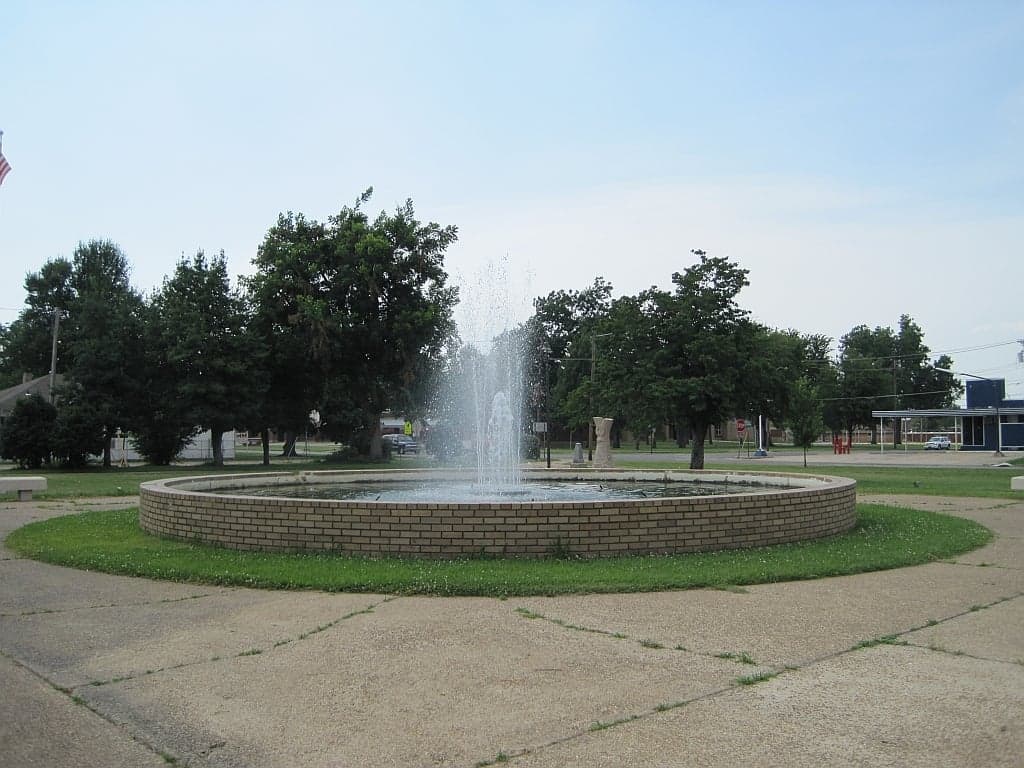
Photo: Wikipedia
Political ClimatePolitical Climate in Blytheville, AR
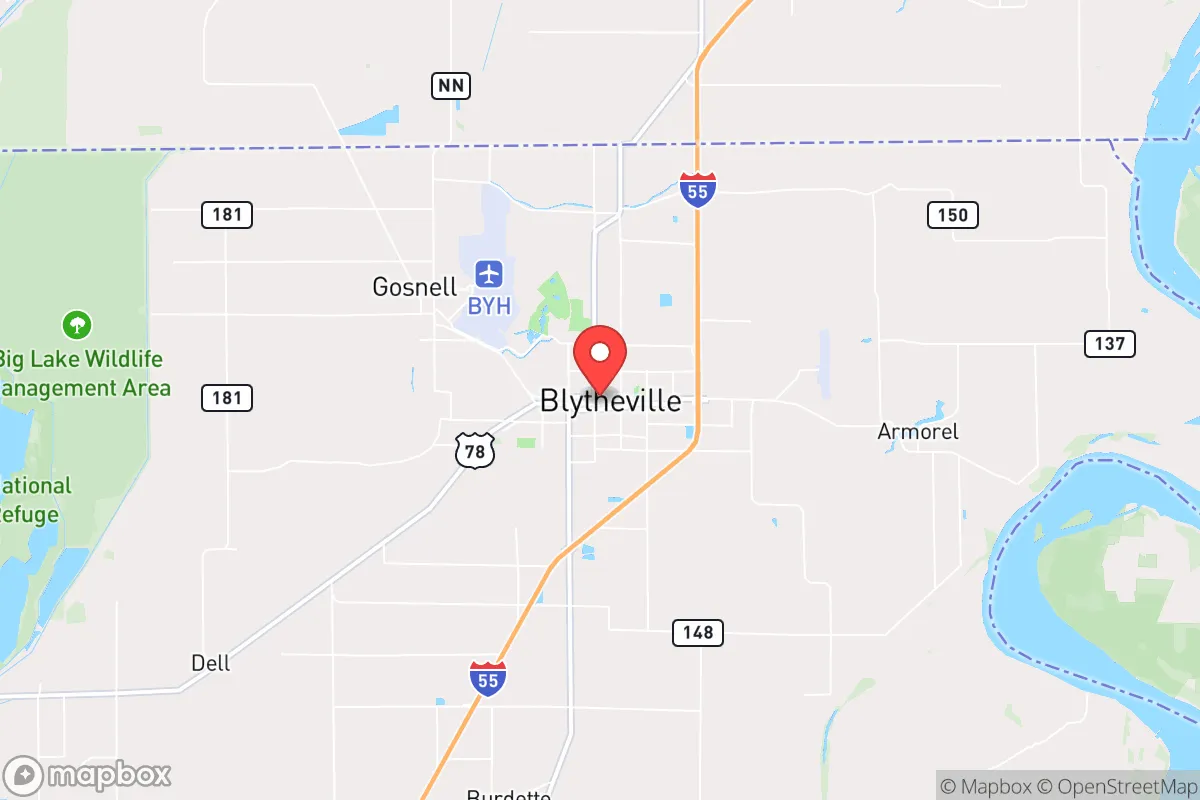
District shown is the primary district for this city’s centroid. Cities may span multiple districts.
Local Political AnalysisPolitical Analysis of Blytheville, AR
Blytheville, Arkansas, sits deep in the heart of the Mississippi Delta, and its politics have long reflected the conservative values of the region. With a Cook Partisan Voting Index (PVI) of R+23, this area leans heavily Republican, and that’s been the case for as long as most folks around here can remember. The shift toward the GOP really solidified in the last couple of decades, as national trends and local priorities aligned—people here value their Second Amendment rights, low taxes, and a government that stays out of their daily lives. While there’s been some chatter about progressive ideas creeping in from places like Jonesboro or even Memphis just across the river, the core of Blytheville remains firmly rooted in traditional, conservative principles.
How it compares
When you stack Blytheville up against its neighbors, the contrast is pretty stark. Head south to Jonesboro, and you’ll find a more moderate, college-town vibe that’s starting to lean a little left on social issues, especially among younger folks. Cross the state line into Memphis, and you’re in a deep-blue urban stronghold where government intervention is seen as a solution, not a problem. But here in Mississippi County, the surrounding towns like Osceola and Manila are cut from the same cloth—strongly Republican, with a focus on agriculture, manufacturing, and personal responsibility. The R+23 rating isn’t just a number; it reflects a community that’s consistently voted against the kind of big-government overreach that’s become common in other parts of the country. If you’re looking for a place where your vote actually counts toward keeping progressive policies at bay, this is it.
What this means for residents
For the folks living here, the political climate translates into a pretty straightforward way of life. You’re not going to see the kind of heavy-handed regulations that choke small businesses or the tax hikes that fund programs you don’t agree with. Property taxes stay reasonable, and there’s a general sense that your hard-earned money is yours to keep. The local government tends to focus on practical stuff—keeping roads paved, supporting the local schools, and maintaining public safety—without getting into the weeds of social engineering. That said, there’s a growing concern among long-time residents about outside influences pushing for changes in zoning laws or school curriculum that don’t align with community values. The key here is staying engaged; if you’re not paying attention, you might wake up to policies that feel like they were imported from somewhere else.
One thing that sets Blytheville apart is its cultural identity, which is deeply tied to the land and the people who work it. You won’t find the kind of coastal elitism or bureaucratic red tape that’s become a hallmark of more progressive areas. Instead, there’s a quiet pride in self-reliance and neighborly support. The biggest policy distinction is the local commitment to keeping government lean—no unnecessary mandates, no overreaching health ordinances, and a strong resistance to any talk of gun control. As the region looks ahead, the challenge will be holding onto that independence as the state and national trends push for more uniformity. For now, though, Blytheville remains a place where conservative values aren’t just tolerated—they’re the norm, and that’s exactly how most folks want it.

State Political ClimatePolitical Climate in Arkansas
State Political AnalysisPolitical Environment in the State
Arkansas has been a reliably red state for decades, but don't mistake that for a monolith. The state leans solidly Republican at the presidential level — Donald Trump won it by 27 points in 2024 — but the real story is a slow, grinding shift in the state's internal coalitions. Over the past 20 years, the old Democratic holdouts in the Delta and the Ozarks have been replaced by a more uniform conservative majority, driven by the exodus of rural voters from the Democratic Party and the steady growth of the northwest corridor. The result is a state that is more Republican than it was in 2004, but also more internally divided between a booming, culturally conservative northwest and a struggling, increasingly Democratic southeast.
Urban vs. rural divide
The political map of Arkansas is a tale of two corridors. The northwest quadrant — anchored by Fayetteville, Springdale, Rogers, and Bentonville — is the state's economic engine and its most reliably Republican region. These cities are home to Walmart, Tyson Foods, and JB Hunt, and they vote like a mix of suburban Texas and the Mountain West: heavily white, affluent, and culturally conservative. In 2024, Benton County (Bentonville) gave Trump 63% of the vote, while Washington County (Fayetteville) was closer to 57%. The contrast is sharp with the capital, Little Rock, which is the state's only real blue dot. Pulaski County went for Joe Biden in 2020 and Kamala Harris in 2024, driven by the city's Black population and a growing professional class. The rest of the state — the Delta counties like Lee and Phillips, the rural Ozarks, and the southern timberlands — are a mixed bag. The Delta, historically Democratic, has flipped hard to the right in presidential races, but still elects conservative Democrats at the local level. Meanwhile, the Ozarks and the River Valley are deep red, with counties like Baxter (Mountain Home) and Pope (Russellville) routinely giving Republicans 70% or more. The real divide isn't just urban vs. rural — it's the growing cultural and economic chasm between the booming northwest and the struggling east and south.
Policy environment
Arkansas's policy environment is a mixed bag for conservatives. On the plus side, the state has a flat income tax that was cut from 4.9% to 4.4% in 2025, with a path to 3.9% by 2027. There's no state property tax, and sales tax is capped at 6.5% for most goods. The regulatory posture is generally business-friendly, especially in the northwest, where local governments compete for corporate relocations. But there are red flags. The state's education system is underperforming — Arkansas ranks 42nd in the nation for K-12 outcomes, and the school choice movement has been slow to gain traction. The LEARNS Act, passed in 2023, created a universal school voucher program, but implementation has been rocky, with many rural districts opting out. On healthcare, the state expanded Medicaid under the private option in 2013, and while Governor Sarah Huckabee Sanders has pushed work requirements, the program remains large and costly. Election laws are solid — voter ID is required, and the state has a clean voter roll maintenance process — but there's no early voting by mail without an excuse, which some conservatives see as a protection against fraud and others as a restriction on access. The biggest concern for liberty-minded residents is the state's heavy reliance on sales tax, which hits low-income families hardest, and the growing influence of the Arkansas State Chamber of Commerce, which often pushes for corporate welfare deals that benefit big business over small entrepreneurs.
Trajectory & freedom
Arkansas is trending in the right direction on most freedom metrics, but the pace is uneven. The most significant recent win for personal liberty was the passage of the Arkansas Sovereignty Act in 2023, which prohibits state and local cooperation with federal gun control measures — a direct response to the Biden administration's ATF rule changes. The state also passed a near-total abortion ban in 2022, with no exceptions for rape or incest, which has held up in court. On parental rights, the Arkansas Parental Rights Act (2023) requires schools to notify parents before any instruction on gender identity or sexual orientation, and it bans transgender girls from female sports. These are popular with the conservative base. However, there are concerning trends. The state's medical marijuana program, approved by voters in 2016, has been slowly expanded, but the legislature has resisted full legalization, and the program remains tightly controlled. Property rights took a hit in 2024 when the state supreme court upheld the use of eminent domain for a private pipeline project in Faulkner County, a decision that alarmed rural landowners. And on taxation, the state's reliance on sales tax means that as inflation rises, the tax burden on families increases without a vote. The biggest looming issue is the Arkansas Freedom of Information Act — the legislature has been chipping away at it for years, with exemptions for economic development deals and police body camera footage. If that trend continues, government transparency will erode, which is a red flag for anyone who values accountability.
Civil unrest & political movements
Arkansas is not a hotbed of civil unrest, but there are visible flashpoints. The most organized activist movements are on the right: the Arkansas Citizens for Liberty and the State Sovereignty Commission (a revived version of the old 1950s group, now focused on nullification) hold regular rallies at the state capitol. In 2024, a protest against federal land management in the Ouachita National Forest drew hundreds of armed demonstrators. On the left, the Arkansas NAACP and Indivisible Arkansas organize around voting rights and criminal justice reform, but their turnout is small. Immigration politics are relatively quiet — Arkansas has a small foreign-born population (about 5%), and the state passed a law in 2023 requiring all employers to use E-Verify, which has been popular with conservatives. The biggest flashpoint in recent years was the 2023 controversy over the Arkansas State Library, when the legislature defunded the library system after a dispute over LGBTQ-themed books. That fight is ongoing, with local libraries in Fayetteville and Little Rock resisting the state's new certification requirements. Election integrity is a live issue — the 2022 primary saw a lawsuit over ballot drop boxes in Pulaski County, and the legislature responded by banning drop boxes entirely in 2023. A new resident would notice that political signs are everywhere, especially in rural areas, and that local politics can be intensely personal — county judge races and school board elections often turn on single issues like library content or zoning.
Projection
Over the next 5-10 years, Arkansas will likely become more conservative, but also more internally fractured. The northwest corridor will continue to grow, attracting conservative-leaning migrants from California and the Midwest who are fleeing high taxes and crime. That will push the state's politics further right on cultural issues — expect more restrictions on transgender rights, more school choice expansion, and more resistance to federal mandates. But the Delta and the southeast will continue to depopulate, losing political clout and becoming even more dependent on state subsidies. The biggest wildcard is the Little Rock metro area. If the city's population continues to grow and diversify, it could become a more reliable Democratic stronghold, which would create a permanent urban-rural split similar to what you see in Oklahoma or Missouri. The state's fiscal picture is stable, but the reliance on sales tax means that any economic downturn will hit the budget hard. The most likely scenario is that Arkansas remains a solid red state, but with a growing libertarian wing that pushes back against corporate welfare and government overreach. A new resident moving in now should expect to find a state that is culturally conservative, economically mixed, and politically stable — but with a simmering tension between the booming northwest and the struggling east.
For a conservative family or individual looking to relocate, Arkansas offers a low-tax, culturally safe environment with a strong sense of community. The key is to choose your location carefully. The northwest corridor — Bentonville, Rogers, Fayetteville — is the best bet for jobs, schools, and a like-minded social circle. The Delta and the southeast are cheaper but offer fewer opportunities and a more isolated lifestyle. The biggest practical takeaway is that Arkansas is not a libertarian paradise — the state has a heavy hand in education, healthcare, and local governance, and the legislature is not afraid to use it. But for someone who values traditional values, low taxes, and a slower pace of life, it's a solid choice. Just keep an eye on the Little Rock metro — if it continues to drift left, it could become a political battleground that affects the whole state.
* Values derived from national, state, county, city and local statistics and may differ in a specific area. Last updated: 2026-04-20T11:00:16.000Z
Narrative content on this page is AI-generated and may contain mistakes. Verify any details that matter before acting on them.
ReloMaps may earn a commission from affiliate links at no extra cost to you.

