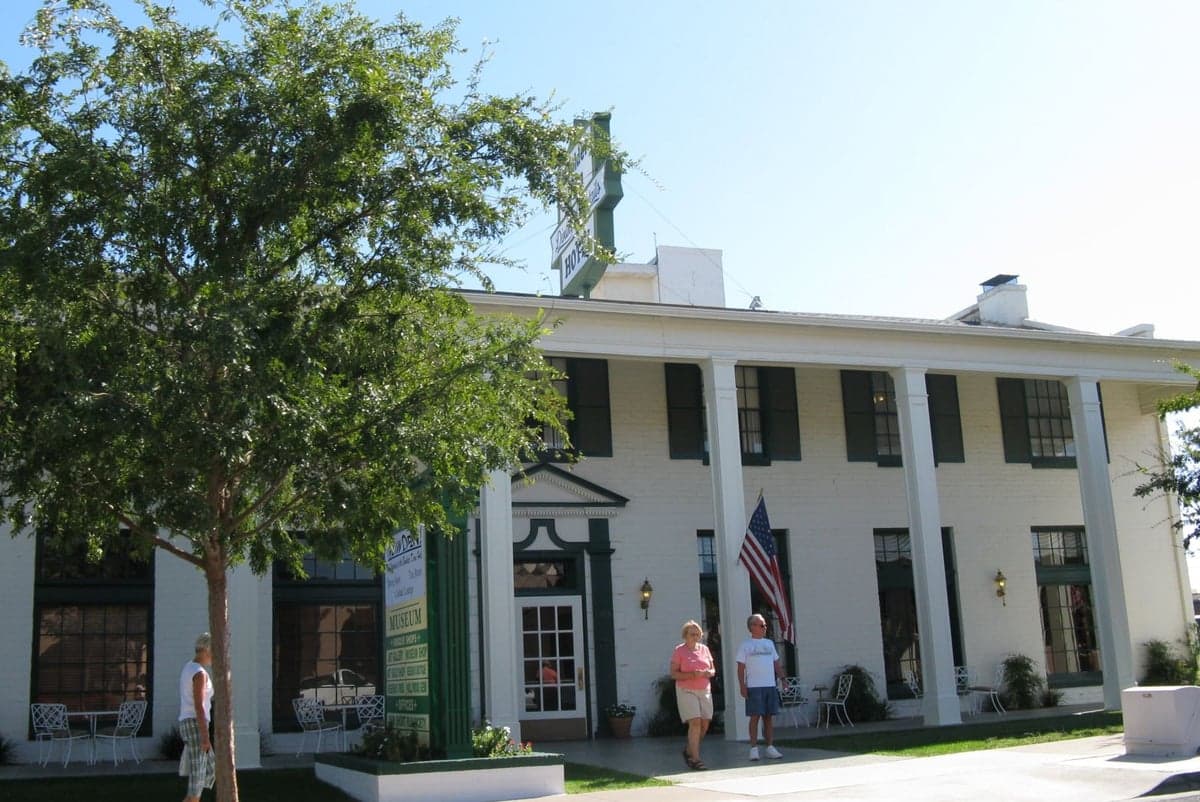
Photo: Wikipedia
Personal Sovereignty in Boulder City, NV
Viable for self-reliance. Generally workable, though some barriers may limit total independence.
What does Personal Sovereignty tell us?
Personal Sovereignty measures your capacity for self-reliance and independence with minimal government friction. Higher scores mean fewer barriers between you and the way you want to live... but it assumes you have the space you need and good neighbors.
What does this tell us?
Personal Sovereignty measures your capacity for self-reliance and independence with minimal government friction. Higher scores mean fewer barriers between you and the way you want to live... but it assumes you have the space you need and good neighbors.
State Policy
Energy independence: Importer (15% of energy produced in-state)
Personal Liberty
Homesteading

Personal Liberty Analysis
For the individualist or prepper evaluating Boulder City, Nevada, the personal sovereignty picture is a study in contrasts: the town was literally founded by the federal government in 1931 to house Hoover Dam workers, yet it sits in a state that constitutionally enshrines the right to keep and bear arms, has no state income tax, and maintains a famously libertarian "live and let live" ethos. The key question for a conservative-leaning relocator is whether Boulder City’s unique local governance—with its own municipal power utility, strict sign ordinances, and a historical ban on gambling—enhances or constrains your ability to live free from government overreach. The short answer: the state provides a strong baseline of autonomy, but the city’s zoning and regulatory posture requires careful navigation, especially if self-reliance and minimal interference are your priorities.
Tax burden and regulatory posture: how Nevada’s fiscal freedom interacts with local control
Nevada is one of the most tax-friendly states in the nation, and that alone is a major draw for those seeking to maximize personal sovereignty. There is no state income tax, no corporate income tax, and no inventory tax—meaning the state government takes a smaller slice of your earnings and business activities than almost anywhere else. Property taxes are capped by the state constitution at a maximum of 3% of assessed value, with actual effective rates in Clark County (which includes Boulder City) averaging around 0.6% to 0.8% of market value. This is a fraction of what you’d pay in, say, California or New York. Sales tax in Boulder City is 8.375% (state + local), which is moderate but not oppressive. The regulatory posture at the state level is generally light-touch: Nevada has no state-level rent control, no state-level price controls, and a right-to-work law that weakens union power. However, Boulder City itself is a municipal corporation with its own police force, planning commission, and zoning board. The city operates its own electric utility (Boulder City Utilities), which keeps rates low and reliable—a plus for preppers who value grid stability—but also means the city has direct control over building permits, land use, and code enforcement. If you want to build a detached workshop, install solar panels, or keep livestock, you’ll be dealing with local bureaucrats, not just state-level rules. The city’s historical character as a planned community means it has stricter design standards than unincorporated Clark County, so expect more scrutiny on exterior modifications.
Self-defense and gun law specifics: what the Second Sanctuary means for your rights
Nevada is a "shall-issue" state for concealed carry permits, and Boulder City sits in Clark County, which has been designated a Second Amendment Sanctuary County by local resolution. This means local law enforcement has formally stated they will not use resources to enforce federal gun laws they deem unconstitutional—a meaningful signal for those concerned about federal overreach. The state allows open carry without a permit for anyone 18 or older who can legally possess a firearm, and concealed carry requires a permit (issued after a background check and training course). There is no state-level magazine capacity ban, no "assault weapon" registry, and no waiting period for long guns (though a 3-day waiting period applies to handgun purchases from dealers). Stand Your Ground laws are in effect: you have no duty to retreat before using deadly force if you are lawfully present and reasonably believe force is necessary to prevent death or great bodily harm. Castle Doctrine protections extend to your home, vehicle, and place of business. For the prepper, this is a solid legal framework. The only local wrinkle: Boulder City has a municipal code that prohibits discharging firearms within city limits except at designated ranges (the Boulder City Gun Club is a well-maintained facility). So while you can carry and store weapons freely, you cannot legally shoot on your own property if you live inside city limits—a limitation that pushes target practice and training to the range or to rural areas outside town. For those with acreage in the surrounding unincorporated areas (like Railroad Pass or along US-93), this restriction does not apply.
Self-reliance and homesteading viability: lot sizes, zoning, and off-grid feasibility
Boulder City’s zoning is a mixed bag for the serious homesteader. The city is divided into residential zones with minimum lot sizes ranging from 6,000 square feet in standard subdivisions to 1-acre or larger parcels in the "Rural Residential" (RR) zone on the outskirts. If you buy in the RR zone, you can keep horses, chickens, and other livestock, and you have more latitude for outbuildings and workshops. However, the city’s building code requires permits for most structures, and there are restrictions on "temporary" dwellings like RVs or shipping containers used as primary residences. Off-grid living is technically possible but practically difficult: the city requires connection to municipal water and sewer for any habitable structure, and solar panels must be installed by licensed contractors and meet utility interconnection standards. True off-grid independence—well water, septic, no grid tie—is effectively prohibited within city limits. The surrounding unincorporated areas of Clark County (e.g., along the Eldorado Valley or near Lake Mead) offer more freedom: no building permits for agricultural structures under 200 square feet, no county-level restrictions on rainwater catchment, and no requirement to connect to any utility. For the prepper who wants to be truly self-reliant, the land just outside Boulder City’s jurisdiction is far more accommodating. Inside the city, you can have a productive garden, a few chickens, and a well-stocked pantry, but you’ll still be paying municipal utility bills and following city codes.
Personal liberties: parental rights, medical autonomy, speech, and property
Nevada’s legal framework generally respects personal liberties, but there are notable exceptions that a conservative relocator should weigh. Parental rights are strong in theory: Nevada has no state-level mandate for critical race theory or comprehensive sex education in K-12 schools (curricula are set by local school boards), and the state’s "Parents’ Bill of Rights" (NRS 392.029) affirms that parents have the right to direct their child’s education and access all school records. However, Boulder City’s schools are part of the Clark County School District (CCSD), the fifth-largest in the nation, which means local parents have limited influence over district-wide policies. Many conservative families opt for private or charter schools (Boulder City has a few small private options) or homeschool, which is legal with minimal state oversight (no notification required for homeschooling, though annual testing is recommended). Medical autonomy is a mixed picture: Nevada has no state-level vaccine mandate for adults, but COVID-era mandates were enforced by private employers and healthcare systems. The state does not have a "Right to Try" law for experimental treatments, but it does allow terminally ill patients to access investigational drugs under federal law. Free speech is protected under the First Amendment, and Boulder City has no local ordinances restricting political signage beyond standard size and time limits. Property rights are generally respected, but eminent domain is a concern near the Lake Mead National Recreation Area—the federal government owns vast tracts around the city, and there is always the theoretical risk of federal land-use restrictions expanding. The city’s own zoning is strict but predictable; you won’t have a neighbor opening a strip club next door, but you also won’t be able to run a home-based gunsmithing business without a conditional use permit.
In the broader landscape of American personal sovereignty, Boulder City offers a solid but not exceptional environment for the survivalist or prepper. The state’s tax structure and gun laws are among the best in the country, and the local community’s small-town character fosters a degree of neighborly self-reliance. However, the city’s federal origins and municipal regulatory apparatus mean you are not truly free from government oversight—you are trading some autonomy for stability and services. For the relocator who values maximum sovereignty, the unincorporated areas of Clark County or the rural counties to the north (like Lincoln or Nye) provide fewer restrictions and lower costs. But if you want a defensible, well-maintained home base with good infrastructure, low taxes, and a community that largely minds its own business, Boulder City is a defensible choice—just know the boundaries of your freedom before you buy.

* Values derived from national, state, county, city and local statistics and may differ in a specific area. Last updated: 2026-04-16T13:10:17.000Z
Narrative content on this page is AI-generated and may contain mistakes. Verify any details that matter before acting on them.
ReloMaps may earn a commission from affiliate links at no extra cost to you.

