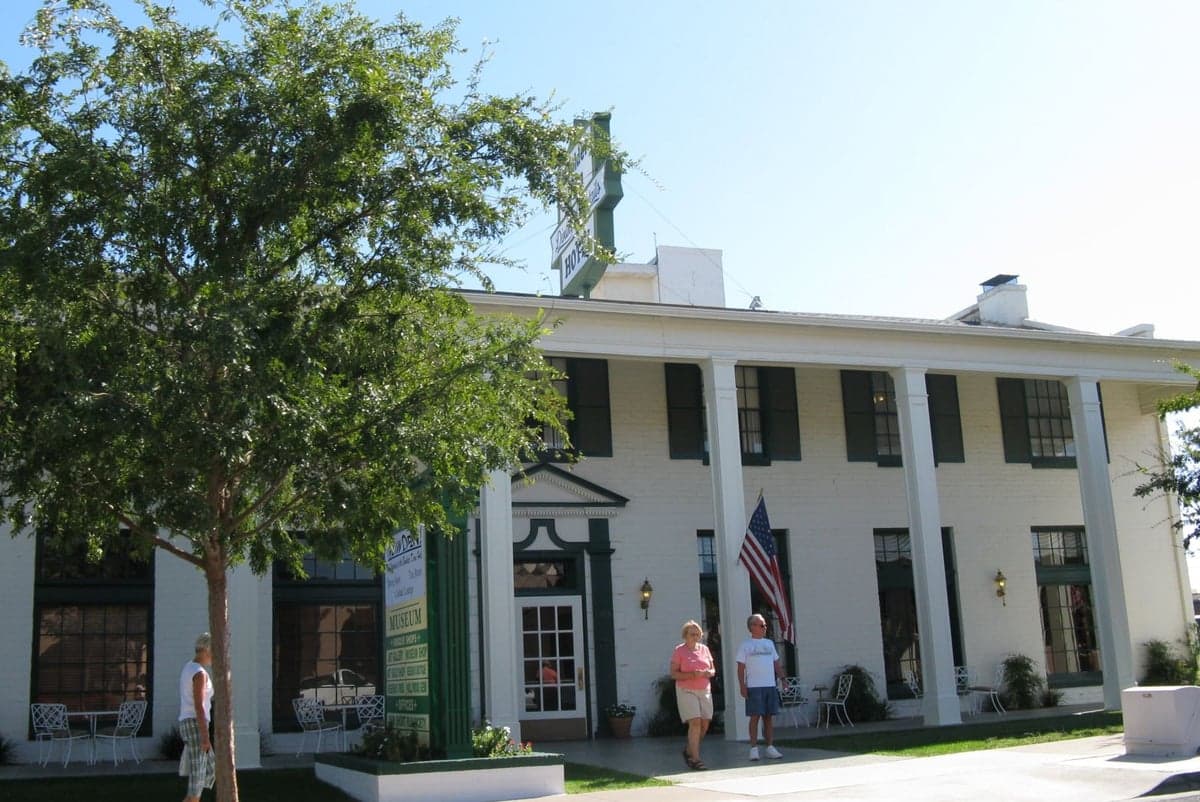
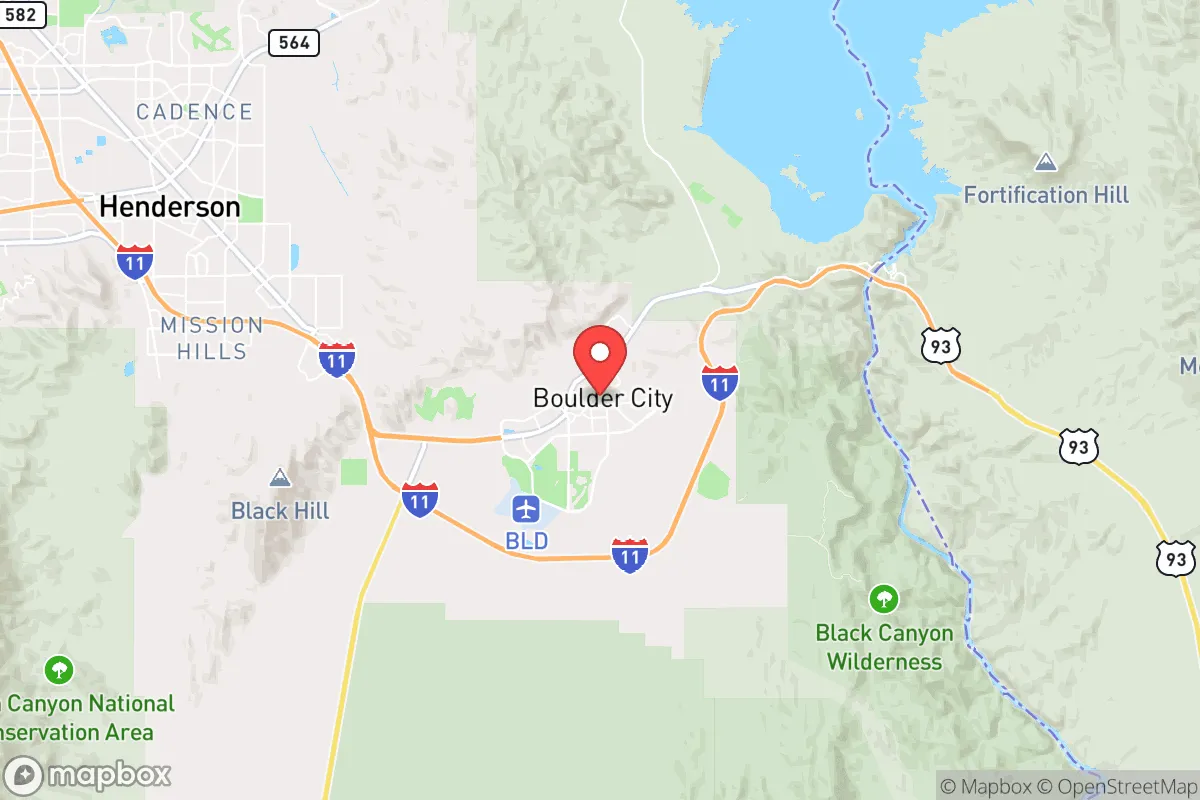
Photo: Wikipedia
Demographics of Boulder City, NV
Affluence Level in Boulder City, NV
A middle-class area roughly in line with national averages across income, home values, education, and employment.
People of Boulder City, NV
Boulder City, Nevada, is a planned community of 14,888 residents that remains one of the state’s most demographically stable and homogeneous cities. With a population that is 84.7% White, 7.4% Hispanic, and only 1.6% foreign-born, the city’s character is defined by its federal-government origins, a strong sense of civic identity, and a notably older, college-educated base (30.3% hold a bachelor’s degree or higher). Unlike the rapid-growth suburbs of Las Vegas, Boulder City retains a small-town, conservative-leaning atmosphere where generational continuity is more common than new immigration.
How the city was settled and grew
Boulder City was founded in 1931 as a federal company town to house workers building Hoover Dam. The U.S. Bureau of Reclamation designed and built the entire community, and the original population was almost entirely white, male, and employed in construction or engineering. The first wave of residents—skilled tradesmen, engineers, and their families—settled in the Historic District, a grid of bungalows and government-built homes centered around Arizona Street and Nevada Way. These original neighborhoods, including Boulder City Historic District and Old Town, were racially restricted by federal policy at the time; Black workers were housed in separate camps near the dam site and were not permitted to live within city limits until after World War II. The city’s population peaked at roughly 12,000 during the dam’s construction (1931–1936), then declined sharply as workers left. A second wave came in the 1940s and 1950s as Boulder City became a permanent residential base for Lake Mead National Recreation Area employees and retirees drawn to the dry climate and low crime. The Lake View and Fairway Estates neighborhoods expanded during this period, attracting middle-class families and federal retirees who valued the city’s strict zoning and lack of casino gambling—a ban that remains in place today.
Modern era (post-1965)
After the 1965 Hart-Cellar Act, Boulder City saw virtually no increase in foreign-born population—the city’s foreign-born share today is just 1.6%, far below the national average. Instead, domestic in-migration from other parts of Nevada and the Western U.S. drove modest growth. The Boulder Creek subdivision, built in the 1990s and 2000s, attracted younger families and some professionals commuting to Henderson or Las Vegas (about 30 minutes away). Hispanic residents, now 7.4% of the population, began arriving in small numbers during the 1980s and 1990s, primarily for service-sector jobs in tourism (Lake Mead, Hoover Dam) and construction. They are dispersed throughout the city, with a slight concentration in the Boulder City Industrial Area near the airport and along the U.S. 93 corridor. East/Southeast Asian residents (1.1%) and Black residents (1.6%) remain very small communities, largely employed in professional or government roles. Indian-subcontinent residents are statistically zero. The city’s racial homogeneity is not the result of exclusionary policies today but of limited housing stock, high home prices (median home value ~$450,000), and a lack of rental diversity—factors that naturally filter for higher-income, predominantly white households.
The future
Boulder City’s population is projected to grow slowly, if at all, due to strict growth-management ordinances and a built-out land base. The city has resisted large-scale development, and new housing is limited to infill projects like the Boulder City Highlands area, which targets empty-nesters and retirees. The Hispanic share is likely to rise modestly as younger service workers move in, but the foreign-born percentage will remain low. The city is not tribalizing into distinct ethnic enclaves—its small minority populations are well-integrated—but it is homogenizing by age and income, becoming older and wealthier. The under-18 population is shrinking, and the median age (about 50) is well above the national average. For a conservative-leaning mover, this means Boulder City will remain a stable, low-crime, culturally traditional community with little demographic churn.
For someone moving in now, Boulder City offers a predictable, slow-paced environment where the population is largely white, native-born, and politically conservative. The city is not diversifying rapidly, and its future is one of gentle aging rather than transformation. New residents should expect a community that values its historical identity, enforces strict land-use rules, and offers a quiet alternative to the growth and change of the Las Vegas Valley.

* Values derived from national, state, county, city and local statistics and may differ in a specific area. Last updated: 2026-04-16T13:10:17.000Z
Narrative content on this page is AI-generated and may contain mistakes. Verify any details that matter before acting on them.
ReloMaps may earn a commission from affiliate links at no extra cost to you.

