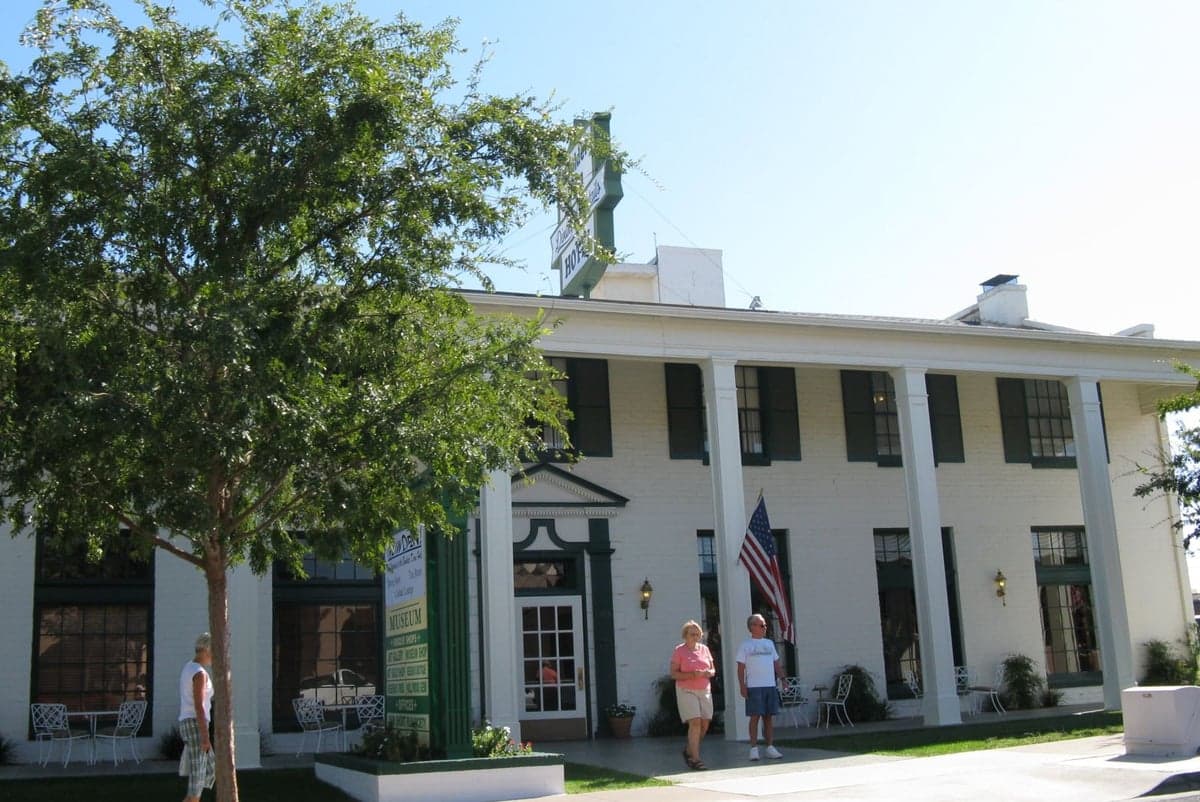
Photo: Wikipedia
Strategic Assessment of Boulder City, NV
Meaningful friction. Expect exposure to either population pressure, blast zones, or natural disaster risk. Consider buying a retreat property.
What does the Strategic Assessment tell us?
Our Strategic Assessment grades tactical survivability of an area. Major population centers, military targets, fallout zones, natural disasters, and border exposure all drive risk — lower exposure means a more defensible position in a crisis.
This is heavily inspired by Joel Skousen's Strategic Relocation book. Highly recommended you checkout the book ($)What does this tell us?
Our Strategic Assessment grades tactical survivability of an area. Major population centers, military targets, fallout zones, natural disasters, and border exposure all drive risk — lower exposure means a more defensible position in a crisis.
This is heavily inspired by Joel Skousen's Strategic Relocation book. Highly recommended you checkout the book ($)Strategic Pillars

Key Distances
Regional Safe Places
Below is our recommended "safe zones" in Nevada and the surrounding area based on our strategic heuristics. For most people, it's unrealistic to live in a “safe zone” full-time due to work, family or other personal reasons. They tend to be more rural. However, many of these areas are perfect for second homes and retreat properties that double as a vacation home or even a short-term rental.
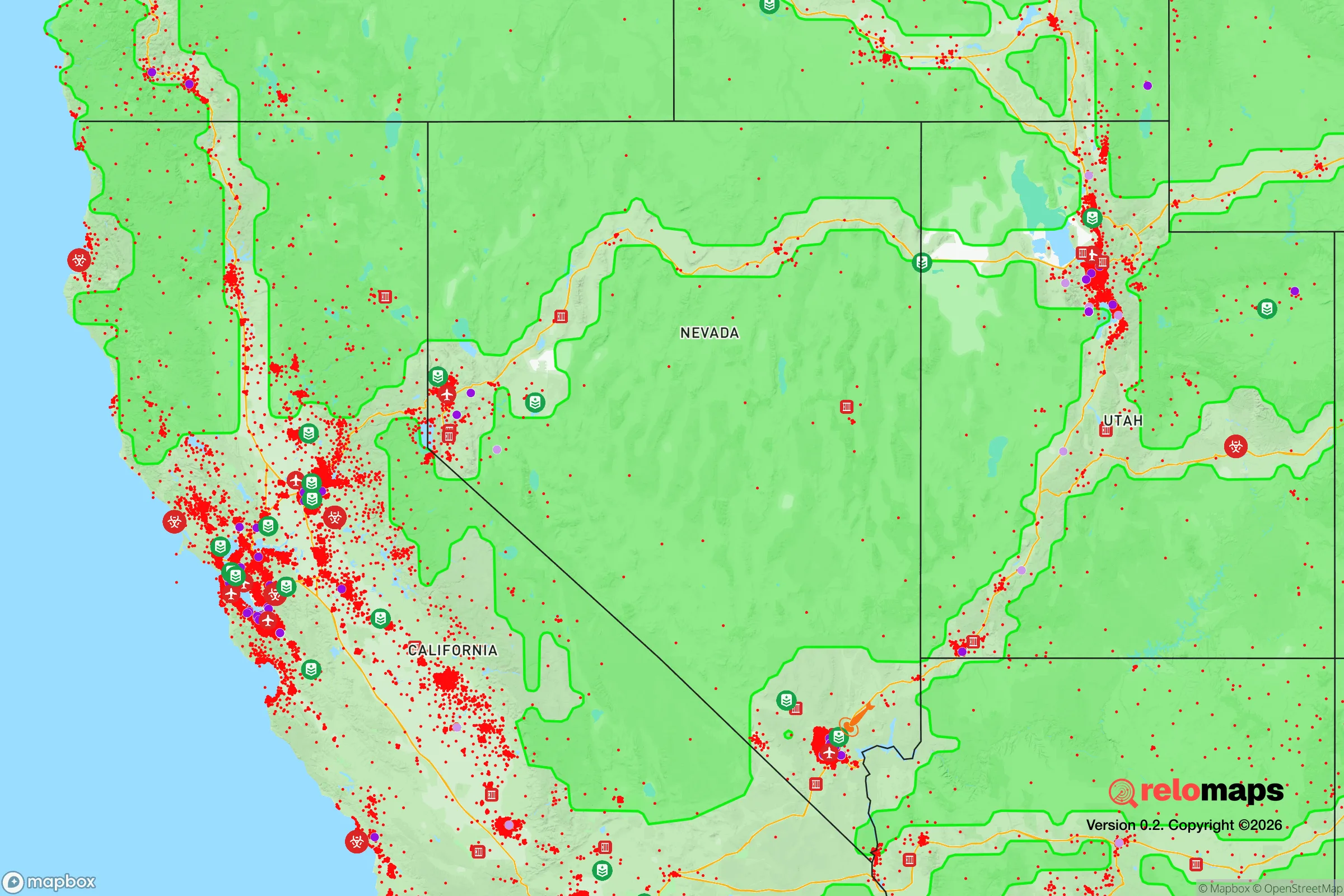
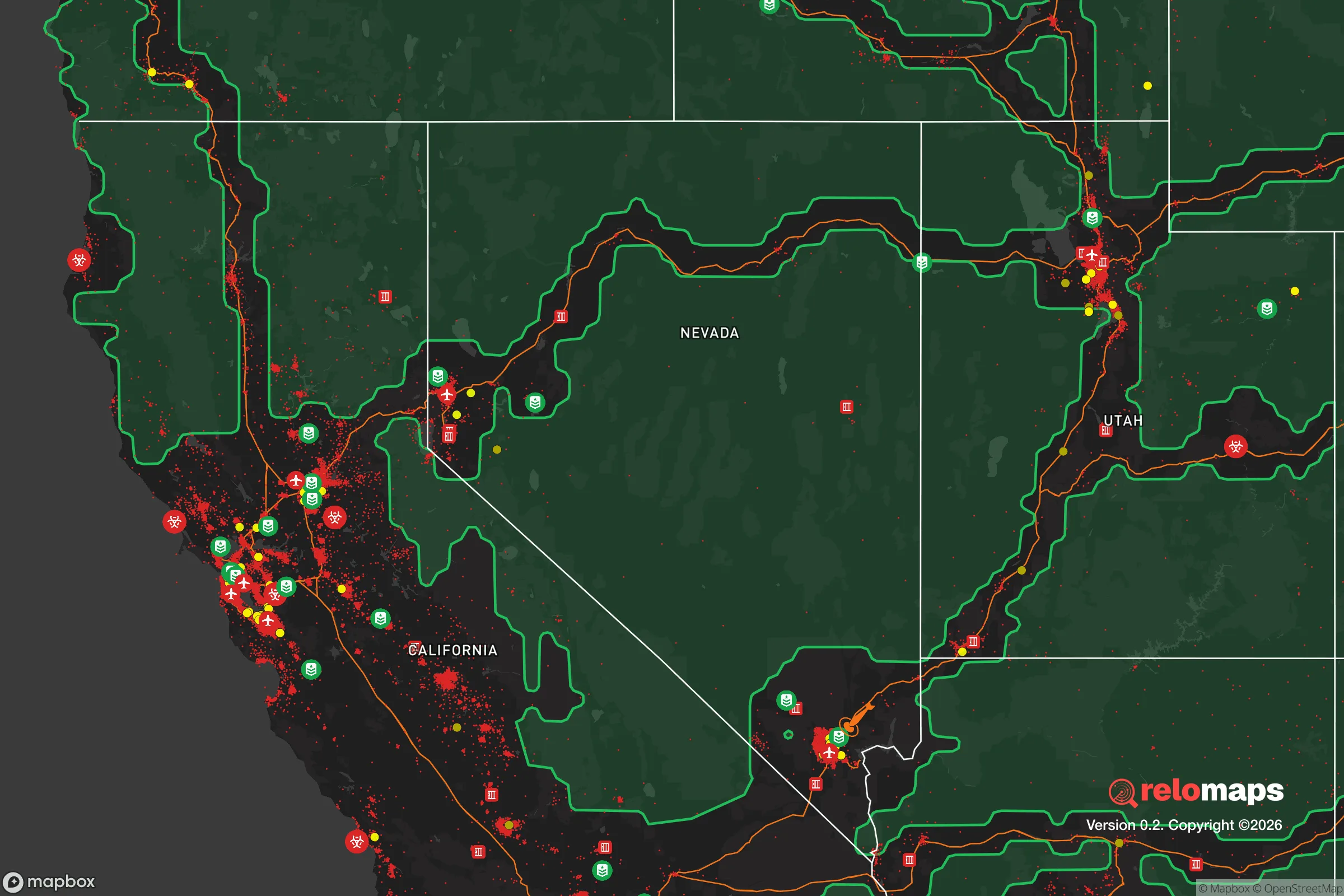


Important Note: For informational purposes only. This does not mean nothing bad ever happens in the green zones. Please use common sense. This is based on public data and modeled with AI. We tried to take a conservative approach but mistakes happen. We update this regularly as new information becomes available.
Solar Generator Recommendations
Backup power matters more here than in safer locations. We've picked three solar generators across budgets and capacity tiers — start with the budget unit if you only need a few essentials, or step up if you want to run a fridge and HVAC for days at a time.

Jackery Portable Power Station Explorer 300
Budget OptionPower on the Go: Weighing only 11 lbs, it's convenient to set up and store with book-sized foldable solar panels

BLUETTI Portable Power Station AC180
Designed for both indoor and outdoor scenarios, AC180 is highly capable as it has a robost capacity and continuous output power.

EF ECOFLOW DELTA Pro Ultra Power Station
Upgraded PickEcoFlow DELTA Pro Ultra is a whole-home energy system designed to grow with your family. Integrated with the Smart Home Panel 2, it scales to meet your evolving energy needs — keeping your home powered, intelligent, and secure through every stage of life.
We earn a commission, at no additional cost to you.
Strategic Assessment Analysis
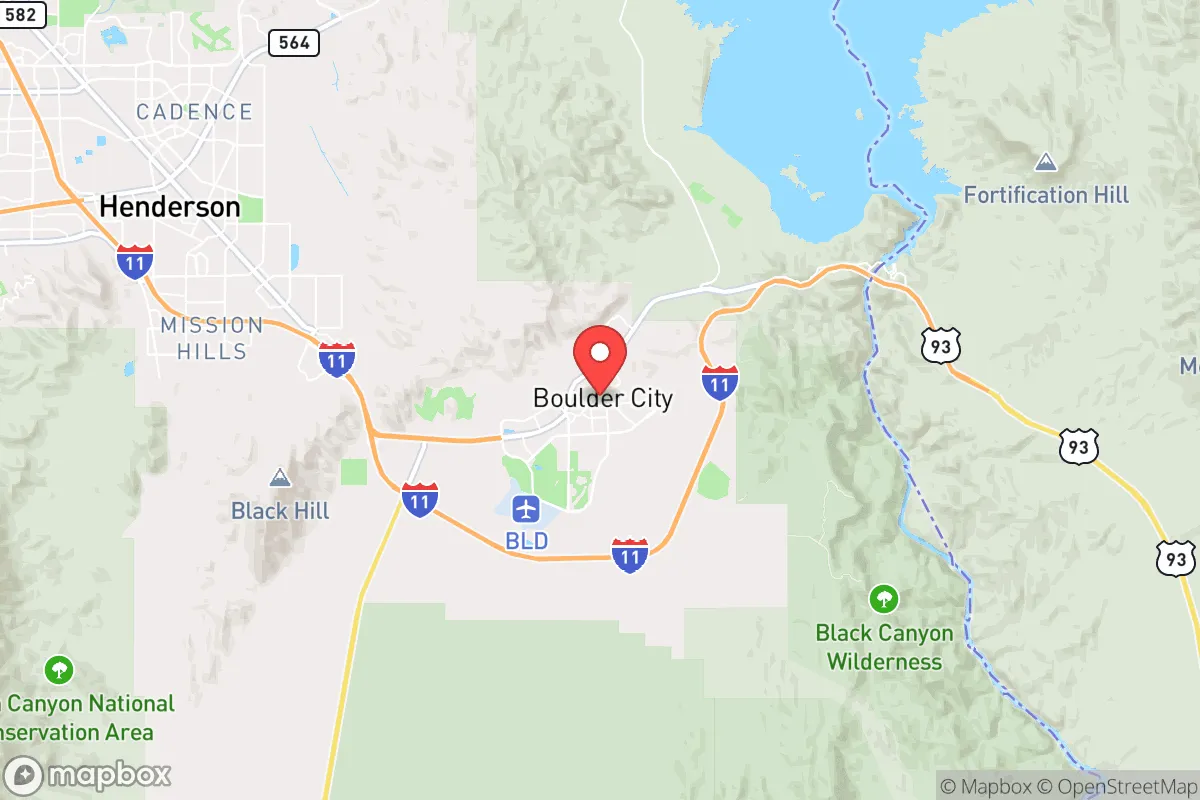
Boulder City, Nevada, occupies a unique strategic position that makes it one of the more interesting relocation options for those thinking seriously about resilience and long-term preparedness. Sitting about 25 miles southeast of Las Vegas, it was originally built by the federal government in the 1930s to house workers building Hoover Dam, and that origin story matters—the town was planned, controlled, and designed with a purpose. Today, it remains the only city in Nevada where gambling is illegal, which says something about the local character. For someone looking at the big picture—civic unrest, supply chain disruptions, or larger-scale disasters—Boulder City offers a mix of geographic insulation, water access, and community stability that’s hard to find elsewhere in the Southwest.
Geographic position and natural advantages for long-term security
Boulder City sits on a plateau at roughly 2,500 feet elevation, overlooking Lake Mead and the Colorado River. That elevation gives it a natural vantage point—you can see threats coming from miles away, whether that’s a dust storm, wildfire smoke, or something less natural. The surrounding terrain is rugged desert, which acts as a buffer. Unlike the sprawl of Henderson or North Las Vegas, Boulder City is physically separated from the Las Vegas Valley by the River Mountains and the Lake Mead National Recreation Area. That separation is a real asset. In a scenario where Las Vegas experiences civil unrest or a cascading infrastructure failure, Boulder City is far enough away to avoid the immediate chaos but close enough to monitor the situation. The town’s layout is also defensible—limited entry points, mostly via US-93 and NV-172, and the terrain funnels traffic in predictable ways. For someone thinking about retreat or relocation, that’s a tangible advantage.
Risks, exposures, and proximity to fallout-relevant landmarks
No place is perfect, and Boulder City has some serious exposures that need to be weighed honestly. The most obvious is its proximity to Las Vegas—25 miles is close enough that a major event in the city, whether a terrorist attack, a grid-down scenario, or a disease outbreak, would send waves outward. The I-15 corridor and McCarran International Airport are both within that radius, and both are high-value targets in any national security scenario. Then there’s Hoover Dam, which is literally right next door—about 7 miles from downtown Boulder City. The dam is a critical infrastructure node for the entire Southwest, providing power to California, Arizona, and Nevada. In a conflict or sabotage scenario, it’s a prime target. A successful attack on Hoover Dam would not only disrupt power but could cause catastrophic flooding downstream. Boulder City sits above the dam, so it’s not in the immediate flood path, but the economic and logistical ripple effects would be severe. Also worth noting: the Nevada National Security Site (formerly the Nevada Test Site) is about 65 miles northwest, and while it’s not an active testing ground, it’s still a federal facility with its own security concerns. The risk profile here is real, but it’s manageable if you’re aware of it and plan accordingly.
Practical resilience for a relocator: food, water, energy, and defensibility
Water is the single most critical resource in the desert, and Boulder City has a better position than almost any other town in Nevada. The city draws its water directly from Lake Mead via the Southern Nevada Water Authority, and because of its elevation, it has gravity-fed pressure—meaning even if the pumps go down, water still flows. That’s a huge deal. Lake Mead itself is a concern—water levels have dropped dramatically over the past two decades—but the city has invested in a new water treatment plant and has rights to Colorado River water that predate many other municipalities. For a relocator, this means you’re not immediately dependent on trucked-in water or deep wells. Food is a different story. The local grocery options are limited—a Smith’s and a few smaller markets—and the town is not a food production hub. You’d need to plan for long-term storage, gardening (possible with desert-adapted techniques like wicking beds), or regular supply runs to Las Vegas. Energy is relatively stable. Boulder City has its own municipal utility, Boulder City Electric, which is separate from NV Energy and has a good track record for reliability. The city also gets a portion of its power from Hoover Dam, so in a grid-down scenario, it might have priority access. Defensibility is strong. The town has a low crime rate, a well-funded police department, and a community that’s historically been tight-knit. The lack of casinos and the ban on gambling mean you’re not attracting the transient, high-risk population that fuels crime in other parts of the state. For a single individual or a family, the ability to lock down and ride out a crisis here is significantly better than in most suburban or urban settings.
The overall strategic picture for Boulder City is one of calculated trade-offs. It’s not a remote bunker in the mountains—it’s a small, planned community with real infrastructure, real water access, and real separation from the chaos of Las Vegas. The risks are there: proximity to a major city, a critical dam, and a federal nuclear site. But those risks are offset by the town’s defensible geography, its independent utility, and its community character. For someone who wants to be prepared without going off-grid entirely, Boulder City offers a middle path. You can live a relatively normal life, send your kids to decent schools, and still have a solid plan for when things go sideways. Just don’t expect to be invisible—this is a place that’s on the map, and in a national emergency, it would be a destination for people fleeing the valley. The key is to get established now, build relationships, and have your own supplies and plans in place before the crisis hits. That’s the real advantage of Boulder City: it gives you time and options, which is more than most places can offer.

* Values derived from national, state, county, city and local statistics and may differ in a specific area. Last updated: 2026-04-16T13:10:17.000Z
Narrative content on this page is AI-generated and may contain mistakes. Verify any details that matter before acting on them.
ReloMaps may earn a commission from affiliate links at no extra cost to you.

