Strategic Assessment of Bozeman, MT
Workable tactical position. Some exposure to population density or targets, but generally defensible in a crisis.
What does the Strategic Assessment tell us?
Our Strategic Assessment grades tactical survivability of an area. Major population centers, military targets, fallout zones, natural disasters, and border exposure all drive risk — lower exposure means a more defensible position in a crisis.
This is heavily inspired by Joel Skousen's Strategic Relocation book. Highly recommended you checkout the book ($)What does this tell us?
Our Strategic Assessment grades tactical survivability of an area. Major population centers, military targets, fallout zones, natural disasters, and border exposure all drive risk — lower exposure means a more defensible position in a crisis.
This is heavily inspired by Joel Skousen's Strategic Relocation book. Highly recommended you checkout the book ($)Strategic Pillars

Key Distances
Regional Safe Places
Below is our recommended "safe zones" in Montana and the surrounding area based on our strategic heuristics. For most people, it's unrealistic to live in a “safe zone” full-time due to work, family or other personal reasons. They tend to be more rural. However, many of these areas are perfect for second homes and retreat properties that double as a vacation home or even a short-term rental.
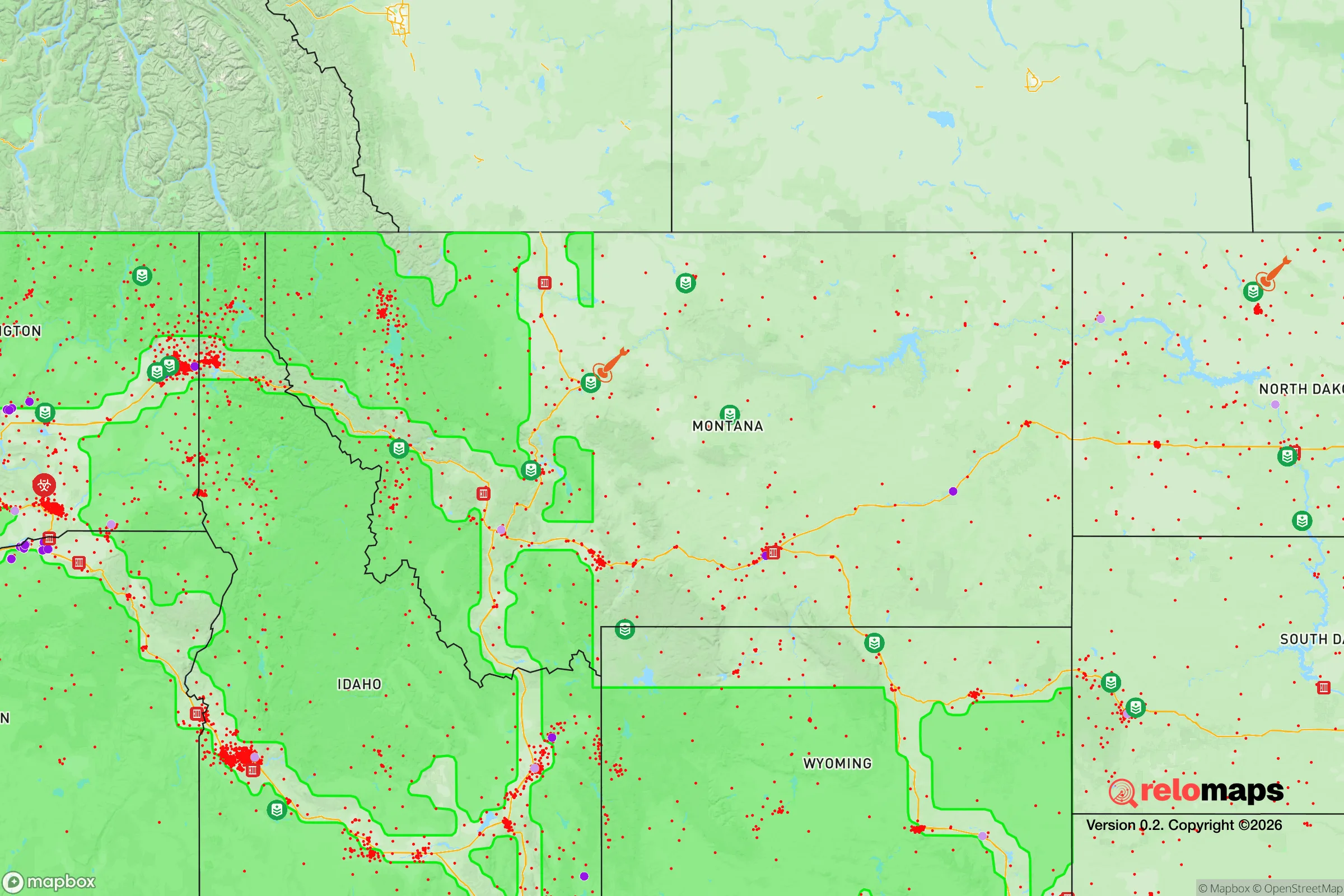


Important Note: For informational purposes only. This does not mean nothing bad ever happens in the green zones. Please use common sense. This is based on public data and modeled with AI. We tried to take a conservative approach but mistakes happen. We update this regularly as new information becomes available.
Solar Generator Recommendations
Backup power matters more here than in safer locations. We've picked three solar generators across budgets and capacity tiers — start with the budget unit if you only need a few essentials, or step up if you want to run a fridge and HVAC for days at a time.

Jackery Portable Power Station Explorer 300
Budget OptionPower on the Go: Weighing only 11 lbs, it's convenient to set up and store with book-sized foldable solar panels

BLUETTI Portable Power Station AC180
Designed for both indoor and outdoor scenarios, AC180 is highly capable as it has a robost capacity and continuous output power.

EF ECOFLOW DELTA Pro Ultra Power Station
Upgraded PickEcoFlow DELTA Pro Ultra is a whole-home energy system designed to grow with your family. Integrated with the Smart Home Panel 2, it scales to meet your evolving energy needs — keeping your home powered, intelligent, and secure through every stage of life.
We earn a commission, at no additional cost to you.
Strategic Assessment Analysis
Bozeman, Montana, sits in a geographic sweet spot that offers genuine strategic depth for those thinking long-term about resilience, but it is not without serious trade-offs. The Gallatin Valley provides a combination of mountain屏障, fertile soil, and a growing local economy that makes it one of the more viable relocation targets in the lower 48 for someone looking to put distance between themselves and the chaos of coastal megacities. However, the same factors that make Bozeman attractive—its rapid growth, proximity to Yellowstone National Park, and status as a regional hub—also introduce vulnerabilities that a serious prepper must weigh carefully. This analysis breaks down the area's defensive strengths, exposure risks, and practical day-to-day resilience factors for a relocator operating from a conservative, survivalist mindset.
Geographic position and natural defensive advantages
Bozeman's primary strategic asset is its location in a high mountain valley at roughly 4,800 feet elevation, surrounded by the Bridger, Gallatin, and Madison mountain ranges. This topography creates natural chokepoints on the major access routes—Interstate 90 through Bozeman Pass to the east, and Highway 191 through the Gallatin Canyon to the south—which could be monitored or controlled in a crisis scenario. The valley itself is roughly 30 miles long and 15 miles wide, offering enough agricultural land to support a local food system, though current development is eating into that rapidly. The area's distance from major population centers is a double-edged sword: Bozeman is about 90 miles from the nearest interstate hub (Butte) and over 140 miles from the nearest major city (Billings), which means supply chains are thin and vulnerable to disruption, but it also means you are not in the blast radius of a major metropolitan collapse. The surrounding national forests—Gallatin, Custer, and Beaverhead-Deerlodge—provide vast buffer zones of public land that could serve as hunting grounds or retreat areas, though they also attract recreational traffic that could become problematic in a grid-down scenario. The valley's high elevation also means a shorter growing season (roughly 90-110 frost-free days) and harsh winters, which is a resilience factor that filters out the unprepared but demands serious self-sufficiency planning for anyone who stays.
Risks, exposures, and proximity to fallout-relevant landmarks
The most significant risk for Bozeman in a national crisis scenario is its proximity to Yellowstone National Park and the underlying supervolcano caldera. While a catastrophic eruption is a low-probability event, the area sits within the ashfall zone for even moderate volcanic activity, and the 1959 Hebgen Lake earthquake (magnitude 7.2) demonstrated that the region is seismically active. More immediately concerning for a prepper is Bozeman's status as a destination for mass migration from coastal states. The population has nearly doubled since 2010, from roughly 37,000 to over 55,000 within city limits, with the broader Gallatin County now pushing 130,000. This growth has created a housing crisis, strained infrastructure, and introduced a demographic mix that includes a significant number of wealthy transplants who may not have the skills or mindset for long-term survival. In a collapse scenario, Bozeman could become a target for refugees fleeing the Front Range cities (Denver is about 500 miles south) or the Pacific Northwest (Seattle is about 550 miles west), though the distance and mountain barriers provide some buffer. The presence of Montana State University (roughly 16,000 students) means a large, concentrated population that could become a liability if civil order breaks down. Additionally, the Malmstrom Air Force Base missile fields in Great Falls (about 150 miles north) make Montana a potential target in a nuclear exchange, though Bozeman itself is not near any primary strategic targets. The nearby Bridger Bowl and Big Sky ski resorts are seasonal economic drivers but also attract crowds that could complicate evacuation routes during a crisis.
Practical resilience for a relocator: food, water, energy, and defensibility
For someone serious about self-sufficiency, Bozeman offers a mixed bag. The Gallatin Valley has some of the best agricultural soil in Montana, and there is a growing local food movement with farmers' markets, CSAs, and a handful of year-round growers using hoop houses. However, the valley's prime farmland is being paved over for subdivisions at an alarming rate, and water rights are a contentious issue—the Gallatin River is overallocated, and new wells are increasingly regulated. A relocator would need to secure property with senior water rights or a reliable spring, and plan for a short growing season with cold-hardy crops and season extension techniques. The area's energy grid is served by NorthWestern Energy, which relies heavily on coal and hydroelectric power, but the grid is vulnerable to winter storms and wildfire-related outages. Solar is viable but requires battery storage for the long, dark winters—expect only 2-3 hours of peak sun in December. Wood heat is common and practical, with ample firewood available from national forests (with a permit) and private timberland. Defensibility is a strong point for a well-chosen property: the valley floor is open, but the foothills and mountain properties offer natural cover and limited access points. Bozeman's gun culture is robust, with multiple shooting ranges and a strong tradition of hunting and firearms ownership, which means a relocator will find like-minded neighbors and resources for training. The local law enforcement (Gallatin County Sheriff's Office) is professional but stretched thin, and response times in rural areas can exceed 30 minutes. Medical infrastructure is decent for a town this size—Bozeman Health Deaconess Hospital is a Level III trauma center—but specialized care requires a flight to Billings or Salt Lake City. The community itself is a mix of old-guard ranchers, outdoor recreationists, and tech workers from the "Bozeman Angels" startup scene, which means social cohesion is not guaranteed in a crisis. A prepper would do well to build relationships with the agricultural community and avoid the transient population that comes and goes with the ski season.
The overall strategic picture for Bozeman is one of high potential tempered by real vulnerabilities. It offers some of the best natural defenses in the lower 48—mountain barriers, distance from major targets, and a climate that discourages unprepared migration—but the rapid growth and cultural shifts of the past decade have introduced risks that did not exist twenty years ago. For a conservative relocator looking to ride out a period of national instability, Bozeman is a viable option if you can secure a property with water, a defensible position, and a buffer from the town center. The key is to get in before the window closes—land prices are already astronomical by Montana standards, and the valley's carrying capacity is finite. If you are willing to trade some convenience for security and put in the work on self-sufficiency, Bozeman can be a strong base. But if you are looking for a place that is already hardened and off the radar, you may want to look further east or north, where the crowds have not yet arrived.

* Values derived from national, state, county, city and local statistics and may differ in a specific area. Last updated: 2026-04-19T06:52:23.000Z
Narrative content on this page is AI-generated and may contain mistakes. Verify any details that matter before acting on them.
ReloMaps may earn a commission from affiliate links at no extra cost to you.

