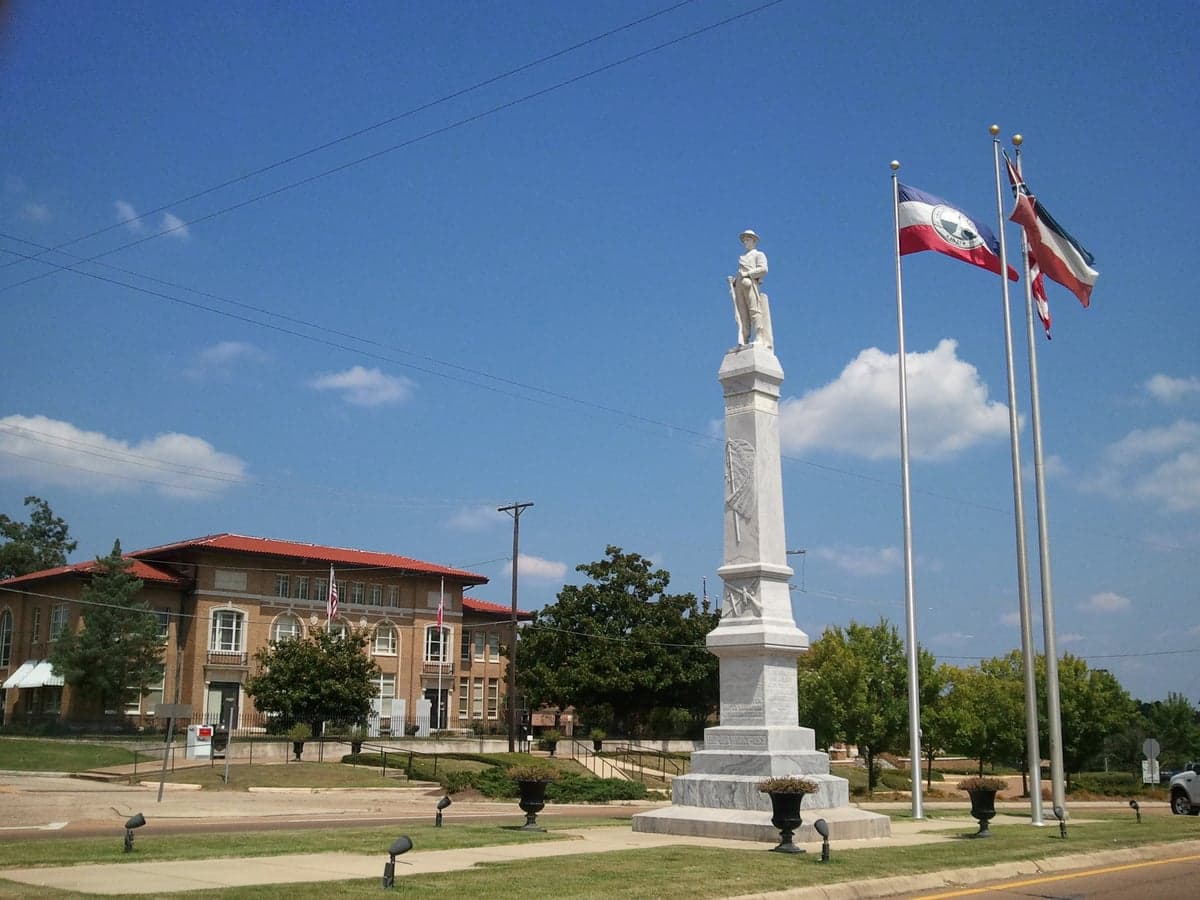
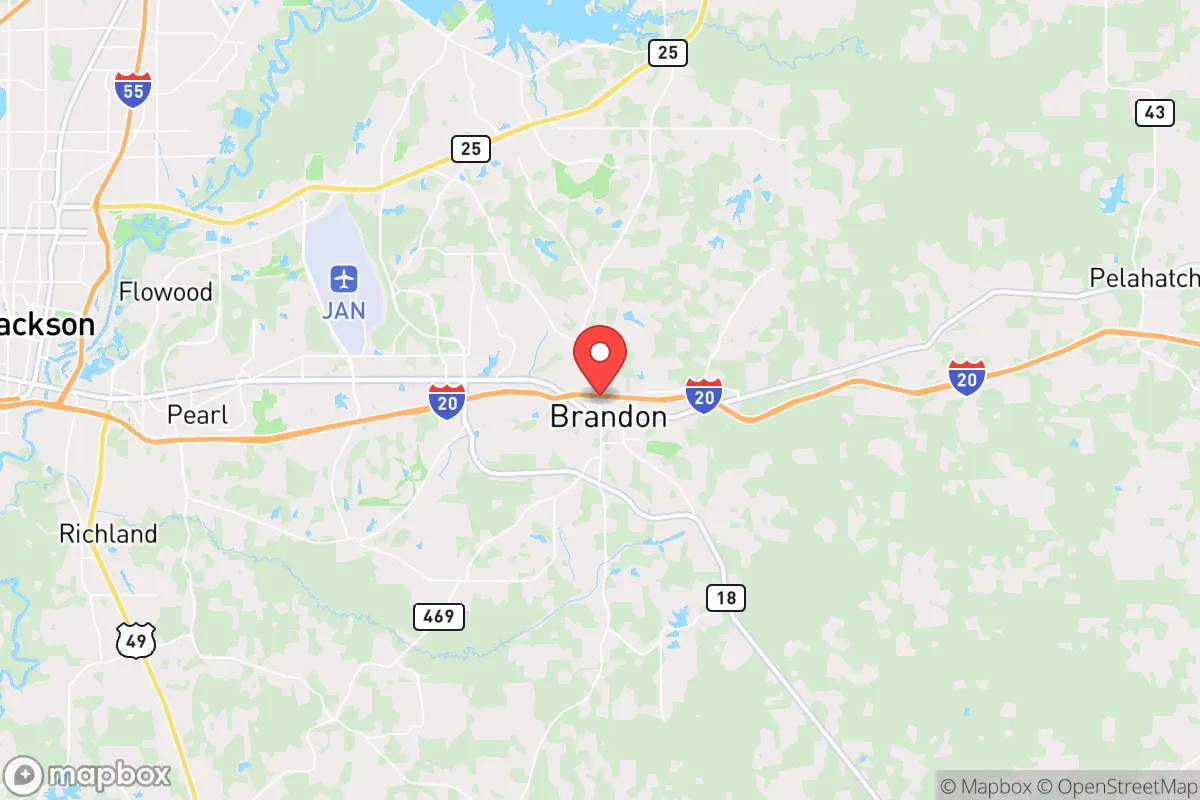
Photo: Wikipedia
Demographics of Brandon, MS
Affluence Level in Brandon, MS
A middle-class area roughly in line with national averages across income, home values, education, and employment.
People of Brandon, MS
The people of Brandon, Mississippi, today form a predominantly white, college-educated, and family-oriented community of 25,352 residents, characterized by a strong sense of local identity and a notably low foreign-born population of just 0.9%. The city’s demographic profile—74.2% white, 22.6% Black, and 2.2% Hispanic—reflects its roots as a small railroad town that has transformed into a prosperous suburb of Jackson, attracting families and professionals seeking good schools and a lower cost of living. Distinctive markers of Brandon’s population include a high homeownership rate, a concentration of residents in the healthcare and education sectors, and a civic culture centered around local churches and the annual Brandon Crawfish Festival. This is a community where generational roots run deep, yet new arrivals are steadily reshaping its character.
How the city was settled and grew
Brandon was founded in 1831 as the seat of Rankin County, named after a local state legislator. The original population was drawn by the promise of fertile farmland and the establishment of a county courthouse, which made the small settlement a hub for legal and agricultural business. The arrival of the railroad in the late 19th century spurred the first significant growth wave, connecting Brandon to Jackson and the Gulf Coast. The historic Downtown Brandon district, centered around Government Street, was built by this early wave of merchants, lawyers, and farmers, many of whom were of English and Scots-Irish descent. A second wave came in the early 20th century with the expansion of the timber and cotton industries, bringing a small but established Black population that settled in the Northwest Brandon area, near the railroad tracks, where many worked as laborers and domestic workers. The city remained a modest county seat of roughly 2,000 residents through the 1950s, with its population largely static until the post-World War II era.
Modern era (post-1965)
The modern transformation of Brandon began in earnest after 1965, driven by two forces: the expansion of Jackson’s suburban footprint and the construction of Interstate 20, which made Brandon a viable commuter suburb. The 1970s and 1980s saw a massive influx of white families moving east from Jackson, drawn by the newly built Crossgates and Lake Caroline subdivisions—planned communities with larger lots, new schools, and a reputation for safety. This wave was part of a broader pattern of white flight from Jackson’s urban core, and it dramatically shifted Brandon’s racial composition: the Black share of the population fell from roughly 35% in 1970 to under 20% by 1990. The 1990s and 2000s brought a second suburban wave, this time of professionals and executives working at the University of Mississippi Medical Center and the growing Nissan plant in Canton. These newcomers, overwhelmingly white and college-educated, settled in newer developments like Reunion and Shiloh, which feature golf courses and gated entries. The small Hispanic population (2.2%) is a recent arrival, concentrated in the Brandon East area near the industrial parks, working in construction and service jobs. The East/Southeast Asian and Indian communities remain tiny (0.1% each), with no distinct neighborhood enclave.
The future
Brandon’s population is projected to continue growing, driven by ongoing residential development along the I-20 corridor and the expansion of Rankin County’s school system, which is a primary draw for families. The city is likely to become more homogenously white and affluent in the near term, as new subdivisions cater to upper-middle-class buyers and the older, more diverse neighborhoods near downtown see less new construction. The Black population, which has held steady at roughly 22-23% since 2010, is not growing in absolute numbers but is becoming more geographically concentrated in the Northwest Brandon and Old Brandon areas, while newer developments remain overwhelmingly white. The Hispanic and Asian populations are expected to grow slowly, but from such a low base (2.2% and 0.1%, respectively) that they will not significantly alter the city’s demographic character for at least a decade. The foreign-born share (0.9%) is among the lowest in the Jackson metro area, indicating that Brandon is not a destination for international immigration. The city is effectively tribalizing into distinct enclaves by income and race, with the newer, pricier subdivisions drawing a nearly all-white population and the older neighborhoods retaining a more diverse, but stable, mix.
For someone moving in now, Brandon is becoming a place where affluence and racial homogeneity are increasingly aligned in the newer neighborhoods, while the older parts of town offer more diversity but fewer new amenities. The city’s future is one of steady, managed growth that will likely preserve its character as a safe, conservative, and family-oriented suburb—but one where the demographic trends point toward greater separation by income and race, not less. New arrivals should expect a community that values stability and tradition, with a population that is overwhelmingly native-born, college-educated, and politically conservative.

* Values derived from national, state, county, city and local statistics and may differ in a specific area. Last updated: 2026-04-30T21:52:56.000Z
Narrative content on this page is AI-generated and may contain mistakes. Verify any details that matter before acting on them.
ReloMaps may earn a commission from affiliate links at no extra cost to you.

