Demographics of Briarcliffe Acres, SC
Affluence Level in Briarcliffe Acres, SC
A wealthy area with high-earning, well-educated households. Incomes, home values, and educational attainment meaningfully outpace national averages.
People of Briarcliffe Acres, SC
Briarcliffe Acres, South Carolina, is a small, affluent, and predominantly white residential enclave of just 499 residents, characterized by its exceptionally high college attainment rate of 61.4% and a complete absence of a foreign-born population. The city functions as a quiet, low-density bedroom community for professionals and retirees seeking proximity to the Grand Strand's amenities without the density of Myrtle Beach proper. Its population is notably homogenous, with a 91.6% white demographic base, a small Black community at 4.8%, and a Hispanic population of 2.6%, while East/Southeast Asian residents make up 0.4% and Indian-subcontinent residents are absent. The city's identity is defined by its single-family homes on large wooded lots, a lack of commercial development, and a strong sense of privacy and exclusivity.
How the city was settled and grew
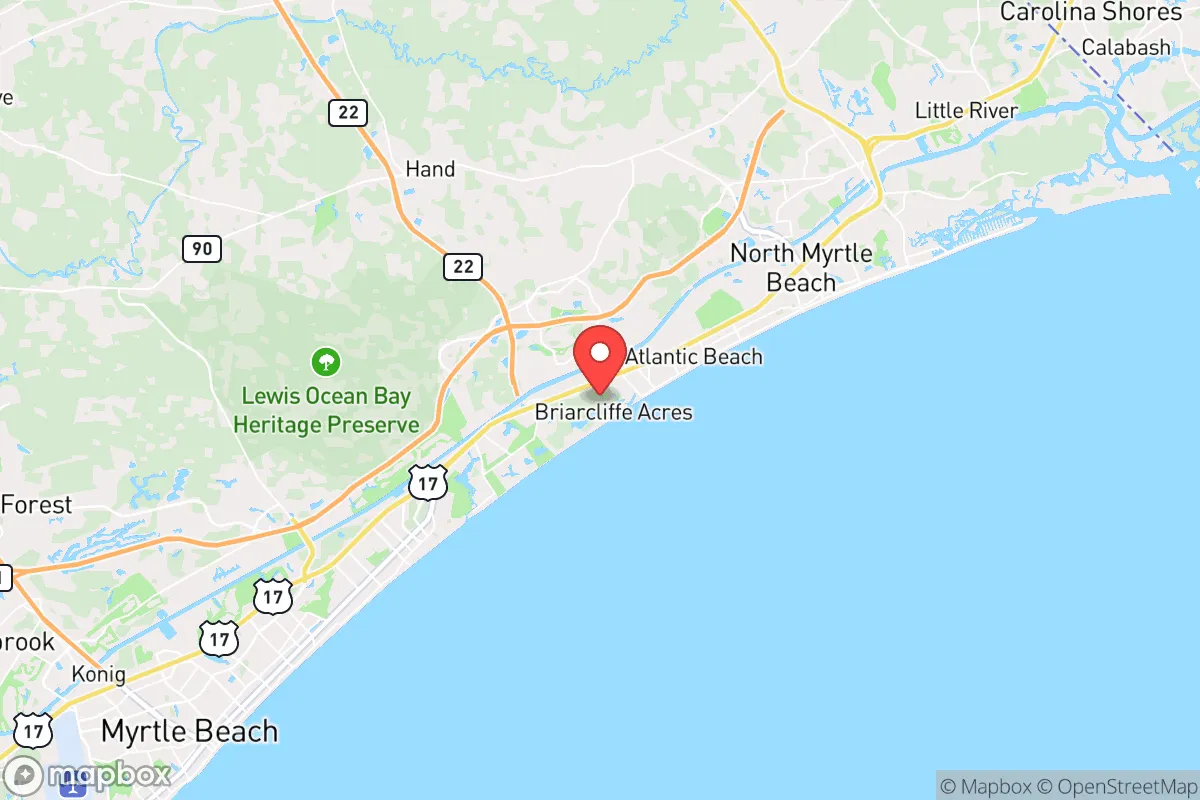
Briarcliffe Acres was not a product of colonial or 19th-century settlement but was instead a planned suburban development established in the mid-20th century. The area was originally part of the larger Briarcliffe plantation tract, but the modern city was formally incorporated in 195 balancing the desire for a rural retreat with the need for municipal services. The original population consisted of white, upper-middle-class families and retirees from the Mid-Atlantic and Northeast, drawn by the area's large, wooded lots—typically one to three acres—and its location just west of the Atlantic Ocean and north of Myrtle Beach. The earliest homes were built in the Briarcliffe Acres Historic District, a core neighborhood of mid-century modern and ranch-style houses that still anchors the community's character. A second wave of development in the 1970s and 1980s filled out King's Grant, a subdivision of larger custom homes that attracted professionals from the growing Myrtle Beach tourism and healthcare sectors. Unlike many coastal South Carolina towns, Briarcliffe Acres never had a significant agricultural or industrial workforce; its population was deliberately curated through large lot sizes and restrictive covenants that limited density and commercial activity.
Modern era (post-1965)
Following the 1965 Hart-Cellar Act, Briarcliffe Acres experienced virtually no immigration-driven demographic change, as its 0.0% foreign-born population today confirms. The city's growth in the post-1965 era has been driven entirely by domestic in-migration, primarily from the Northeastern United States and the Midwest. The 1990s and 2000s saw a wave of retirees and second-home buyers settling in Ocean Forest Estates, a gated enclave within the city that offers larger estates and direct access to the Briarcliffe Acres beach access point. This neighborhood absorbed many of the wealthier newcomers, while Briarcliffe Shores, a smaller subdivision closer to the ocean, attracted younger families and professionals commuting to Myrtle Beach's expanding medical and hospitality industries. The city's Black population, at 4.8%, is concentrated in a handful of older homes within the Briarcliffe Acres Historic District, reflecting a small but stable presence that predates the city's incorporation. The Hispanic population, at 2.6%, is dispersed across the city, primarily in service-industry households renting homes in the older sections. The East/Southeast Asian community, at 0.4%, is negligible and consists of a few professional families in King's Grant. The city's demographic stability is reinforced by its zoning: minimum lot sizes of one acre and a ban on multifamily housing have effectively prevented the kind of rapid, diverse growth seen in neighboring Myrtle Beach and North Myrtle Beach.
The future
Briarcliffe Acres is likely to remain a demographically static community over the next 10 to 20 years. The city's population has hovered around 500 for decades, and its restrictive zoning and high property values—median home prices well above $500,000—create a high barrier to entry for new residents. The white population share, currently 91.6%, may decline slightly as a small number of Hispanic and Black families move in, but the city's lack of rental housing and commercial development limits the potential for significant diversification. The foreign-born population is expected to remain at or near zero, as the city offers no employment base or affordable housing to attract immigrants. The most likely demographic shift is a gradual aging of the population, as the current retiree cohort is replaced by younger professionals and families drawn by the city's schools and low crime rates. The Briarcliffe Acres Historic District and King's Grant will continue to be the primary residential areas, with infill development limited to a few vacant lots. The city's character as a quiet, exclusive, and overwhelmingly white enclave is unlikely to change meaningfully.
For a conservative-leaning individual or family moving to Briarcliffe Acres today, the city offers a stable, low-density, and highly educated community with minimal demographic turnover and no immigration-driven change. It is a place where property values are protected by strict zoning, schools are strong, and the pace of life is deliberately slow. The trade-off is a lack of diversity and commercial amenities, but for those seeking a predictable, secure, and homogeneous environment, Briarcliffe Acres delivers exactly that.

* Values derived from national, state, county, city and local statistics and may differ in a specific area. Last updated: 2026-04-23T03:12:34.000Z
Narrative content on this page is AI-generated and may contain mistakes. Verify any details that matter before acting on them.
ReloMaps may earn a commission from affiliate links at no extra cost to you.

