Political ClimatePolitical Climate in Briarcliffe Acres, SC
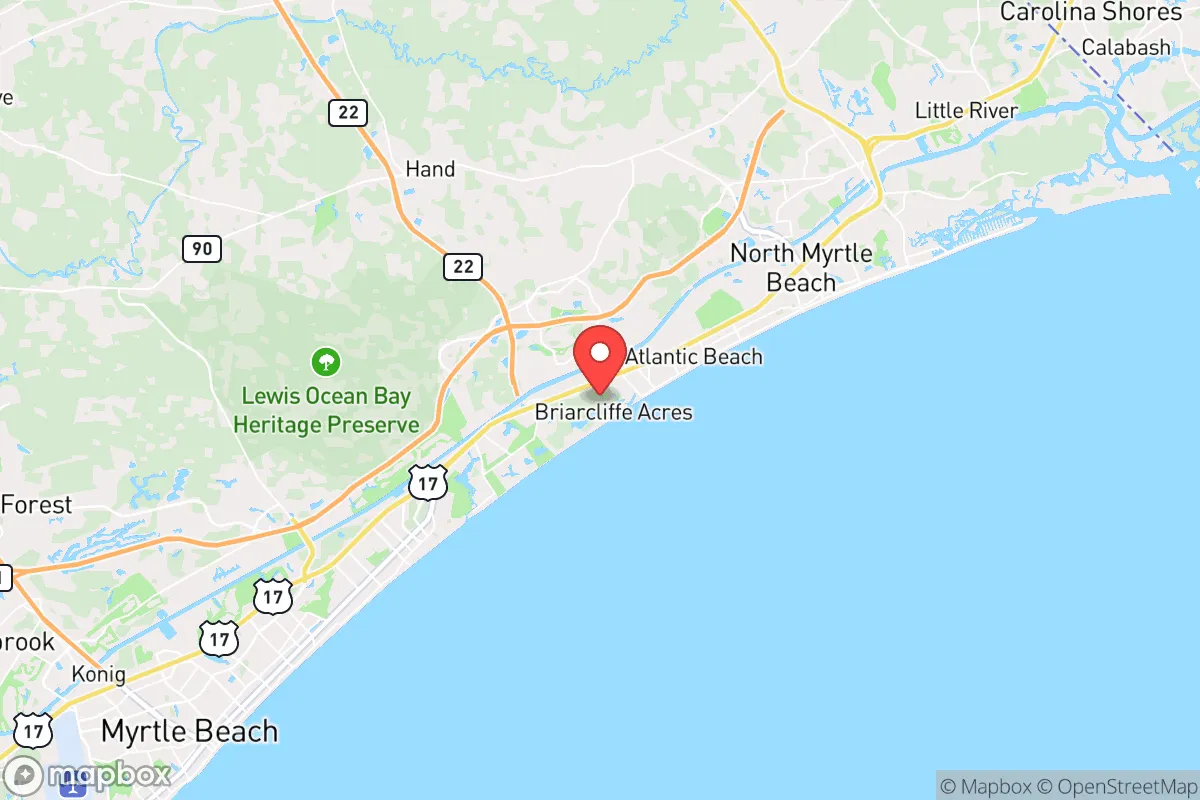
District shown is the primary district for this city’s centroid. Cities may span multiple districts.
Local Political AnalysisPolitical Analysis of Briarcliffe Acres, SC
Briarcliffe Acres leans solidly conservative, with a Cook PVI of R+12 that places it among the more reliably Republican enclaves along the Grand Strand. This isn’t a recent shift—the area has long been a pocket of traditional values, where neighbors still wave from golf carts and the biggest local debates tend to center on property setbacks and HOA rules, not national politics. But if you’ve been around here as long as I have, you’ve noticed the winds changing, especially as Myrtle Beach to the south and Conway to the west have seen younger, more transient populations bring a different energy. Briarcliffe Acres has held the line better than most, but it’s worth keeping an eye on.
How it compares
Drive ten minutes south to Myrtle Beach proper, and you’ll find a much more mixed political picture—tourist dollars and seasonal workers have diluted the local voting base, making it a swing area that’s trended bluer in recent cycles. Conway, home to Coastal Carolina University, is even more of a contrast: the college crowd and faculty have pushed it toward a purple-to-blue lean, especially in city council races. Meanwhile, Briarcliffe Acres remains a quiet outlier. Its small population—just a few hundred year-round residents—means local elections are decided by people who actually know each other, and that tends to favor candidates who respect property rights and keep taxes low. The R+12 rating isn’t just a number; it reflects a community that hasn’t been swayed by the coastal transplants or the university influence. If you’re looking for a place where your vote still feels like it counts, this is it.
What this means for residents
For folks who value personal freedoms and minimal government overreach, Briarcliffe Acres offers a refreshing contrast to the regulatory creep you see in bigger cities. The Horry County Council, which oversees most of the area’s zoning and development, has historically been pro-business and skeptical of new mandates—whether that’s mask requirements, energy efficiency codes, or short-term rental restrictions. That’s not to say it’s perfect; the HOA here can be particular about landscaping and paint colors, but that’s a far cry from the kind of top-down policy shifts that make you feel like you’re being managed. The real concern, and I hear this from neighbors all the time, is that as Myrtle Beach and North Myrtle Beach continue to grow, pressure will mount to regionalize services or adopt uniform building standards. That’s the kind of thing that sounds harmless on paper but often leads to higher fees and less local control. So far, Briarcliffe Acres has resisted that drift, but it’s something to watch in the next five to ten years.
Culturally, this is still a place where the Fourth of July parade is a bigger deal than any political rally, and where the local church potluck draws a bigger crowd than the town hall meeting. That’s the kind of community that tends to self-correct when things start sliding left. The biggest policy distinction you’ll notice is the absence of the kind of progressive ordinances you see in Charleston or Columbia—no plastic bag bans, no sanctuary city talk, no push for density bonuses in the zoning code. It’s a deliberate, quiet conservatism that doesn’t need to shout because it’s still the default. If that changes, it’ll be because the people who moved here for the beaches and the golf courses start voting like they did back in Ohio or New York. So far, that hasn’t happened, and with the R+12 lean holding steady, it doesn’t look like it will anytime soon. But I’d be lying if I said I wasn’t keeping one eye on the ballot box every November.

State Political ClimatePolitical Climate in South Carolina
State Political AnalysisPolitical Environment in the State
South Carolina has long been a reliably red state, but the nature of that conservatism has shifted significantly over the past two decades. The state’s overall partisan lean remains solidly Republican at the presidential level—Donald Trump carried it by 11 points in 2024—but the coalition driving that majority has changed. The old-school, establishment GOP that dominated the 2000s has given way to a more populist, culturally conservative base, while the Democratic vote has become increasingly concentrated in a handful of urban and suburban corridors. For a conservative looking to relocate, the state offers a generally friendly policy environment, but the political geography is more complex than a simple red-state label suggests.
Urban vs. rural divide
The political map of South Carolina is a study in contrasts. The state’s two major metros—Charleston and Columbia—have become the primary engines of Democratic growth. Charleston County, once a Republican stronghold, has trended blue over the last decade, driven by an influx of out-of-state professionals, tech workers, and retirees from liberal-leaning areas. In 2024, Charleston County voted for Kamala Harris by a narrow margin, a shift that would have been unthinkable 20 years ago. Richland County, home to Columbia and the state capital, is reliably Democratic, powered by the presence of the University of South Carolina and a large African American population. Greenville, in the Upstate, remains a Republican anchor, but even there, the city proper has seen a modest leftward drift as younger professionals move in. The real conservative firepower comes from the rural and suburban counties that surround these metros. Lexington County, just west of Columbia, is a deep-red suburban stronghold, voting +35 points for Trump in 2024. Spartanburg County and York County (home to Rock Hill and Fort Mill) are similarly solid, with the latter benefiting from an influx of conservative-leaning families fleeing higher taxes in Charlotte, just across the North Carolina line. The coastal Horry County, anchored by Myrtle Beach, is another reliably red area, though its rapid growth is bringing in a mix of retirees and service-industry workers that could shift the balance over time.
Policy environment
South Carolina’s policy landscape is broadly conservative, but with some notable wrinkles. The state has a flat income tax rate of 6.2%, which is scheduled to phase down to 6% by 2026, and no state-level property tax on vehicles—a perk that residents from high-tax states like New York or California quickly appreciate. The sales tax rate is 6%, but local options can push it higher in some counties. On education, the state has embraced school choice in a limited way: the Education Scholarship Trust Fund program, enacted in 2023, provides vouchers of roughly $6,000 per year for low- and middle-income families to use toward private school tuition or homeschooling expenses. It’s not a universal program, but it’s a step in the right direction. Healthcare policy is a mixed bag. The state did not expand Medicaid under the Affordable Care Act, which keeps government involvement in healthcare relatively low, but it also means that rural hospitals face financial pressure. On election integrity, South Carolina has a voter ID law that is considered one of the stricter in the South, requiring a photo ID to vote in person. Absentee voting requires an excuse, and early voting was expanded to two weeks in 2024, a compromise that satisfied neither side fully. The state also has a constitutional carry law for firearms, passed in 2021, allowing permitless concealed carry for residents 18 and older.
Trajectory & freedom
The trajectory of personal freedom in South Carolina is a mixed bag, leaning positive for conservatives but with some concerning trends. On the plus side, the constitutional carry law (2021) was a clear expansion of Second Amendment rights, and the state has resisted federal overreach on gun control. The Fetal Heartbeat Act (2023) banned abortion after roughly six weeks, a major win for pro-life advocates. Parental rights have been strengthened by the Parents’ Bill of Rights (2024), which requires schools to notify parents of any changes to a child’s health or well-being and prohibits instruction on sexual orientation or gender identity in K-5 classrooms. However, there are warning signs. The state’s Medicaid expansion debate continues to simmer, with some Republicans in the legislature pushing for a limited expansion under a work requirement waiver—a move that would increase government dependency. More concerning is the influx of out-of-state migrants from blue states, particularly in the Charleston and Greenville areas, who bring with them progressive voting habits. The state’s property tax system is also a point of friction: while there’s no vehicle tax, homeowners in rapidly growing areas like Fort Mill and Mount Pleasant have seen assessments skyrocket, leading to higher tax bills despite relatively low rates. The state legislature has so far resisted indexing property taxes to inflation, a failure that could become a flashpoint.
Civil unrest & political movements
South Carolina has not seen the level of civil unrest seen in larger states, but it has had its share of political flashpoints. The Confederate flag removal from the Statehouse grounds in 2015, following the Charleston church shooting, was a deeply divisive moment that still resonates. On the left, activist groups like Indivisible Charleston and the SC Progressive Network have been active in pushing for racial justice reforms and expanded voting access, but their influence is limited outside of the urban cores. On the right, the SC Freedom Caucus has emerged as a powerful force in the state legislature, pushing for stricter immigration enforcement, school choice expansion, and resistance to federal mandates. Immigration politics are a growing issue, particularly in the Upstate, where a significant Hispanic population has settled in areas like Greer and Duncan. The state has not declared itself a sanctuary jurisdiction, and local law enforcement generally cooperates with ICE, but tensions have risen as the population grows. Election integrity remains a hot-button issue, with the state’s State Election Commission facing criticism from both sides—conservatives argue that the 2020 and 2024 elections were secure but that the system could be improved, while progressives claim the voter ID law is too restrictive. A new resident would notice that political discourse is generally civil in day-to-day life, but the underlying divisions are real and visible in local news coverage.
Projection
Over the next 5-10 years, South Carolina is likely to remain a red state, but the margin of that redness will narrow. The key demographic driver is in-migration from blue states, particularly to the coastal and Upstate metros. Charleston County is already trending blue, and if that trend spreads to neighboring Berkeley County or Dorchester County, the state could become competitive at the state level within a decade. The rural counties will remain deeply red, but they are losing population, which dilutes their electoral power. The state’s Republican primary will likely become more contentious as the establishment wing and the populist wing battle for control. On policy, expect continued fights over school choice expansion, property tax reform, and the scope of Medicaid. The state’s constitutional carry law is unlikely to be rolled back, but new restrictions on where firearms can be carried (e.g., government buildings, schools) could be proposed. The biggest wildcard is the growth of the Hispanic population, which could shift the political calculus if it becomes more politically active. For a conservative moving in now, the state will likely still be a comfortable place to live in a decade, but the political environment will be more contested, particularly in the suburbs.
For a new resident, the bottom line is this: South Carolina offers a generally favorable environment for conservative values—low taxes, strong gun rights, and a culture that respects traditional family structures—but it is not immune to the demographic and cultural shifts affecting the rest of the country. If you’re looking for a place where your vote will still matter and your way of life is respected, the Upstate (Greenville, Spartanburg, Anderson) or the Midlands (Lexington, York counties) are your best bets. The coast is beautiful, but the politics there are shifting faster than you might expect. Keep an eye on local school board races and county council elections—that’s where the real battles over the future of the state are being fought.
* Values derived from national, state, county, city and local statistics and may differ in a specific area. Last updated: 2026-04-23T03:12:34.000Z
Narrative content on this page is AI-generated and may contain mistakes. Verify any details that matter before acting on them.
ReloMaps may earn a commission from affiliate links at no extra cost to you.

