Strategic Assessment of Briarcliffe Acres, SC
Meaningful friction. Expect exposure to either population pressure, blast zones, or natural disaster risk. Consider buying a retreat property.
What does the Strategic Assessment tell us?
Our Strategic Assessment grades tactical survivability of an area. Major population centers, military targets, fallout zones, natural disasters, and border exposure all drive risk — lower exposure means a more defensible position in a crisis.
This is heavily inspired by Joel Skousen's Strategic Relocation book. Highly recommended you checkout the book ($)What does this tell us?
Our Strategic Assessment grades tactical survivability of an area. Major population centers, military targets, fallout zones, natural disasters, and border exposure all drive risk — lower exposure means a more defensible position in a crisis.
This is heavily inspired by Joel Skousen's Strategic Relocation book. Highly recommended you checkout the book ($)Strategic Pillars

Key Distances
Regional Safe Places
Below is our recommended "safe zones" in South Carolina and the surrounding area based on our strategic heuristics. For most people, it's unrealistic to live in a “safe zone” full-time due to work, family or other personal reasons. They tend to be more rural. However, many of these areas are perfect for second homes and retreat properties that double as a vacation home or even a short-term rental.
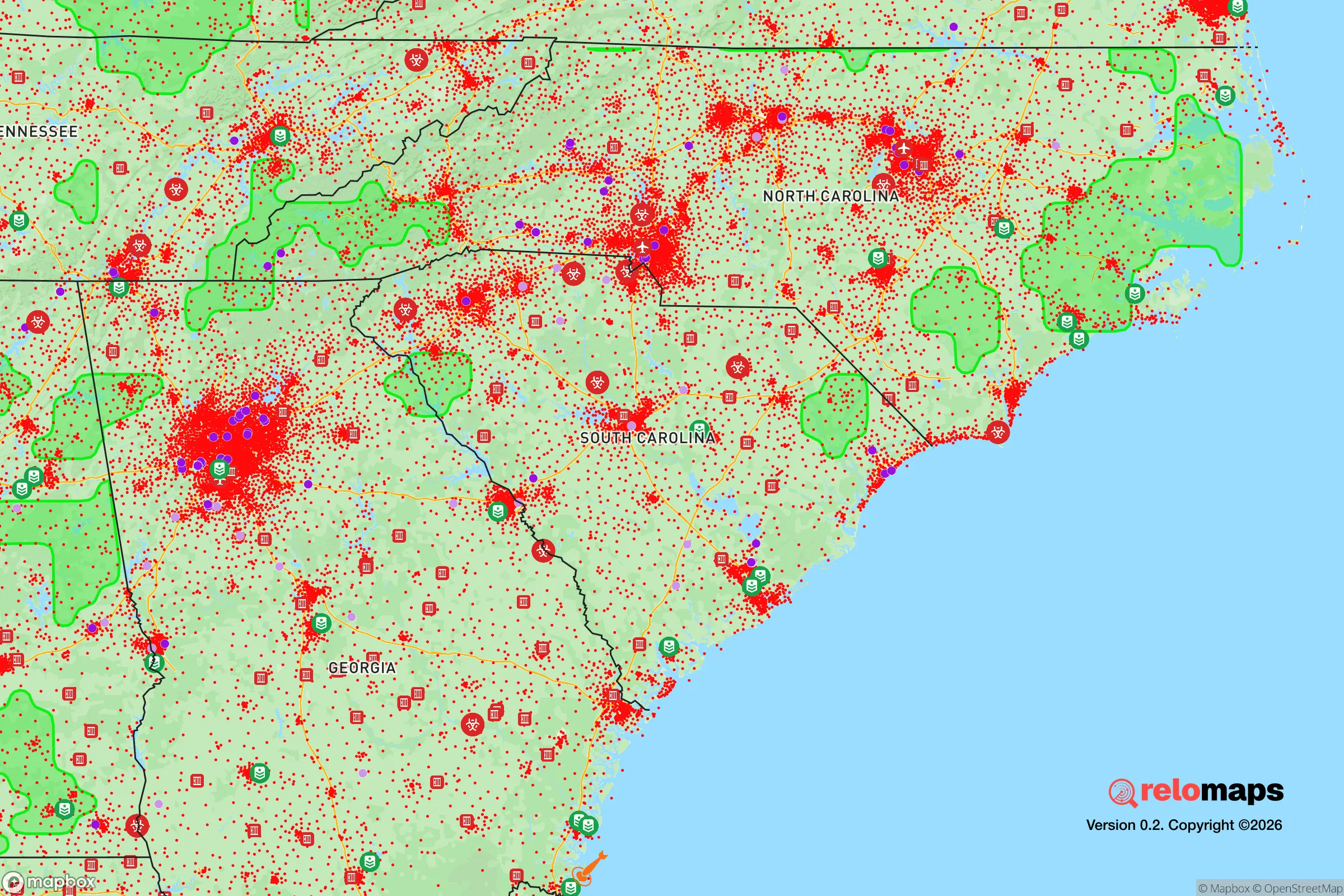
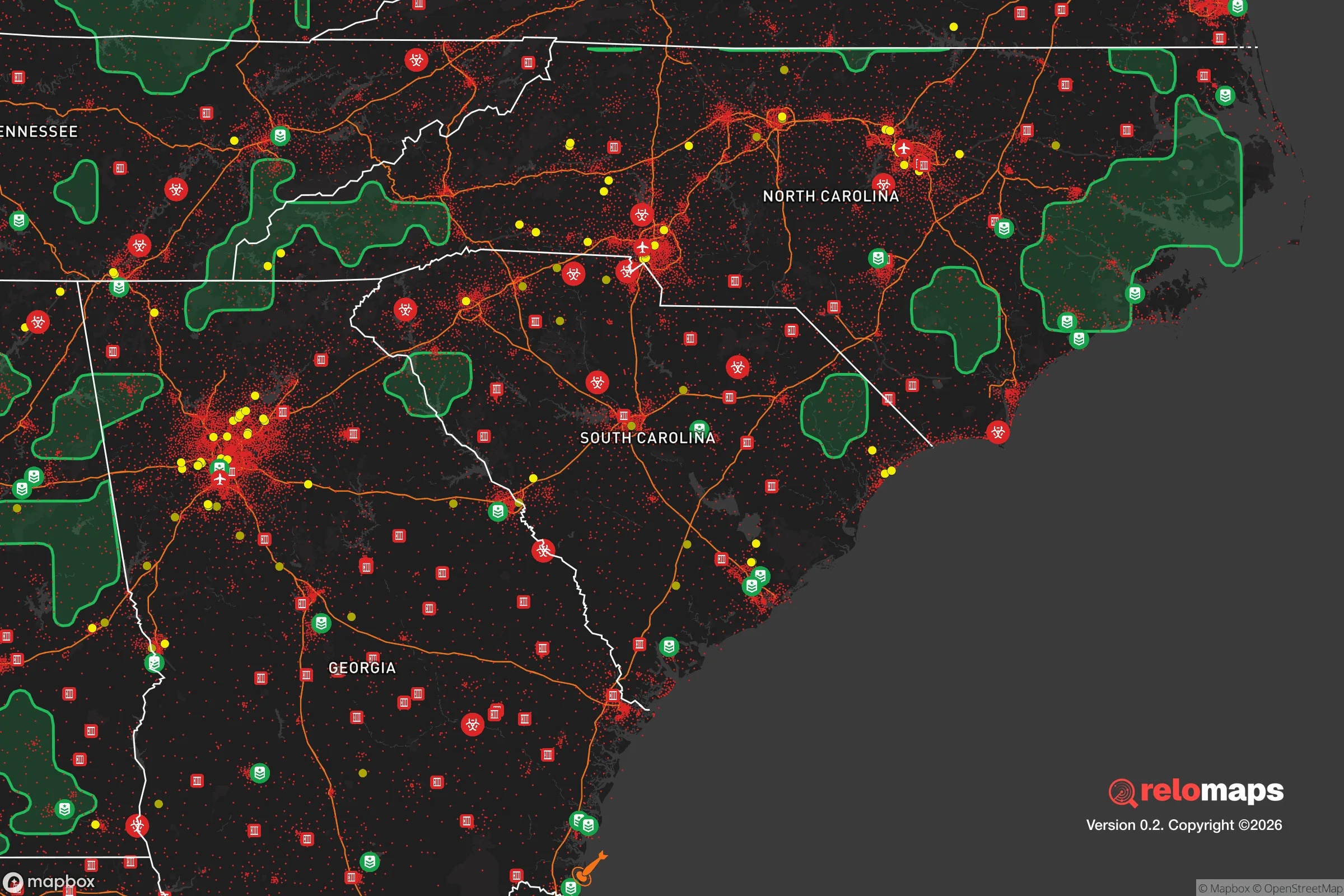


Important Note: For informational purposes only. This does not mean nothing bad ever happens in the green zones. Please use common sense. This is based on public data and modeled with AI. We tried to take a conservative approach but mistakes happen. We update this regularly as new information becomes available.
Solar Generator Recommendations
Backup power matters more here than in safer locations. We've picked three solar generators across budgets and capacity tiers — start with the budget unit if you only need a few essentials, or step up if you want to run a fridge and HVAC for days at a time.

Jackery Portable Power Station Explorer 300
Budget OptionPower on the Go: Weighing only 11 lbs, it's convenient to set up and store with book-sized foldable solar panels

BLUETTI Portable Power Station AC180
Designed for both indoor and outdoor scenarios, AC180 is highly capable as it has a robost capacity and continuous output power.

EF ECOFLOW DELTA Pro Ultra Power Station
Upgraded PickEcoFlow DELTA Pro Ultra is a whole-home energy system designed to grow with your family. Integrated with the Smart Home Panel 2, it scales to meet your evolving energy needs — keeping your home powered, intelligent, and secure through every stage of life.
We earn a commission, at no additional cost to you.
Strategic Assessment Analysis
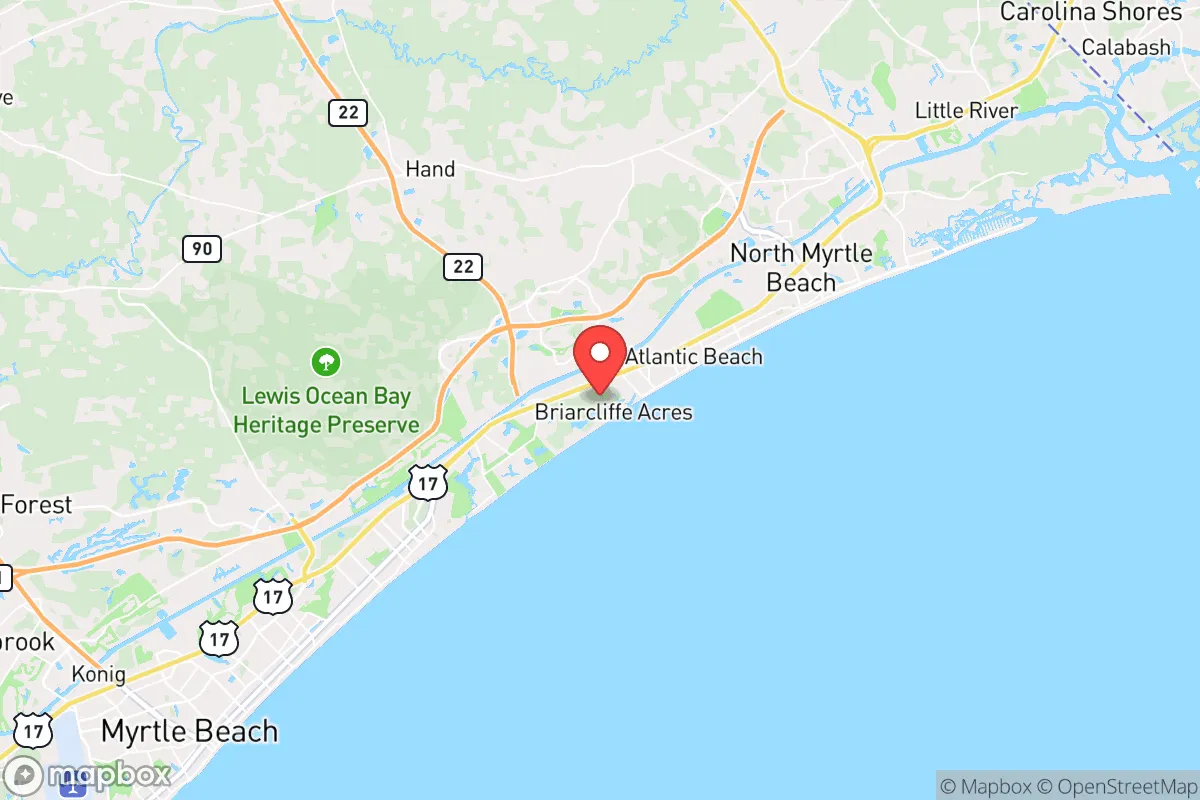
Briarcliffe Acres, South Carolina, sits in a peculiar strategic pocket that offers genuine resilience advantages for those thinking ahead about civic unrest, supply chain disruptions, or mass casualty events, but it comes with serious trade-offs that demand clear-eyed assessment. This tiny incorporated town of roughly 450 residents is physically embedded within the larger Myrtle Beach metropolitan area, yet it maintains its own municipal governance, zoning, and police protection—a setup that provides a degree of local control most suburban neighborhoods lack. The key question for a relocator with a prepper mindset is whether the area’s natural buffers and low population density within the town itself outweigh the risks of being less than 10 miles from a major tourist hub that could become a focal point for chaos during a crisis.
Geographic position and natural buffers that work in your favor
Briarcliffe Acres occupies a narrow strip of land between the Atlantic Intracoastal Waterway to the west and the Atlantic Ocean to the east, giving it a natural moat-like quality that limits approach vectors for any large-scale unrest. The town is bordered by the Myrtle Beach State Park to the south, which provides a green buffer of undeveloped maritime forest and dunes that would be difficult to traverse quickly on foot or by vehicle. To the north, the community of Arcadian Shores and the Dunes Golf and Beach Club create another layer of semi-private, low-density development. This geographic arrangement means that any large group moving toward Briarcliffe Acres would have to funnel through a limited number of roadways—primarily Highway 17 and a handful of local streets—making the area inherently more defensible than sprawling suburban subdivisions. The town’s elevation averages around 20 feet above sea level, which is modest but sufficient to avoid the worst storm surge risks that plague lower-lying parts of the Grand Strand. For a relocator concerned with natural disasters as a trigger for societal breakdown, the area’s position on a relatively stable coastal plain with no fault lines and minimal tornado activity is a net positive, though hurricane risk remains a factor that requires serious planning.
Risks, exposures, and proximity to high-value targets you can’t ignore
The most glaring vulnerability of Briarcliffe Acres is its proximity to Myrtle Beach proper, a city that draws over 14 million visitors annually and has a permanent population of roughly 35,000. During peak tourist season, the area’s population swells to unsustainable levels, straining local infrastructure, medical resources, and law enforcement capacity. In a mass casualty event or widespread civil unrest, Myrtle Beach’s dense concentration of hotels, entertainment venues, and transient populations would likely become a hotspot for looting, violence, and resource competition. Briarcliffe Acres is close enough—about 8 miles from the Myrtle Beach boardwalk—that the spillover effects could reach the town within hours. Additionally, the town lies roughly 70 miles from the Savannah River Site, a Department of Energy nuclear facility that processes tritium and stores plutonium. While a catastrophic release from SRS is statistically unlikely, the prevailing wind patterns in the region could carry fallout toward the coast in certain scenarios. The nearby Grand Strand Medical Center, a Level I trauma center, is both an asset and a liability—it would be a magnet for the injured during a crisis, drawing crowds and potential security threats to within a few miles of the town. For the survivalist-minded relocator, these proximity risks mean that any prepping strategy for Briarcliffe Acres must include a robust plan for either hunkering down with sufficient supplies to avoid venturing into the city or having a secondary bug-out location further inland.
Practical resilience for daily life and crisis scenarios
On the practical side, Briarcliffe Acres offers some genuine advantages for a relocator building a resilient lifestyle. The town’s small size and low-density zoning mean that most homes sit on lots of at least half an acre, with many properties backing up to the Intracoastal Waterway or the state park—space that allows for private gardens, rainwater catchment systems, and discreet storage of supplies without drawing neighborly attention. The local water supply comes from the Grand Strand Water and Sewer Authority, which draws from the Pee Dee River basin and the Lower Floridan Aquifer, a source that is less vulnerable to drought than surface-water-dependent systems elsewhere in the Southeast. However, the system is grid-dependent, so a well with a hand pump or a solar-powered backup would be a wise investment for anyone serious about long-term self-sufficiency. Food resilience is a mixed bag: the area has year-round growing seasons that allow for cool-weather crops in winter and warm-weather staples in summer, but the sandy, acidic soil typical of coastal South Carolina requires raised beds or significant soil amendment to produce meaningful yields. Local hunting and fishing are viable options—the Intracoastal Waterway offers redfish, flounder, and shrimp, while the state park’s maritime forest holds deer and small game—but these resources would be quickly depleted if a crisis drove large numbers of people to the coast. Energy resilience is moderately achievable: the region gets ample sunlight for solar panels, and many homes in the area already have natural gas connections that could be used for cooking and heating if the electrical grid fails. The town’s defensibility is enhanced by its single primary road access and the fact that it is patrolled by the Briarcliffe Acres Police Department, a small force that knows the local residents and can respond faster than county sheriff’s deputies during a breakdown of order. For a single individual or a family, the key takeaway is that Briarcliffe Acres can work as a base of operations if you are willing to invest in off-grid capabilities and maintain a low profile, but it is not a location where you can simply show up and expect the environment to provide for you.
The overall strategic picture for Briarcliffe Acres is one of calculated trade-offs rather than clear-cut advantages. It offers a rare combination of coastal access, natural buffers, and municipal independence that is hard to find in the crowded Southeast, but those benefits come with the constant shadow of Myrtle Beach’s instability and the region’s vulnerability to hurricane-related disruptions. For a relocator with a conservative, self-reliant mindset who is willing to put in the work—digging a well, hardening a home, stockpiling supplies, and building relationships with the small local community—this town could serve as a defensible redoubt during the kind of slow-burn societal decay that many preppers anticipate. But for anyone expecting a turnkey survival paradise, the reality is that Briarcliffe Acres is a suburban enclave with a thin veneer of rural character, and its proximity to a major tourist economy means that when things go sideways, the chaos will arrive faster than the help. The smart play here is to treat the town as a forward operating base rather than a final destination, with a clear plan for inland relocation if the coastal corridor becomes untenable. If that sounds like the kind of strategic flexibility you can live with, Briarcliffe Acres deserves a serious look. If not, keep moving west.

* Values derived from national, state, county, city and local statistics and may differ in a specific area. Last updated: 2026-04-23T03:12:34.000Z
Narrative content on this page is AI-generated and may contain mistakes. Verify any details that matter before acting on them.
ReloMaps may earn a commission from affiliate links at no extra cost to you.

