Photo: Wikipedia
Demographics of Bridgeton, NJ
Affluence Level in Bridgeton, NJ
A low-income area with significant economic hardship. Household wealth and educational attainment are well below national averages.
People of Bridgeton, NJ
Bridgeton, New Jersey, is a small, densely populated city of 26,836 residents defined by its deep poverty, low educational attainment, and a starkly diverse population that is majority Hispanic (57.0%) with a substantial Black minority (30.3%). The city’s white population has collapsed to just 10.0%, while the foreign-born share stands at a high 21.3.3%, reflecting ongoing immigration. With only 5.8% of adults holding a college degree, Bridgeton is one of the least educated cities in New Jersey, a fact that shapes its economic struggles and social fabric. The population is young, working-class, and heavily concentrated in neighborhoods like the South Avenue corridor and the West Side, where distinct ethnic enclaves have formed over decades.
How the city was settled and grew
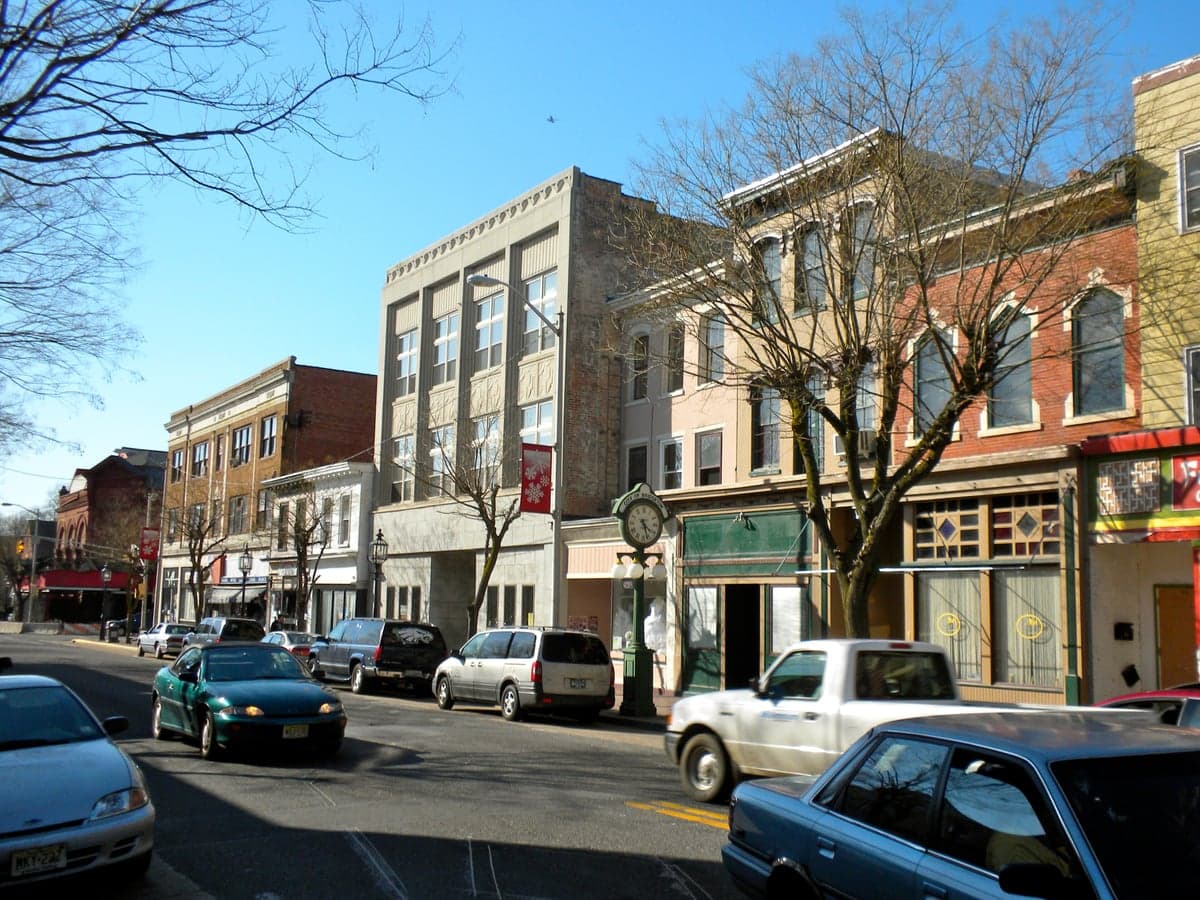
Bridgeton’s original population was built by English and Scotch-Irish settlers in the late 17th and early 18th centuries, drawn by the fertile land along the Cohansey River and the promise of agricultural prosperity. The city’s name derives from a bridge built over the river in 1716, and by the 19th century, it had become a regional hub for glassmaking, shipbuilding, and food processing. The historic Bridgeton Historic District, centered around Commerce Street and the riverfront, was the heart of this early Anglo-Protestant community, with brick Federal-style homes and churches reflecting the original settlers’ wealth and influence. A second wave arrived in the late 19th and early 20th centuries: Italian and Polish immigrants who worked in the city’s glass factories and canneries. They settled in the North Pearl Street area and the East Lake neighborhood, building tight-knit Catholic parishes and ethnic social clubs that persisted through the mid-20th century. By 1950, Bridgeton was a predominantly white, working-class city of about 18,000, with a small Black population concentrated near the South Avenue corridor.
Modern era (post-1965)
The 1965 Hart-Cellar Act and the subsequent collapse of Bridgeton’s manufacturing base triggered a dramatic demographic transformation. As glass factories and canneries closed in the 1970s and 1980s, white families began a rapid exodus to suburbs like Upper Deerfield and Hopewell townships, leaving behind a hollowed-out urban core. Simultaneously, a large wave of Black migrants from the rural South arrived, settling in the West Side neighborhood around West Commerce Street and the South Avenue corridor, where public housing projects and aging stock offered cheap rents. By 1990, the city was roughly 40% Black and 50% white. The next major shift came in the 1990s and 2000s, when Hispanic immigrants—primarily from Puerto Rico, Mexico, and the Dominican Republic—began arriving in large numbers, drawn by low housing costs and agricultural jobs in the surrounding Cumberland County farmlands. They concentrated in the North Pearl Street area and the Bridgeton Village district, transforming these once-Italian and Polish neighborhoods into vibrant Latino enclaves. Today, the white population has dwindled to 10.0%, while Hispanics make up 57.0% and Blacks 30.3%. The East/Southeast Asian population is negligible at 0.1%, and there is no measurable Indian-subcontinent population. The foreign-born share of 21.3% is nearly all Hispanic, with a small number of Black immigrants from West Africa and the Caribbean.
The future
Bridgeton’s population is heading toward further Hispanicization, with the white share likely to fall below 5% within a decade as older residents die or leave. The Hispanic population is young and has a higher birth rate, while the Black population is aging and slowly declining through out-migration to nearby suburbs like Vineland and Millville. The city is not homogenizing but rather tribalizing into distinct enclaves: the West Side and South Avenue remain predominantly Black, while North Pearl Street and Bridgeton Village are overwhelmingly Hispanic. There is little mixing between these groups, and the small remaining white population is concentrated in the historic district. Immigrant communities are growing, with new arrivals from Central America (Guatemala, Honduras) joining the existing Puerto Rican and Mexican base, but assimilation is slow due to low English proficiency and high poverty. The next 10-20 years will likely see Bridgeton become a majority-Hispanic city with a Black minority of around 20-25%, a white population of under 5%, and a foreign-born share approaching 30%. The city’s poverty rate (over 30%) and low educational attainment will persist unless major economic investment occurs, which seems unlikely given the region’s stagnation.
For someone moving in now, Bridgeton is a deeply challenged, ethnically segmented city with limited economic opportunity and a population that is overwhelmingly Hispanic and Black. It is not a place of upward mobility or demographic stability, but rather a low-cost, high-poverty urban center where newcomers will find themselves in a specific ethnic enclave—likely Hispanic on the north side or Black on the west side—with little intermixing. The city’s future is one of continued Hispanic growth and white flight, making it a distinctively Latino working-class city in a state known for its affluent suburbs.

* Values derived from national, state, county, city and local statistics and may differ in a specific area. Last updated: 2026-05-18T07:43:26.000Z
Narrative content on this page is AI-generated and may contain mistakes. Verify any details that matter before acting on them.
ReloMaps may earn a commission from affiliate links at no extra cost to you.

