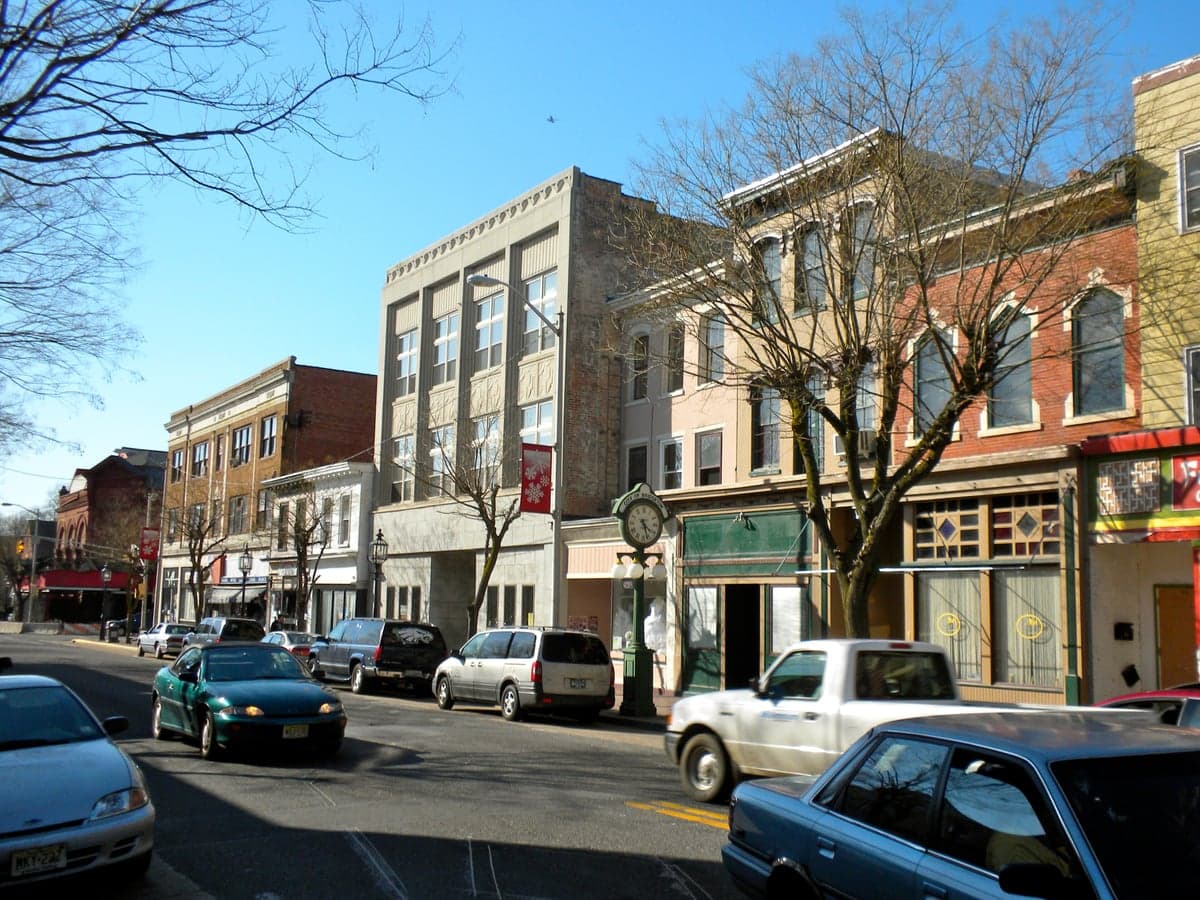
Photo: Wikipedia
Personal Sovereignty in Bridgeton, NJ
Viable for self-reliance. Generally workable, though some barriers may limit total independence.
What does Personal Sovereignty tell us?
Personal Sovereignty measures your capacity for self-reliance and independence with minimal government friction. Higher scores mean fewer barriers between you and the way you want to live... but it assumes you have the space you need and good neighbors.
What does this tell us?
Personal Sovereignty measures your capacity for self-reliance and independence with minimal government friction. Higher scores mean fewer barriers between you and the way you want to live... but it assumes you have the space you need and good neighbors.
State Policy
Energy independence: Importer (8% of energy produced in-state)
Personal Liberty
Homesteading

Personal Liberty Analysis
For the individual or family prioritizing personal sovereignty—the ability to live, defend, and provide for oneself without excessive government interference—Bridgeton, New Jersey presents a deeply conflicted picture. On one hand, the city’s lower cost of entry and aging housing stock offer a rare foothold in an otherwise expensive state, which can be leveraged for self-reliance. On the other areas cannot match. On the other hand, Bridgeton sits within a state whose regulatory apparatus, tax structure, and recent legislative trends actively constrain personal autonomy in ways that should give any survivalist or prepper serious pause. The trade-off is stark: you gain a lower barrier to land ownership, but you operate under a government that has shown little restraint in expanding its reach into your finances, your home, and your rights.
Tax burden and regulatory posture: the cost of operating under Trenton
New Jersey’s tax burden is the highest in the nation, and Bridgeton residents are not exempt from this reality. The effective property tax rate in Cumberland County hovers around 3.0% of assessed value, meaning a modest $150,000 home carries an annual tax bill of roughly $4,500. For a prepper trying to keep overhead low to fund supplies, land improvements, or a bug-out property, this is a significant recurring drain. The state income tax is progressive, topping out at 10.75% for high earners, but even middle-income households face rates around 5-6%. Sales tax is 6.625%, and while groceries and prescription drugs are exempt, nearly everything else is taxed. Beyond taxes, the regulatory posture is hostile to self-sufficiency. New Jersey’s Department of Environmental Protection (DEP) imposes strict rules on everything from rainwater collection (requiring permits for systems over certain sizes) to building codes that make DIY construction expensive and legally risky. The state’s Right-to-Farm Act offers some protection for agricultural activities, but only on parcels of five acres or more with active farming—a threshold few Bridgeton lots meet. For the individualist, the message is clear: the state views your property as a resource to be managed by Trenton, not a domain of personal authority.
Self-defense and gun law specifics: navigating a restrictive regime
New Jersey’s gun laws are among the most restrictive in the nation, and Bridgeton residents must operate within a framework that treats firearm ownership as a heavily regulated privilege rather than a right. The state requires a Firearms Purchaser Identification Card (FPID) for long-guns and a separate permit for each handgun purchase, with a 30-day waiting period between handgun purchases. The carry permit process, post-Bruen, has become slightly less arbitrary but remains expensive and slow, often taking six months or more, and requires a demonstrated "justifiable need" that goes beyond general self-defense. Magazine capacity is capped at 10 rounds. The state’s "safe storage" law, effective in 2024, mandates that all firearms be locked in a secure container or with a trigger lock when not in use, even in your own home—a direct intrusion into how you choose to secure your defense tools. For the prepper, this means that maintaining a ready-to-hand readiness for a home invasion or civil unrest scenario is legally precarious. Castle Doctrine exists but is narrower than in many states; you have no duty to retreat in your home, but the burden of proof that you reasonably feared death or serious injury falls squarely on you. In short, Bridgeton is not a place where you can freely arm yourself to the teeth. Your defensive capabilities will be limited by law, and any use of force will be scrutinized by a state whose political leadership is openly hostile to civilian firearm ownership.
Self-reliance and homesteading viability: lot sizes, zoning, and off-grid feasibility
Bridgeton’s older residential lots, many in the 5,000 to 10,000 square foot range, offer limited space for serious homesteading. While you can plant a substantial vegetable garden and keep a few chickens (city code allows up to four hens, no roosters), the zoning code is restrictive. No livestock larger than poultry is permitted within city limits, and beekeeping requires a permit and neighbor notification. The city’s building code requires permits for any structural addition, including sheds over 100 square feet, and all electrical and plumbing work must be done by licensed contractors. Off-grid living is effectively illegal: the city requires connection to municipal water and sewer where available, and solar panels must be grid-tied with utility approval. Rainwater collection for potable use is prohibited by state health code. For the prepper seeking true self-reliance—a property where you can grow food, store water, generate power, and live independently of the grid—Bridgeton’s urban zoning and state-level regulations make it a poor fit. The better play is to look at the surrounding rural areas of Cumberland County, such as Upper Deerfield or Hopewell Township, where one- to five-acre parcels are available for under $20,000 per acre, and zoning is far more permissive. There, you can keep goats, install a septic system, and build a workshop without a dozen without the city’s oversight. Bridgeton itself is best viewed as a base of operations, not a self-sufficient compound.
Personal liberties: parental rights, medical autonomy, speech, and property
On parental rights, New Jersey has moved aggressively in recent years to centralize authority in the state. The state’s mandates comprehensive sex education in public schools, with no parental opt-out for specific lessons, and has passed laws that allow minors to consent to certain medical treatments (including mental health and substance abuse care) without parental notification. For parents who believe they should have the final say in their children’s education and healthcare, this is a direct erosion of authority. Medical autonomy for adults is similarly constrained: New Jersey has strict vaccine mandates for school attendance and healthcare workers, and during the COVID-19 pandemic, the state imposed some of the nation’s longest-lasting emergency orders. The state’s Public Health Emergency Health Powers Act gives the governor broad authority to compel treatment, quarantine, and property seizure during a declared public health emergency—powers that were exercised and have not been significantly rolled back. Free speech is protected by the First Amendment, but New Jersey has a "bias intimidation" law that enhances penalties for crimes motivated by certain beliefs, which some critics argue can chill protected speech. Property rights are weak: the state’s eminent domain authority is broad, and the New Jersey Supreme Court has upheld its use for economic development, not just public use. For the survivalist, the cumulative message is that the state sees itself as the ultimate arbiter of your family’s health, your children’s education, and your property’s fate.
In the broader landscape of American personal sovereignty, Bridgeton and New Jersey rank near the bottom. The state’s tax burden, regulatory density, and restrictions on self-defense and medical autonomy create an environment where the individual is constantly negotiating with government power. For the prepper or conservative-leaning relocator, the calculus is simple: Bridgeton offers a cheap entry point into a region with access to Mid-Atlantic resources, but the price of admission is a constant, grinding erosion of personal freedom. If your priority is maximum autonomy, you will find far more breathing room in states like New Hampshire, Idaho, or even rural Pennsylvania. But if your circumstances require you to stay in New Jersey, Bridgeton’s lower cost and aging infrastructure at least give you a financial foothold—just be prepared to fight for every inch of your independence

* Values derived from national, state, county, city and local statistics and may differ in a specific area. Last updated: 2026-05-18T07:43:26.000Z
Narrative content on this page is AI-generated and may contain mistakes. Verify any details that matter before acting on them.
ReloMaps may earn a commission from affiliate links at no extra cost to you.

