
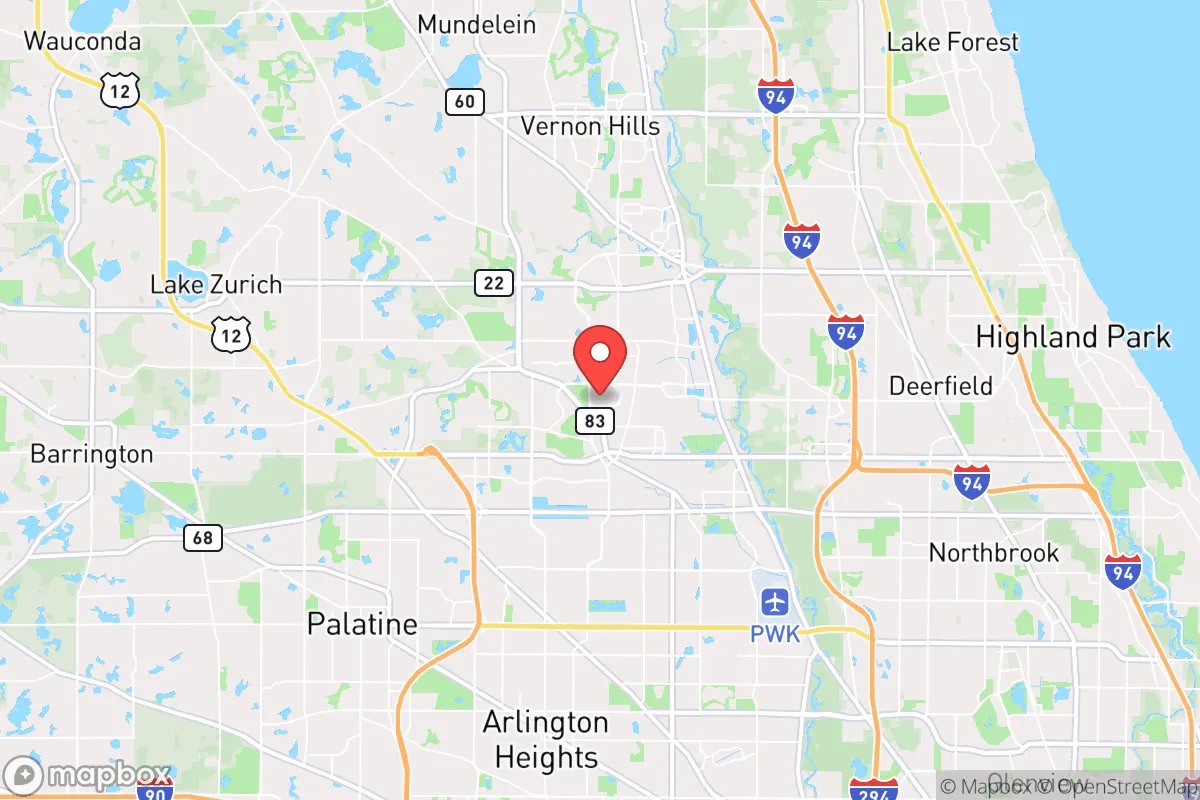
Photo: Wikipedia
Personal Sovereignty in Buffalo Grove, IL
Viable for self-reliance. Generally workable, though some barriers may limit total independence.
What does Personal Sovereignty tell us?
Personal Sovereignty measures your capacity for self-reliance and independence with minimal government friction. Higher scores mean fewer barriers between you and the way you want to live... but it assumes you have the space you need and good neighbors.
What does this tell us?
Personal Sovereignty measures your capacity for self-reliance and independence with minimal government friction. Higher scores mean fewer barriers between you and the way you want to live... but it assumes you have the space you need and good neighbors.
State Policy
Energy independence: Importer (45% of energy produced in-state)
Personal Liberty
Homesteading

Personal Liberty Analysis
Buffalo Grove, Illinois, presents a challenging environment for those prioritizing personal sovereignty, as the state’s legal and regulatory framework consistently prioritizes collective mandates over individual autonomy. While the village itself offers a safe, well-maintained suburban setting, residents must navigate a dense web of state-level controls that directly impact self-reliance, self-defense, and financial independence. For a conservative-leaning individual or family evaluating this area from a survivalist or prepper perspective, the core question is whether the benefits of a stable, resource-rich community outweigh the significant erosion of personal freedoms inherent in Illinois law.
Tax burden and regulatory posture: How Illinois law impacts your financial independence
Illinois imposes one of the heaviest tax burdens in the nation, and Buffalo Grove residents feel this acutely. The state’s flat income tax rate of 4.95% is compounded by some of the highest property taxes in the country. In Buffalo Grove, effective property tax rates often exceed 2.5% of a home’s assessed value annually, meaning a $400,000 home can carry a tax bill of over $10,000 per year. This is not a one-time cost; it is a permanent, escalating lien on your property and a direct transfer of your wealth to government entities. The state’s regulatory posture is equally aggressive, with a thicket of licensing, permitting, and environmental regulations that can stifle small-scale business ventures and home-based enterprises. For a prepper seeking to build a self-sufficient workshop, operate a side business, or even keep a few chickens for eggs, the local zoning and state health codes can be prohibitive. The state’s pension crisis and persistent budget deficits signal that these tax burdens are unlikely to decrease, making long-term financial sovereignty a constant uphill battle.
Self-defense and gun law specifics: Navigating Illinois’ restrictive firearms environment
For anyone serious about personal and family security, Illinois’ gun laws are a major liability. The state requires a Firearm Owners Identification (FOID) card for mere possession of firearms or ammunition, a system that creates a government registry of gun owners and introduces delays and potential denial of a constitutional right. The concealed carry licensing process is expensive, time-consuming, and requires 16 hours of state-approved training. More critically, Illinois enacted a ban on so-called “assault weapons” and high-capacity magazines in 2023, effectively criminalizing the ownership of many common semi-automatic rifles and standard-capacity magazines that are legal in most other states. This law directly limits the tools available for home defense and community protection in a crisis scenario. While Buffalo Grove itself is a low-crime area, the legal framework means that a resident’s ability to defend their home with the most effective means is severely curtailed by state mandate. The legal risk of non-compliance is high, and the political climate in Springfield shows no sign of reversing these restrictions.
Self-reliance and homesteading viability: Lot sizes, zoning, and off-grid feasibility
Buffalo Grove is a classic post-war suburb, and its zoning and lot sizes reflect that. The vast majority of homes sit on quarter-acre or smaller lots, with strict homeowners’ association (HOA) covenants and village ordinances governing everything from lawn height to the types of structures allowed. True homesteading—raising livestock, maintaining a large garden, or installing solar panels for significant energy independence—is largely impractical. Most lots cannot support a well or septic system, as the village is fully connected to municipal water and sewer. Off-grid living, such as disconnecting from the power grid or installing a composting toilet, would almost certainly violate building codes and HOA rules. The village’s tree-lined streets and manicured lawns offer a pleasant aesthetic, but they represent a landscape of enforced conformity that is antithetical to the prepper ideal of self-sufficiency. For those seeking to grow a substantial portion of their own food, harvest rainwater, or establish a defensible perimeter, Buffalo Grove’s suburban density is a significant constraint.
Personal liberties: Parental rights, medical autonomy, speech, and property
On several fronts, Illinois law actively undermines personal liberties that many conservatives consider fundamental. Parental rights have been weakened by state mandates that allow minors to access certain medical procedures, including reproductive health services and gender transition care, without parental consent. The state’s education code also requires schools to adopt policies that can override parental authority on matters of student identity. Medical autonomy was severely tested during the COVID-19 pandemic, with Illinois imposing some of the nation’s longest-lasting mask mandates, vaccine requirements for certain workers, and business closures. The state’s public health powers remain broad, and there is little legal protection for individuals who refuse future mandates based on personal conscience or medical judgment. Free speech is generally protected, but local ordinances in Buffalo Grove and surrounding Cook County can restrict certain forms of political expression, such as signage on private property, through size and placement rules. Property rights are compromised by the state’s aggressive use of eminent domain and by environmental regulations that can limit what you do on your own land, from tree removal to building a fence. The cumulative effect is a legal environment where the state’s authority is presumed to supersede individual choice in nearly every domain.
In the broader context of the Midwest and the nation, Buffalo Grove offers a stable, low-crime, and well-resourced community, but it does so at the cost of significant personal sovereignty. For a survivalist or prepper, the area’s strengths—access to healthcare, supply chains, and a strong social fabric—are real, but they are offset by a state government that is actively hostile to self-defense, financial independence, and parental authority. Compared to a state like Indiana or Wisconsin, where property taxes are lower, gun laws are more permissive, and local control is stronger, Buffalo Grove represents a trade-off: security in the present, but a diminished capacity to act independently in a crisis. For those who prioritize autonomy above all else, this suburb is a comfortable cage, not a bastion of freedom.

* Values derived from national, state, county, city and local statistics and may differ in a specific area. Last updated: 2026-04-23T15:54:49.000Z
Narrative content on this page is AI-generated and may contain mistakes. Verify any details that matter before acting on them.
ReloMaps may earn a commission from affiliate links at no extra cost to you.

