Photo: Wikipedia
Demographics of Buffalo, WY
Affluence Level in Buffalo, WY
A middle-class area roughly in line with national averages across income, home values, education, and employment.
People of Buffalo, WY
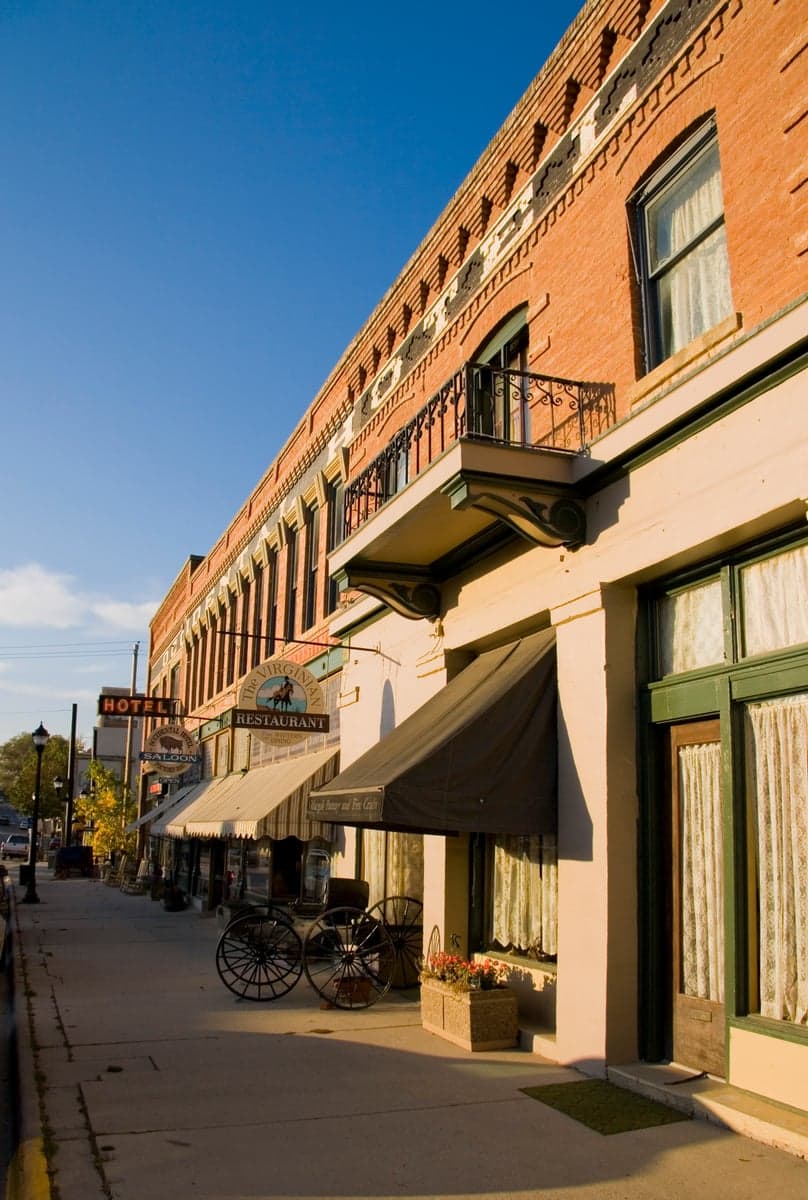
Buffalo, Wyoming, is a small, predominantly white community of 4,516 residents where 91.5% of the population identifies as white alone. The city maintains a distinctly Western, ranching-oriented character, with a foreign-born population of just 0.5% and a median age that skews older than the national average. Its residents are overwhelmingly native-born, and the city's identity is rooted in a deep sense of local history and self-reliance.
How the city was settled and grew
Buffalo was founded in 1879 as a railroad town and supply center for the surrounding cattle ranches, a direct result of the expansion of the Fremont, Elkhorn and Missouri Valley Railroad. The original population was a mix of Anglo-American cattle ranchers, homesteaders, and a small number of European immigrants, primarily of German and Scandinavian descent, who were drawn by the promise of open range and the 1862 Homestead Act. The historic downtown district, centered on Main Street, was built by these early settlers and remains the city's commercial and social core. The West Side neighborhood, with its older, modest homes, was the original residential area for railroad workers and tradesmen. By the early 20th century, the city had stabilized as a quiet agricultural hub, with little new immigration after the initial boom. The population remained overwhelmingly white and native-born through the mid-20th century, with growth driven primarily by natural increase and the consolidation of nearby ranching families into town.
Modern era (post-1965)
After the 1965 Immigration and Nationality Act, Buffalo saw virtually no demographic change. The city's foreign-born population remains at 0.5%, and its racial composition has held steady at over 90% white. The small Hispanic population (3.5%) is largely composed of families who have lived in the region for generations, working on ranches or in local services, and they are concentrated in the South Main area and in scattered rural properties just outside city limits. The Indian subcontinent population (1.0%) is a very recent addition, likely tied to a handful of professionals working at the Johnson County Healthcare Center or in remote tech roles; they do not form a distinct neighborhood enclave. The Lakeview and Bighorn subdivisions, built from the 1980s onward, have absorbed most new domestic in-migrants—retirees from Colorado and the Midwest, and a small number of remote workers seeking a lower cost of living. These subdivisions are almost entirely white and have reinforced the city's existing demographic profile rather than diversifying it.
The future
Buffalo's population is projected to remain stable or grow very slowly, with no major industrial or immigration-driven expansion on the horizon. The city is homogenizing further as younger, college-educated residents (30.9% have a bachelor's degree or higher) leave for larger job markets, while retirees continue to move in. The Indian subcontinent population may grow slightly if the healthcare sector expands, but it will remain a tiny fraction of the total. The Hispanic population is plateauing, with no significant new arrivals. The city is not tribalizing into distinct ethnic enclaves; instead, it is becoming a more uniformly white, older, and politically conservative community. The Clear Creek corridor and the Airport Road area are likely to see the most new residential construction, but these will cater to the same demographic: domestic migrants seeking a quiet, rural lifestyle.
For someone moving in now, Buffalo is a stable, culturally homogeneous place where the population is not diversifying. The city offers a strong sense of community and low crime, but newcomers should expect little ethnic or cultural variety and a population that is aging in place. The next decade will likely see a continued slow decline in the school-age population and a steady influx of retirees, reinforcing the city's existing character rather than transforming it.

* Values derived from national, state, county, city and local statistics and may differ in a specific area. Last updated: 2026-10-10T16:26:45.000Z
Narrative content on this page is AI-generated and may contain mistakes. Verify any details that matter before acting on them.
ReloMaps may earn a commission from affiliate links at no extra cost to you.

