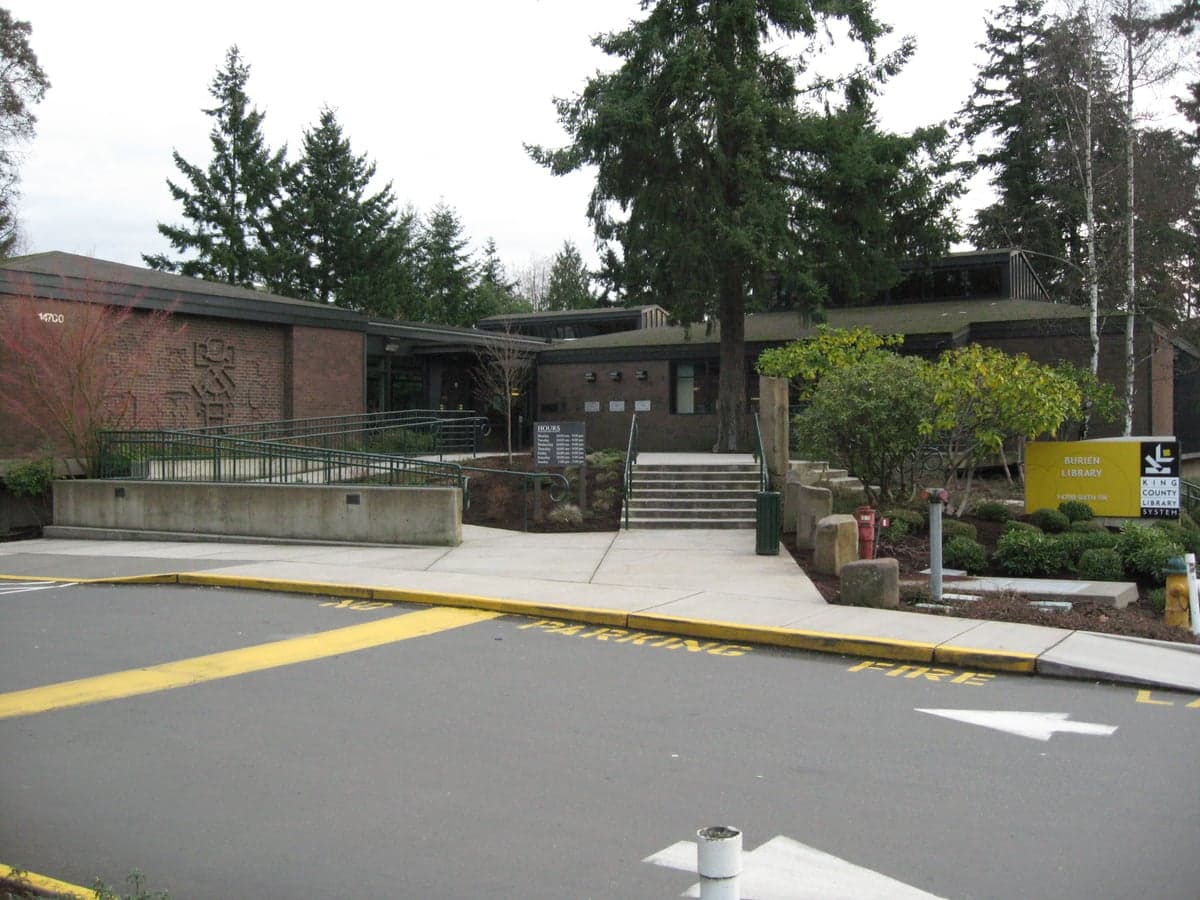
Photo: Wikipedia
Demographics of Burien, WA
Affluence Level in Burien, WA
A middle-class area roughly in line with national averages across income, home values, education, and employment.
People of Burien, WA
The people of Burien, Washington, today form a densely packed, racially diverse suburb of roughly 51,000 residents, distinct from Seattle’s core yet deeply tied to it economically. The city is a majority-minority community where no single ethnic group holds a numerical majority, with a notable East/Southeast Asian population of 13.8% and a Hispanic population of 23.1%. Its character is working- to middle-class, with a 31.5% college-educated rate that trails the Seattle metro average, and a foreign-born share of 13.7% that reflects ongoing immigration. Burien feels less like a bedroom community and more like a self-contained town with its own commercial spine along Ambaum Boulevard and a growing downtown core around Town Square.
How the city was settled and grew
Burien’s human history begins with the Duwamish and Coast Salish peoples, who used the area for seasonal fishing and gathering along the Puget Sound shoreline. White settlement began in the 1850s with homesteaders drawn to the dense timber and fertile soil, but the town remained a scattering of farms and logging camps until the early 20th century. The arrival of the Seattle-Tacoma Interurban railway in 1902 spurred the first real wave of growth, attracting Scandinavian and German immigrant families who cleared land for dairy farms and truck gardens. These early settlers concentrated in what is now Olde Burien, the historic core around SW 152nd Street, and in the Lake Burien neighborhood, where small summer cottages gave way to year-round homes. By the 1940s, Boeing’s wartime expansion drew a second wave of domestic migrants—Midwesterners and Southerners—who settled in the Seahurst and Glendale neighborhoods, building modest single-family homes on former farmland. Burien incorporated as a city only in 1993, making it a genuinely post-1900 suburb that skipped the colonial era entirely.
Modern era (post-1965)
The 1965 Hart-Cellar Act reshaped Burien’s population. The first post-1965 arrivals were Filipino and Korean immigrants, many employed in healthcare and hospitality, who clustered in the Boulevard Park area near Sea-Tac Airport. By the 1980s, Vietnamese refugees—part of the post-war boat people wave—joined them, opening restaurants and grocery stores along Ambaum Boulevard. Hispanic migration accelerated in the 1990s and 2000s, driven by construction and service jobs; today, the North Highline unincorporated area (annexed by Burien in phases) and the Hilltop neighborhood have the highest Hispanic concentrations. Black residents, 7.0% of the population, arrived primarily from other U.S. cities during the 1990s and 2000s, drawn by lower housing costs relative to Seattle. The Indian-subcontinent population (1.2%) is a smaller, more recent cohort, mostly professionals in tech and healthcare who live in the newer developments near Three Tree Point. White residents, now 47.9%, have aged in place in Seahurst and Olde Burien, while younger white families have been priced out of Seattle and are moving into the Gregory Heights area. The result is a city of distinct ethnic enclaves rather than a fully integrated melting pot.
The future
Burien’s population is heading toward greater diversity, but not necessarily toward homogenization. Hispanic and East/Southeast Asian communities are growing steadily through both immigration and higher birth rates, while the white share is declining slowly. The Indian-subcontinent population, though small, is likely to grow as tech workers seek affordable alternatives to Seattle’s Eastside. The city is not tribalizing into hostile camps, but neighborhoods remain ethnically distinct: Boulevard Park is heavily Asian and Hispanic, Seahurst remains predominantly white, and North Highline is majority Hispanic. The next 10-20 years will likely see continued infill development—townhouses and small apartment buildings replacing older single-family homes—which will attract younger, more diverse households. The foreign-born share may rise modestly, but the bigger story is the aging of the white population and the youth of the Hispanic and Asian cohorts, which will shift the median age downward and the school-age population upward.
For someone moving in now, Burien is becoming a denser, more polyglot suburb that offers a middle-class alternative to Seattle’s high costs. It is not a place of rapid gentrification or white flight, but of steady demographic churn where immigrant communities are putting down roots and building institutions. The city’s identity is still forming, and its future will be shaped by whether these distinct enclaves integrate or remain separate. For a conservative-leaning newcomer, the key takeaway is that Burien is a working-class town with a strong sense of local place, where the politics lean left but the daily life is pragmatic and family-oriented.

* Values derived from national, state, county, city and local statistics and may differ in a specific area. Last updated: 2026-04-21T11:01:26.000Z
Narrative content on this page is AI-generated and may contain mistakes. Verify any details that matter before acting on them.
ReloMaps may earn a commission from affiliate links at no extra cost to you.

