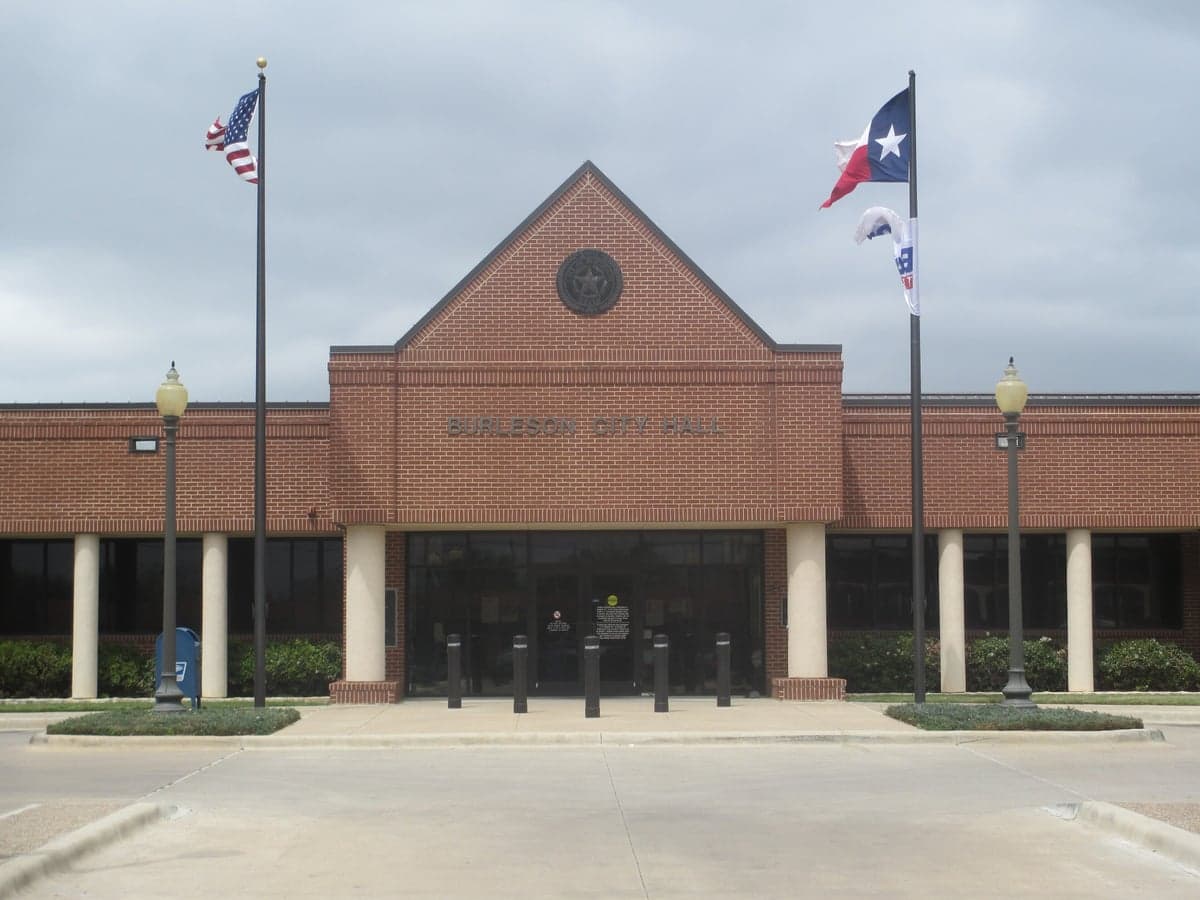
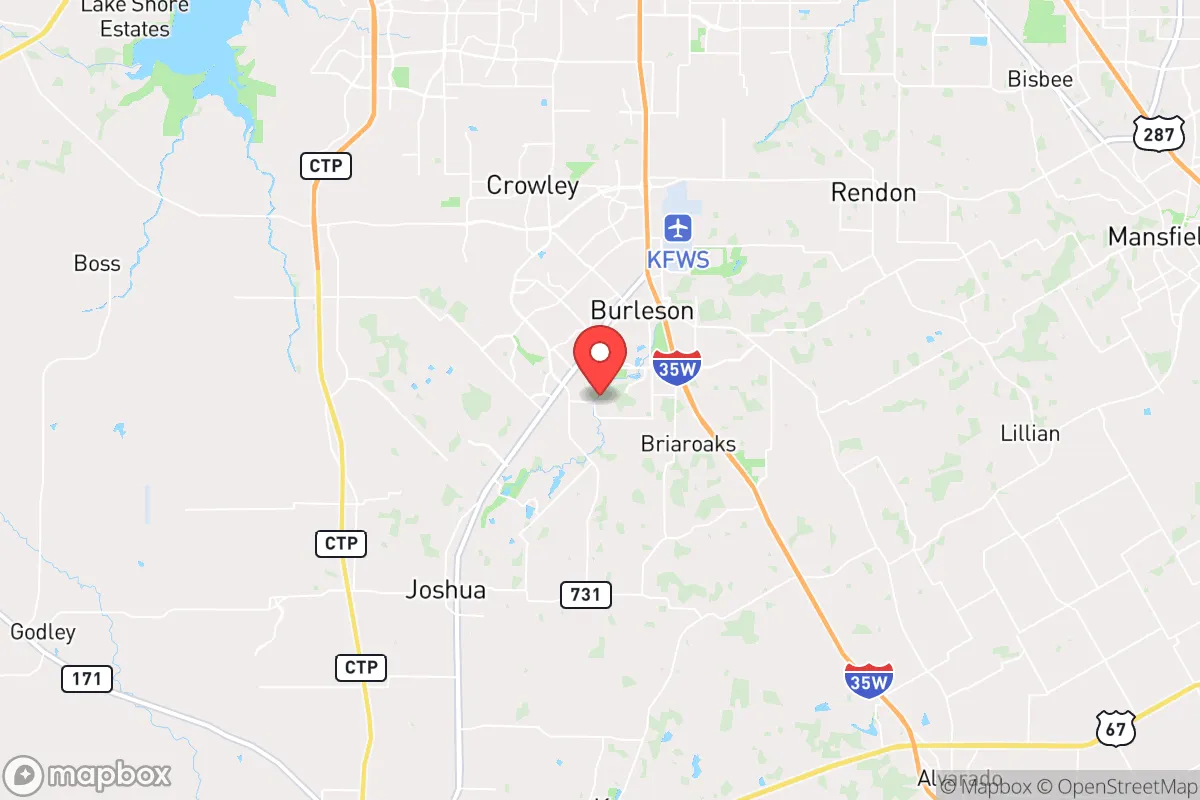
Photo: Wikipedia
Demographics of Burleson, TX
Affluence Level in Burleson, TX
A middle-class area roughly in line with national averages across income, home values, education, and employment.
People of Burleson, TX
The people of Burleson, Texas today number just over 50,000, forming a predominantly white (69.0%) and increasingly Hispanic (19.4%) community that blends small-town Southern roots with suburban growth. The city’s identity is shaped by its position as a bedroom community for Fort Worth and Dallas, with a foreign-born population of only 1.9%—well below the national average—and a college-educated rate of 30.8%. Burleson retains a distinctly family-oriented, conservative character, reflected in its low crime rates and strong local school system, while its demographic shifts are slowly diversifying a historically homogenous population.
How the city was settled and grew
Burleson was founded in the 1880s as a railroad stop along the Gulf, Colorado and Santa Fe Railway, named after Dr. Rufus C. Burleson, a prominent Baptist educator and former president of Baylor University. The original settlers were Anglo-American farmers and ranchers drawn by the fertile Blackland Prairie soil and the promise of rail access to markets. The town incorporated in 1907 with fewer than 500 residents, and its early economy revolved around cotton, corn, and livestock. The historic Old Town Burleson district, centered around Renfro Street and the railroad depot, became the heart of the community, where merchants, blacksmiths, and cotton ginners set up shop. A small African American population, primarily working as sharecroppers and domestic laborers, settled in the Briarwood area east of the tracks, though segregation kept the community largely separate until the mid-20th century. The city remained a quiet farming town through the 1940s, with population hovering around 1,000, as the Great Depression and Dust Bowl slowed growth across the region.
Modern era (post-1965)
The post-1965 era transformed Burleson from a rural hamlet into a fast-growing suburb, driven by the expansion of the Dallas-Fort Worth metroplex and the completion of Interstate 35W in the 1970s. Domestic in-migration from other parts of Texas and the Midwest surged, as families sought affordable housing and shorter commutes to Fort Worth’s defense and aerospace jobs. The Hidden Creek subdivision, developed in the 1980s, absorbed many of these new arrivals—mostly white middle-class families—while the Briarwood area saw modest growth among Black residents, though the African American share has remained stable at 5.2% since 2000. The Hispanic population began rising noticeably in the 1990s, settling primarily in the West Burleson corridor near Highway 174, drawn by construction and service-sector jobs. This wave was largely domestic (Texas-born Hispanic families moving from South Texas and the Rio Grande Valley), not foreign-born, which explains the city’s very low 1.9% foreign-born rate. East/Southeast Asian residents (0.9%) and Indian-subcontinent residents (0.4%) arrived later, mostly as professionals in healthcare and engineering, and are concentrated in newer developments like Chisenhall Fields and Summercrest, built after 2000. The city’s population exploded from 7,000 in 1980 to over 50,000 by 2025, with most growth occurring in the last two decades.
The future
Burleson’s population is heading toward greater Hispanic representation, projected to reach 25-28% by 2040, driven by natural increase and continued domestic migration from Texas’s Hispanic-majority regions. The white share will likely decline to around 60-63%, while the Black and Asian shares are expected to grow slowly, each reaching 6-7% and 2-3% respectively, as the city’s affordability attracts a more diverse workforce from the metroplex. The foreign-born rate may rise to 3-4% but will remain low compared to national averages, as Burleson lacks the industrial or agricultural magnets that draw large immigrant populations. The city is not tribalizing into distinct ethnic enclaves; rather, newer subdivisions like Summercrest and Chisenhall Fields are economically integrated, with Hispanic and white families living side by side. However, Old Town and Briarwood remain more homogenous—older, whiter, and less affluent—while West Burleson is emerging as a Hispanic-majority corridor. The next decade will see Burleson become slightly more diverse but retain its core identity as a conservative, family-oriented suburb where homeownership and school quality drive decisions.
For someone moving in now, Burleson offers a stable, low-diversity community with a strong sense of local identity, where the dominant culture is white, Southern, and evangelical Protestant, and where Hispanic growth is assimilating into the suburban mainstream rather than creating separate enclaves. The city is becoming more diverse at a measured pace, but it remains a place where newcomers—especially those from outside Texas—will find a welcoming but culturally cohesive environment centered on family, faith, and fiscal conservatism.

* Values derived from national, state, county, city and local statistics and may differ in a specific area. Last updated: 2026-04-28T18:30:44.000Z
Narrative content on this page is AI-generated and may contain mistakes. Verify any details that matter before acting on them.
ReloMaps may earn a commission from affiliate links at no extra cost to you.

