Photo: Wikipedia
Demographics of Caliente, NV
Affluence Level in Caliente, NV
A middle-class area roughly in line with national averages across income, home values, education, and employment.
People of Caliente, NV
Caliente, Nevada, is a small, tight-knit railroad town of 613 residents where 84.3% of the population is White, 4.4% is Black, and 2.6% is Hispanic. With a foreign-born population of just 0.2% and a college attainment rate of 21.2%, the city remains overwhelmingly native-born and working-class, its identity still shaped by the railroad and ranching heritage that defined its founding. The population is aging and slowly declining, with few signs of significant demographic change on the horizon.
How the city was settled and grew
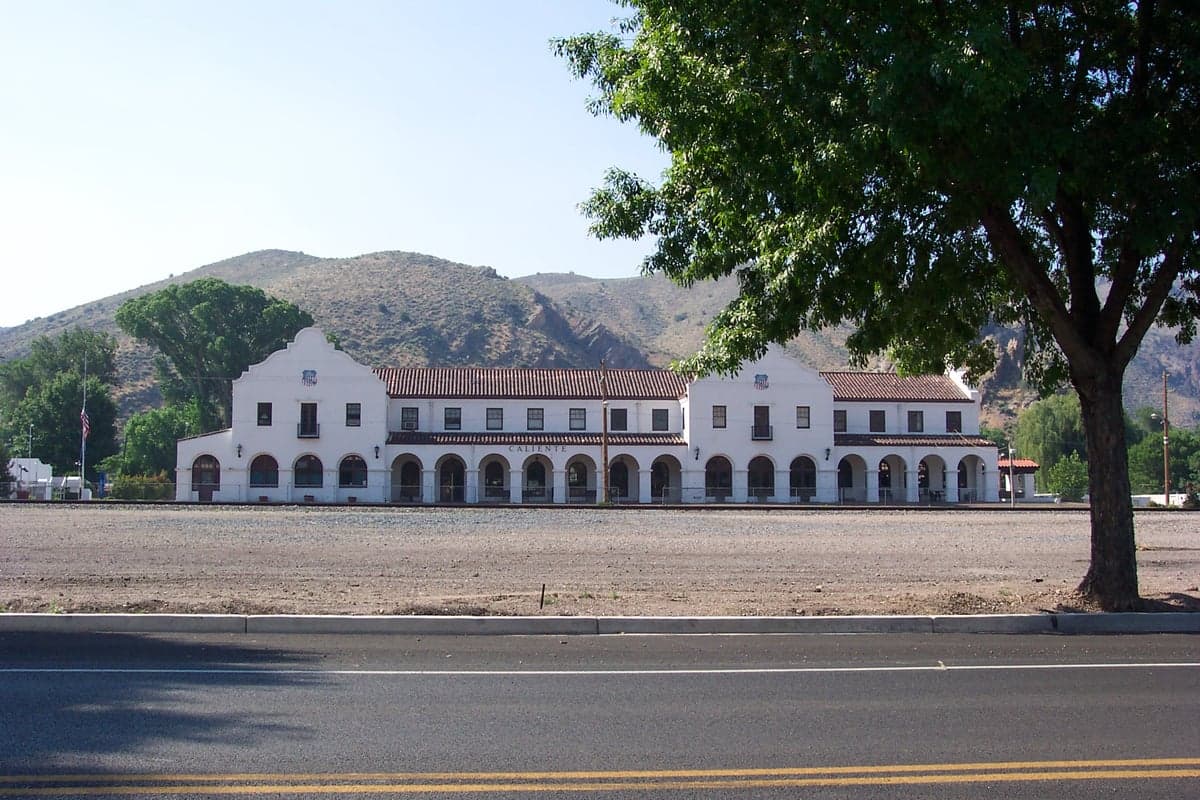
Caliente was born as a railroad town in the early 1900s, when the San Pedro, Los Angeles & Salt Lake Railroad (later Union Pacific) built a major depot and maintenance yard here. The town was officially platted in 1901, and the railroad brought the first wave of settlers: skilled mechanics, engineers, and track laborers, predominantly of European descent. The original residential core, known as Depot Hill, grew up around the rail yard on the east side of the tracks, where Irish and Italian immigrant workers built modest wood-frame houses. A second neighborhood, West Caliente, developed west of the tracks on higher ground, housing railroad supervisors and local merchants. The town's economy remained almost entirely railroad-dependent through the 1950s, with a small ranching and mining support sector. No significant land grants or homesteading waves occurred; Caliente was a company town from the start.
Modern era (post-1965)
After the 1965 Hart-Cellar Act, Caliente saw virtually no immigration wave. The foreign-born share today is 0.2%, meaning the town's demographic composition has been shaped almost entirely by domestic migration and natural change. The railroad's decline as a major employer after the 1970s triggered a slow out-migration of younger families, leaving an older, predominantly White population. The small Black population (4.4%) is largely descended from railroad workers who settled in South Caliente, a neighborhood of smaller homes near the old roundhouse. The Hispanic population (2.6%) is concentrated in scattered rental properties along Front Street, many working in seasonal ranching or highway maintenance. No significant suburbanization occurred; the town's built footprint has not expanded since the 1960s. The college-educated share of 21.2% is below the national average, reflecting the limited white-collar job base.
The future
Caliente's population is projected to continue a slow decline, with no major employer or migration wave on the horizon. The town is homogenizing rather than diversifying: the White share has remained stable above 80% for decades, and the small Black and Hispanic populations are not growing. The foreign-born share of 0.2% is effectively zero, and no immigrant community is emerging. The Caliente Creek Estates subdivision, a small development of manufactured homes on the north edge, has attracted a few retirees from Las Vegas and rural Utah, but this inflow is too small to reverse population loss. The next 10-20 years will likely see a continuation of the current trend: an older, whiter, and smaller population, with the remaining young adults leaving for job opportunities in Las Vegas or St. George, Utah.
For a conservative-leaning single individual or parent considering a move, Caliente offers a stable, low-crime, and culturally homogeneous environment where nearly everyone is native-born and English-speaking. The trade-off is a shrinking job market, limited educational opportunities, and a population that is aging faster than it is replacing itself. This is a town for those seeking quiet, predictability, and a strong sense of local history, not for those looking for demographic diversity or economic growth.

* Values derived from national, state, county, city and local statistics and may differ in a specific area. Last updated: 2026-05-03T20:32:23.000Z
Narrative content on this page is AI-generated and may contain mistakes. Verify any details that matter before acting on them.
ReloMaps may earn a commission from affiliate links at no extra cost to you.

