Photo: Wikipedia
Demographics of Cambridge, VT
Affluence Level in Cambridge, VT
A middle-class area roughly in line with national averages across income, home values, education, and employment.
People of Cambridge, VT
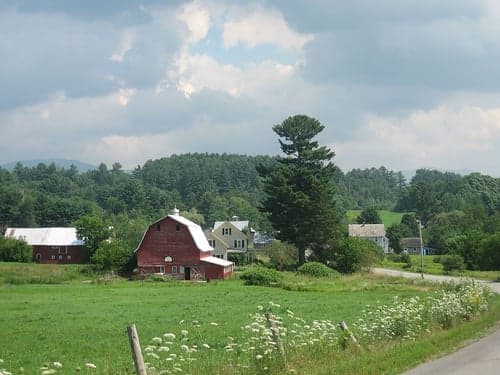
The people of Cambridge, Vermont, today form a small, tight-knit community of roughly 173 residents, characterized by its overwhelming racial homogeneity and a strong rural, family-oriented identity. With 86.7% of the population identifying as White and a foreign-born share of just 0.6%, the village remains one of the least diverse places in Lamoille County. Its distinctive markers are a quiet, agrarian lifestyle, a high proportion of college-educated residents (37.1%), and a population that has changed little in composition over the past century, making it a stable but aging enclave for those seeking seclusion and tradition.
How the city was settled and grew
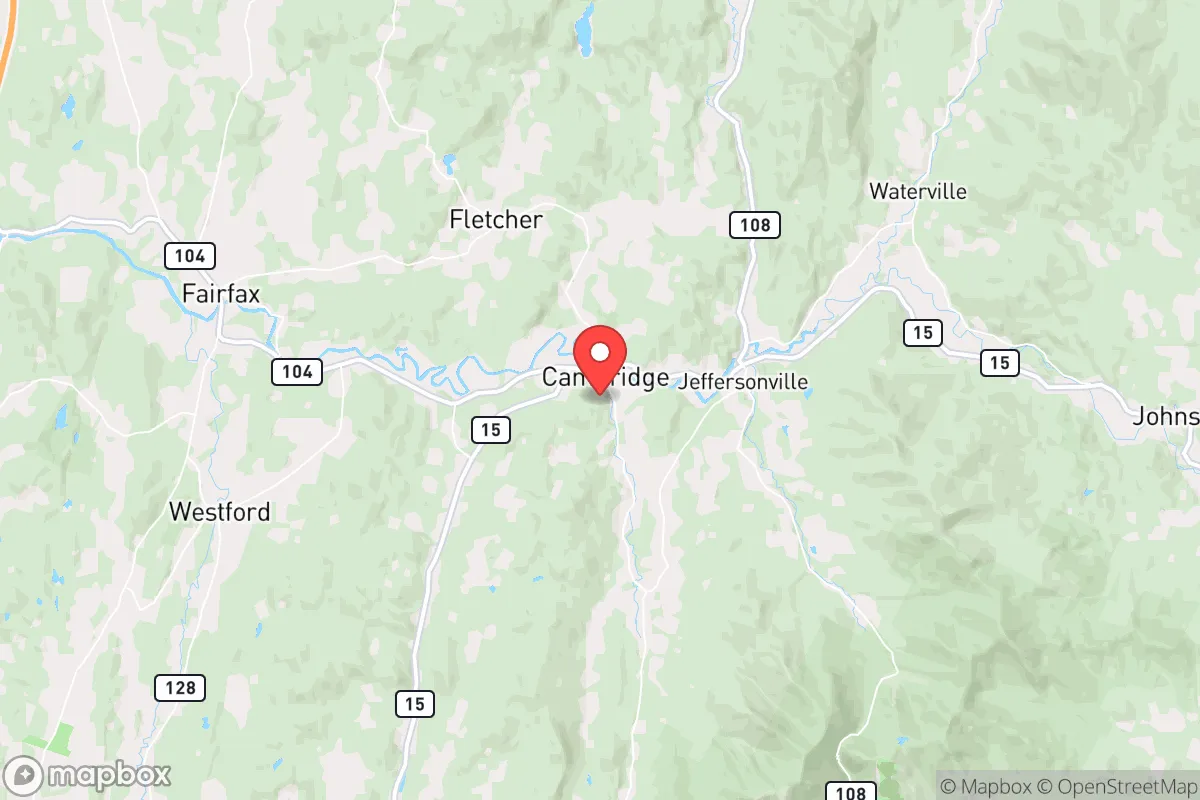
Cambridge was chartered in 1781 as part of the New Hampshire Grants, with the first permanent settlers arriving in the 1790s from southern New England, primarily Massachusetts and Connecticut. These early families were drawn by the promise of fertile river valleys and timber-rich hillsides, establishing subsistence farms and small mills along the Lamoille River. The village core, known as Cambridge Village, grew around the junction of the river and the main stagecoach road, hosting a handful of merchants, blacksmiths, and a church. A second settlement cluster, Jeffersonville, emerged about two miles north, centered on a sawmill and gristmill, and would later become the commercial hub of the town. Throughout the 19th century, population growth was slow and organic, fueled by natural increase and a trickle of Yankee farmers. The arrival of the Vermont Central Railroad in the 1850s briefly spurred a small Irish and French-Canadian laboring population, but these groups largely moved on after construction ended, leaving the village overwhelmingly Anglo-American. By 1900, Cambridge’s population had plateaued at around 200, a figure that would remain remarkably stable for the next 120 years.
Modern era (post-1965)
The post-1965 period brought no significant demographic transformation to Cambridge. Unlike many Vermont towns that saw an influx of out-of-state migrants during the back-to-the-land movement of the 1970s, Cambridge’s remote location and limited housing stock kept new arrivals to a minimum. The village’s population actually dipped slightly in the 1980s and 1990s as young adults left for college and did not return. The few newcomers who did arrive were overwhelmingly White, domestic migrants from other parts of New England, drawn by affordable land and a quiet lifestyle. These families settled in the existing neighborhoods of Cambridge Village and Jeffersonville, as well as along the rural roads leading to Pleasant Valley and Waterville, where they renovated old farmhouses. The 0.6% Asian and 3.5% Hispanic populations recorded in recent data are almost entirely attributable to a handful of professional families who moved in during the 2010s, likely employed by the nearby ski resorts or remote-work opportunities. There is no evidence of any Black, Indian, or Arab population in the village. The foreign-born share of 0.6% represents just one or two individuals, making Cambridge one of the least immigrant-receiving places in Vermont.
The future
Cambridge’s population is heading toward continued stability with a risk of slow decline. The village’s age structure is older than the state average, and the lack of rental housing and employment opportunities means few young families are moving in. The 37.1% college-educated rate is high for a village this size, but it reflects a population that is increasingly retired or telecommuting, not a sign of economic dynamism. The Hispanic share, while small, may grow slightly as service workers from the broader Lamoille County area seek affordable housing, but Cambridge’s zoning and housing stock offer few entry points. The Asian population is likely to remain negligible. There is no trend toward tribalization into distinct enclaves; the village is too small and too homogeneous for that. Instead, the population is slowly homogenizing further as older residents age in place and the few non-White residents either leave or assimilate fully. The next 10-20 years will likely see a flat or slightly declining population, with the village becoming even more of a bedroom community for workers in Stowe and Burlington.
For someone moving in now, Cambridge offers a stable, safe, and deeply traditional community where neighbors know each other and change comes slowly. The trade-off is a lack of diversity, limited services, and a population that is not growing. It is a place for those who value seclusion and continuity over opportunity and variety.

* Values derived from national, state, county, city and local statistics and may differ in a specific area. Last updated: 2026-04-30T13:05:00.000Z
Narrative content on this page is AI-generated and may contain mistakes. Verify any details that matter before acting on them.
ReloMaps may earn a commission from affiliate links at no extra cost to you.

