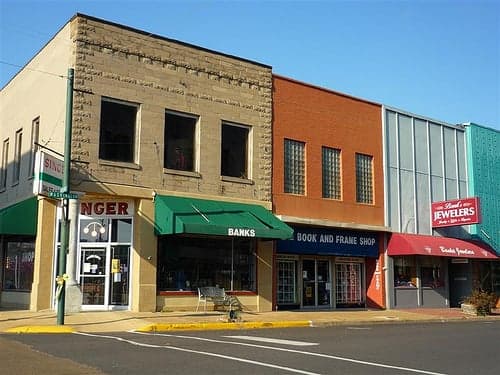
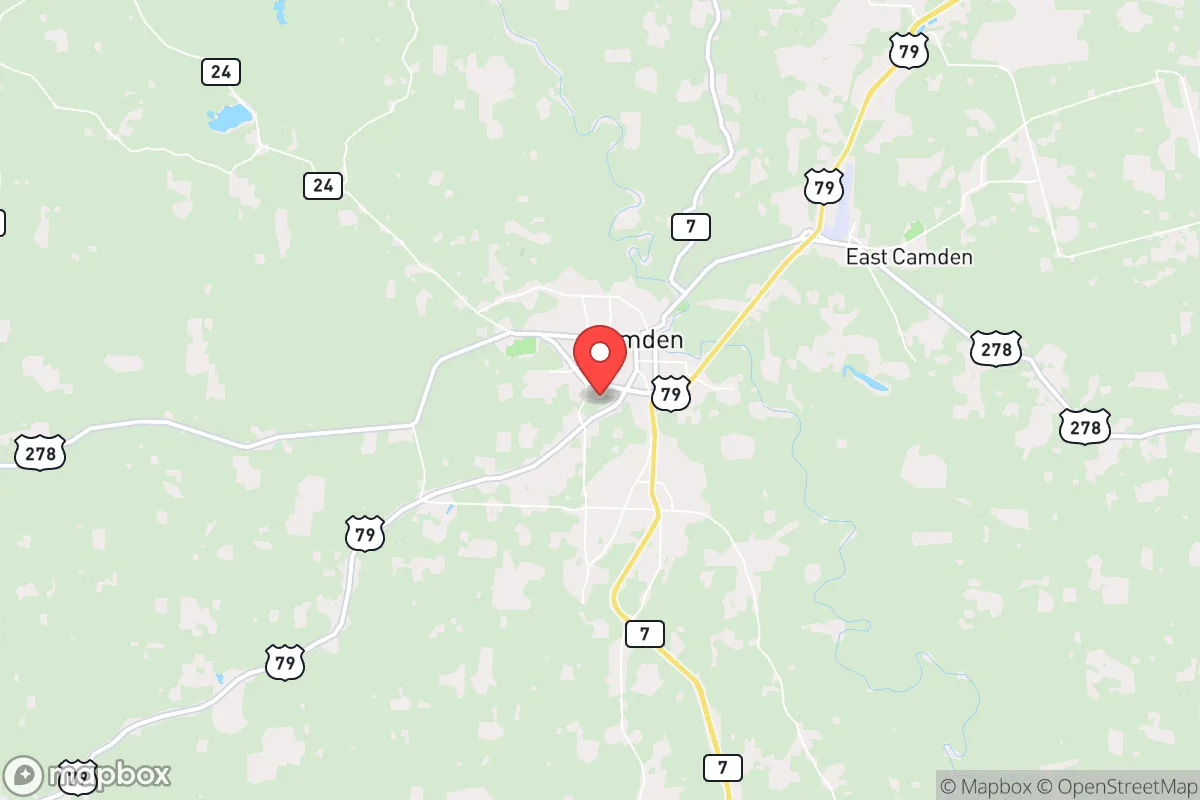

Photo: Wikipedia
Demographics of Camden, AR
Affluence Level in Camden, AR
A below-average socioeconomic profile. Incomes, home values, and educational attainment trail the U.S., with higher poverty and unemployment.
People of Camden, AR
The people of Camden, Arkansas today form a majority-Black community of just over 10,400 residents, shaped by deep Southern roots and a quiet, family-oriented character. With a foreign-born population of only 0.3%, this is one of the most native-born cities in the state, where nearly 53% of residents identify as Black or African American and 42% as White, with a small but growing Hispanic share of 3.1%. The city’s identity is anchored in its historic role as a regional industrial and timber hub, and its neighborhoods still reflect the settlement patterns of the 19th and early 20th centuries.
How the city was settled and grew
Camden was founded in 1844 on the Ouachita River as a river port and trading post, drawing its first wave of settlers from the Deep South—primarily white planters and their enslaved Black laborers from Alabama, Mississippi, and Georgia. The city’s early economy revolved around cotton and timber, with the river providing a direct route to the Mississippi. The original white planter class built homes in what is now the Historic Washington Street District, a tree-lined area of antebellum and Victorian homes that remains a landmark today. Enslaved and later freed Black families settled in the Fairview and East Camden neighborhoods, which became the core of the city’s African American community. After the Civil War, the arrival of the railroad in the 1870s spurred a second wave of growth, drawing white and Black laborers to work in sawmills and cotton gins. By 1900, Camden’s population had reached roughly 3,000, with a clear racial divide: whites concentrated north of the railroad tracks in the North Camden area, while Black families remained in Fairview and along the riverfront. The discovery of oil in the nearby Smackover field in the 1920s brought a brief boom, attracting white oil workers who settled in the West Camden neighborhood, but the city’s growth slowed after the Great Depression.
Modern era (post-1965)
The post-1965 period saw Camden’s population peak at around 15,000 in the 1970s, driven by the expansion of manufacturing plants like the International Paper mill and the Camden Army Ammunition Plant. These jobs drew both white and Black workers from rural Ouachita County, but the city’s racial geography hardened. White families increasingly moved to the West Camden and North Camden subdivisions, while Black residents remained concentrated in Fairview and the East Camden corridor along Highway 79. The 1980s and 1990s brought deindustrialization: the ammunition plant downsized, and International Paper cut jobs, leading to a steady population decline from 15,000 to the current 10,427. This exodus was disproportionately white and middle-class, shifting the city’s racial balance from roughly 55% white in 1970 to 42% white today. The Hispanic population, now at 3.1%, began arriving in the 2000s, primarily as laborers in poultry processing and construction, settling in the East Camden area near the industrial parks. The Asian and Indian subcontinent populations remain negligible at 0.2% and 0.0%, respectively, reflecting the city’s lack of professional or tech-sector immigration. The college-educated share stands at just 18%, well below the national average, underscoring the city’s working-class character.
The future
Camden’s population is projected to continue its slow decline, with the city losing roughly 1-2% of residents per year since 2010. The trend is toward homogenization: the white population is aging and shrinking, while the Black population remains stable but younger. The small Hispanic community is growing slowly, but at 3.1% it is unlikely to reach a critical mass that would reshape the city’s cultural or political dynamics. The city is not tribalizing into distinct new enclaves; rather, the historic neighborhoods—Fairview, East Camden, West Camden—are becoming less racially distinct as older white residents pass away and their homes are purchased by Black families. The lack of new industry or significant in-migration means Camden will likely remain a predominantly Black, low-income, and native-born community for the next 10-20 years. The city’s future depends on whether it can attract new employers to reverse the population drain; without that, the population may fall below 9,000 by 2040.
For someone moving in now, Camden offers a deeply rooted, slow-paced Southern community where family ties and church life dominate. The racial and economic realities are straightforward: this is a majority-Black, working-class city with limited diversity and a shrinking tax base. New residents should expect a close-knit but economically challenged environment, where the historic neighborhoods still tell the story of who came, when, and why.

* Values derived from national, state, county, city and local statistics and may differ in a specific area. Last updated: 2026-04-30T02:27:03.000Z
Narrative content on this page is AI-generated and may contain mistakes. Verify any details that matter before acting on them.
ReloMaps may earn a commission from affiliate links at no extra cost to you.

