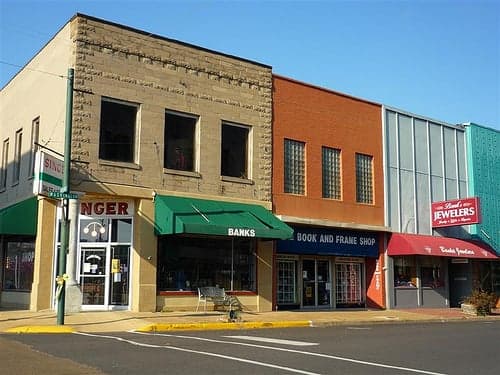
Photo: Wikipedia
Strategic Assessment of Camden, AR
Workable tactical position. Some exposure to population density or targets, but generally defensible in a crisis.
What does the Strategic Assessment tell us?
Our Strategic Assessment grades tactical survivability of an area. Major population centers, military targets, fallout zones, natural disasters, and border exposure all drive risk — lower exposure means a more defensible position in a crisis.
This is heavily inspired by Joel Skousen's Strategic Relocation book. Highly recommended you checkout the book ($)What does this tell us?
Our Strategic Assessment grades tactical survivability of an area. Major population centers, military targets, fallout zones, natural disasters, and border exposure all drive risk — lower exposure means a more defensible position in a crisis.
This is heavily inspired by Joel Skousen's Strategic Relocation book. Highly recommended you checkout the book ($)Strategic Pillars

Key Distances
Regional Safe Places
Below is our recommended "safe zones" in Arkansas and the surrounding area based on our strategic heuristics. For most people, it's unrealistic to live in a “safe zone” full-time due to work, family or other personal reasons. They tend to be more rural. However, many of these areas are perfect for second homes and retreat properties that double as a vacation home or even a short-term rental.
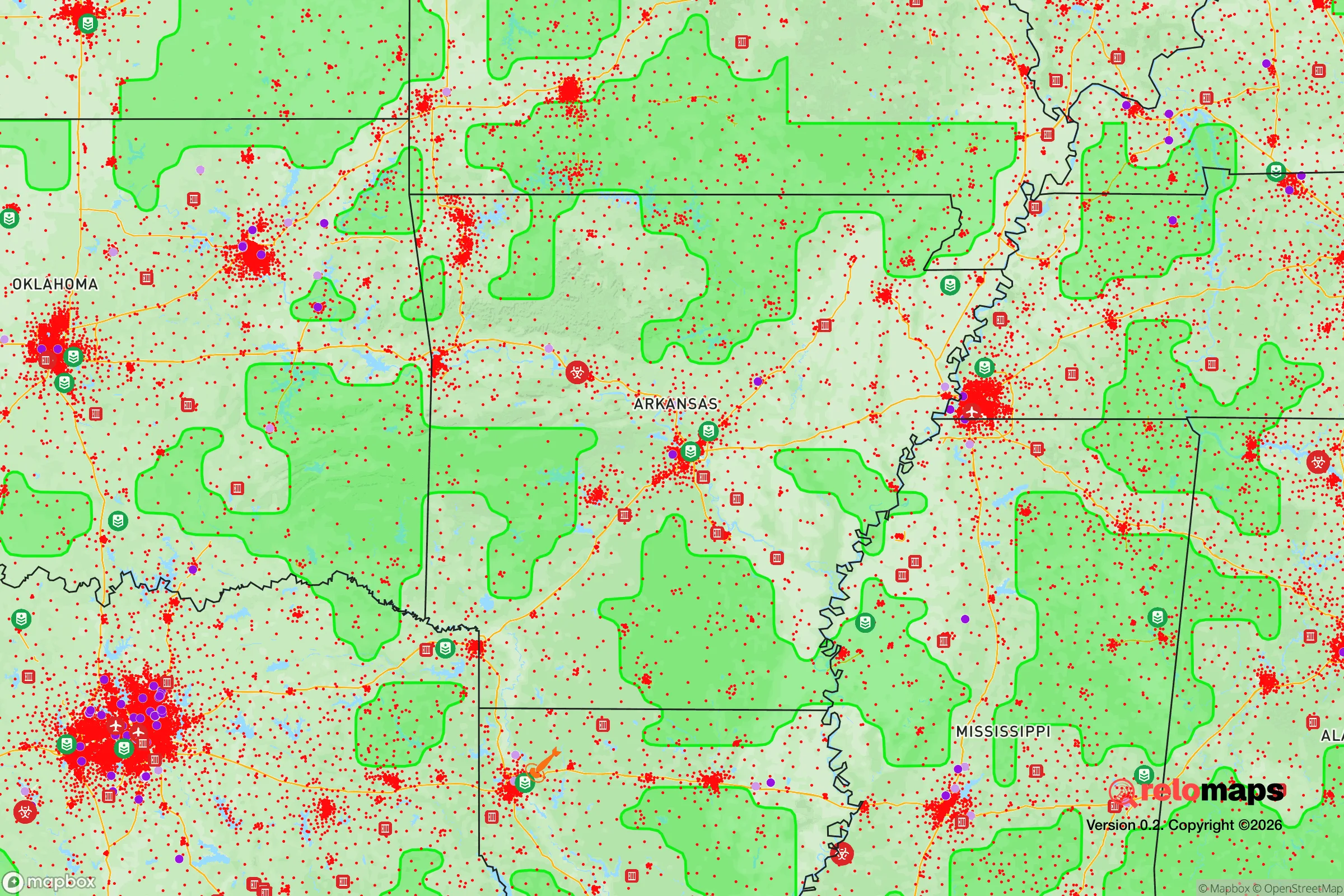
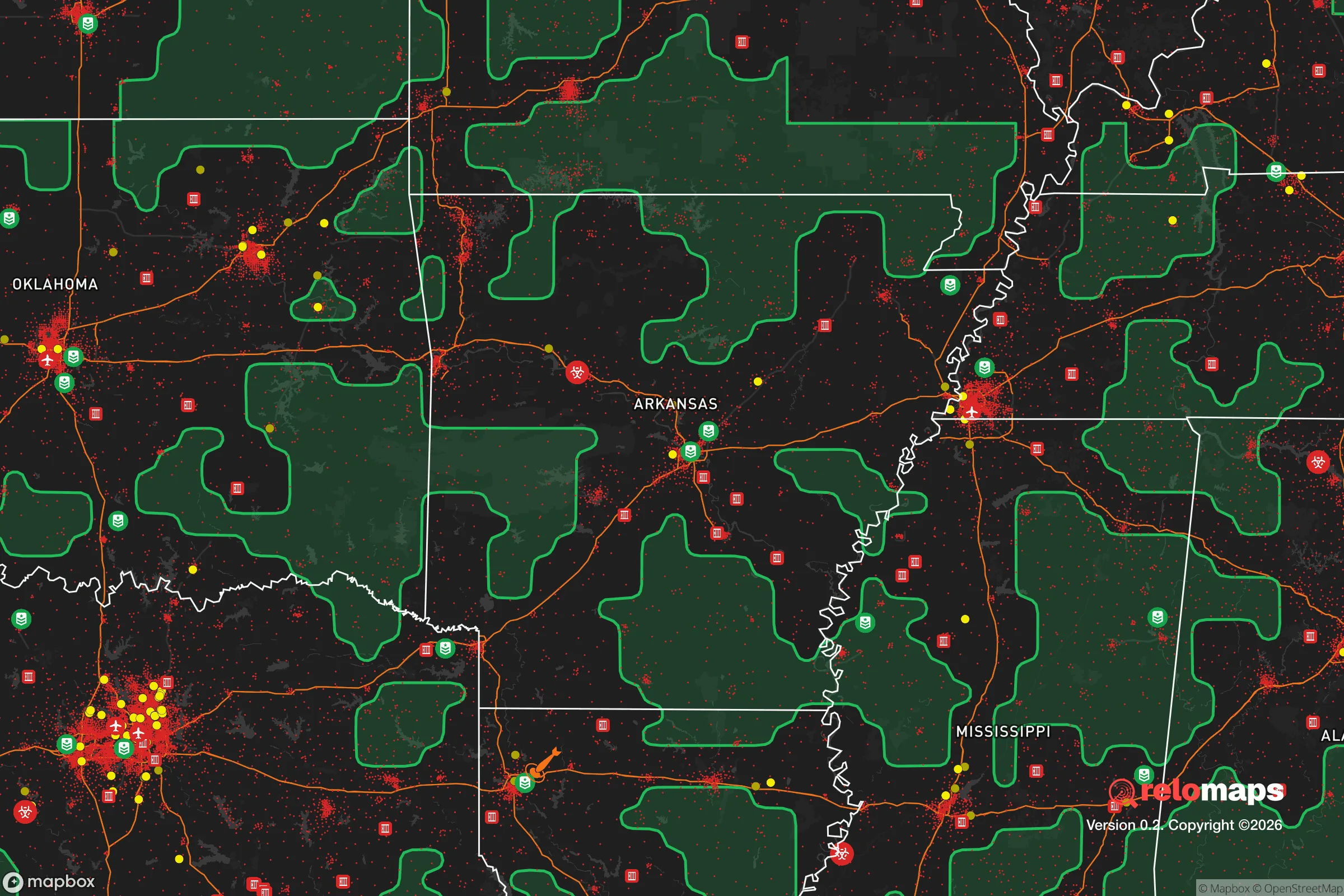


Important Note: For informational purposes only. This does not mean nothing bad ever happens in the green zones. Please use common sense. This is based on public data and modeled with AI. We tried to take a conservative approach but mistakes happen. We update this regularly as new information becomes available.
Solar Generator Recommendations
Backup power matters more here than in safer locations. We've picked three solar generators across budgets and capacity tiers — start with the budget unit if you only need a few essentials, or step up if you want to run a fridge and HVAC for days at a time.

Jackery Portable Power Station Explorer 300
Budget OptionPower on the Go: Weighing only 11 lbs, it's convenient to set up and store with book-sized foldable solar panels

BLUETTI Portable Power Station AC180
Designed for both indoor and outdoor scenarios, AC180 is highly capable as it has a robost capacity and continuous output power.

EF ECOFLOW DELTA Pro Ultra Power Station
Upgraded PickEcoFlow DELTA Pro Ultra is a whole-home energy system designed to grow with your family. Integrated with the Smart Home Panel 2, it scales to meet your evolving energy needs — keeping your home powered, intelligent, and secure through every stage of life.
We earn a commission, at no additional cost to you.
Strategic Assessment Analysis
Camden, Arkansas, offers a strategic blend of geographic isolation and practical resilience that appeals to those preparing for long-term instability, but it comes with trade-offs that demand careful consideration. Located in Ouachita County in the southern part of the state, Camden sits roughly 90 miles south of Little Rock and 50 miles east of Texarkana, placing it outside the immediate blast radius of major metropolitan targets while still accessible for supply runs or family evacuations. The town’s population hovers around 10,500, with the county at roughly 22,000, meaning you’re not invisible, but you’re far from the density that makes a city a target or a tinderbox during civil unrest. For a conservative-leaning relocator focused on self-reliance, Camden’s real value lies in its position along the Ouachita River, its proximity to the Ouachita National Forest, and its historical industrial base—but you need to understand the vulnerabilities that come with that same geography.
Geographic position and natural advantages for long-term survival
Camden’s location is its strongest card. The town sits on the southern edge of the Ouachita Mountains, a region of rolling hills, dense hardwood forests, and abundant waterways that provide natural cover and resources. The Ouachita River runs right through Camden, offering a reliable freshwater source for filtration, irrigation, and potential hydropower if you’re set up for it. The surrounding Ouachita National Forest—over 1.8 million acres—is a short drive north, giving you access to game, timber, and remote retreat land that’s hard to monitor from the air. The terrain itself is defensible: hills, ravines, and thick vegetation create natural chokepoints and concealment, which is a serious advantage if you’re worried about roving groups or government overreach during a collapse scenario. Camden’s elevation (roughly 200 feet above sea level) also means it’s not prone to the flooding that plagues river towns further south, though the river itself can rise during heavy rains. The climate is humid subtropical—hot summers, mild winters—which supports year-round gardening and livestock, but you’ll need to plan for humidity-related mold and pest pressure. For a prepper, this is a solid base: water, wood, and cover are all within arm’s reach, and the low population density means you’re not competing with millions for the same resources.
Risks, exposures, and proximity to fallout-relevant landmarks
No location is a fortress, and Camden has clear vulnerabilities that a strategic relocator must weigh. The biggest concern is its proximity to the Arkansas Nuclear One plant, located just 12 miles northwest of town near Russellville. That’s a dual-reactor facility that’s been operational since the 1970s, and while it’s not a high-profile target like a military base, any major event—terrorist attack, grid failure, or natural disaster—could turn it into a fallout source. The prevailing winds in this region generally blow from the south and southwest, meaning a release would push contamination toward the Ozarks and Missouri, but Camden sits close enough that you’d need a solid shelter-in-place plan and potassium iodide stocks. Beyond the nuke plant, Camden is within 90 miles of Little Rock Air Force Base, a major C-130 hub that’s a plausible target in a conflict with a near-peer adversary. That’s not a direct fallout zone, but it means military traffic, checkpoints, and potential refugee flows if things go sideways. The town itself has a paper mill (Georgia-Pacific) and a chemical plant (Lion Elastomers), both of which are industrial hazards—fires, chemical spills, or sabotage could disrupt local air and water quality. On the social side, Camden’s poverty rate hovers around 25%, and the local economy is heavily dependent on manufacturing and agriculture. In a prolonged crisis, that could mean higher crime, resource competition, and less community cohesion than you’d find in a more affluent rural area. You’re not in a war zone, but you’re not in a bunker either.
Practical resilience for a relocator: food, water, energy, and defensibility
For someone serious about self-sufficiency, Camden offers a mix of immediate assets and gaps you’ll need to fill. Water is the easiest win: the Ouachita River is year-round and reliable, but you’ll need a good filtration system (Berkey or similar) and a backup pump, because municipal water treatment could fail in a grid-down scenario. Well water is an option if you buy land outside town—the water table is high in this region, and many rural properties have existing wells. Food production is viable: the growing season runs from April to October, and the soil in the river bottoms is fertile for vegetables, though you’ll want raised beds or amended soil for the clay-heavy uplands. Hunting is legal and accessible—deer, turkey, and small game are abundant in the national forest—but you’ll need to secure private land or a hunting lease, because public land gets pressured fast. Energy is a weak point. Camden’s grid is served by Entergy Arkansas, which has a mixed reliability record; ice storms and summer storms cause outages regularly. Solar is viable (the area gets about 210 sunny days per year), but you’ll need battery storage and a backup generator for the cloudy stretches. Natural gas is available in town, but rural properties often rely on propane, so plan for that. Defensibility is decent if you choose your property wisely: the hills and forest provide natural barriers, and the low population density means fewer eyes on your movements. But Camden itself is a small town with a main street and a police force of about 20 officers—in a major unrest event, you’re largely on your own. The nearest hospital is Ouachita County Medical Center, a small facility that could be overwhelmed quickly. Your best bet is to buy land 10-15 miles outside town, near a water source, with good road access that you can monitor.
The overall strategic picture for Camden is one of moderate potential with clear trade-offs. It’s not a prepper paradise—you’re within striking distance of a nuclear plant and a major Air Force base, and the local economy is fragile enough that social breakdown is a real risk in a prolonged crisis. But the natural resources—water, timber, game, defensible terrain—are better than 90% of the South, and the isolation from major population centers means you’re not in the first wave of chaos. For a single individual or a family willing to invest in off-grid infrastructure (solar, well, garden, shelter), Camden offers a realistic base for weathering the next decade of instability. The key is to avoid the town itself and focus on the rural periphery, build community with like-minded neighbors (there’s a small but active gun culture and church network here), and keep a low profile. If you’re looking for a place that’s not on the radar of the federal government or the coastal elites, and you’re willing to work for your security, Camden is worth a serious look. Just don’t expect it to be easy—resilience never is.

* Values derived from national, state, county, city and local statistics and may differ in a specific area. Last updated: 2026-04-30T02:27:03.000Z
Narrative content on this page is AI-generated and may contain mistakes. Verify any details that matter before acting on them.
ReloMaps may earn a commission from affiliate links at no extra cost to you.

