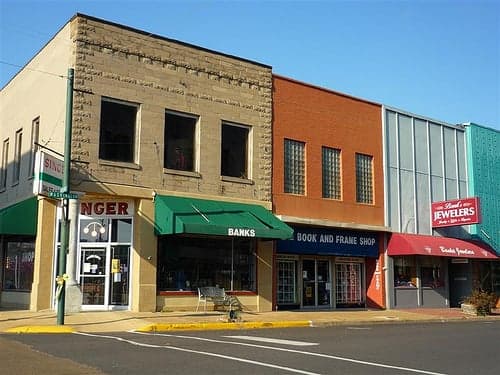
Photo: Wikipedia
Political ClimatePolitical Climate in Camden, AR
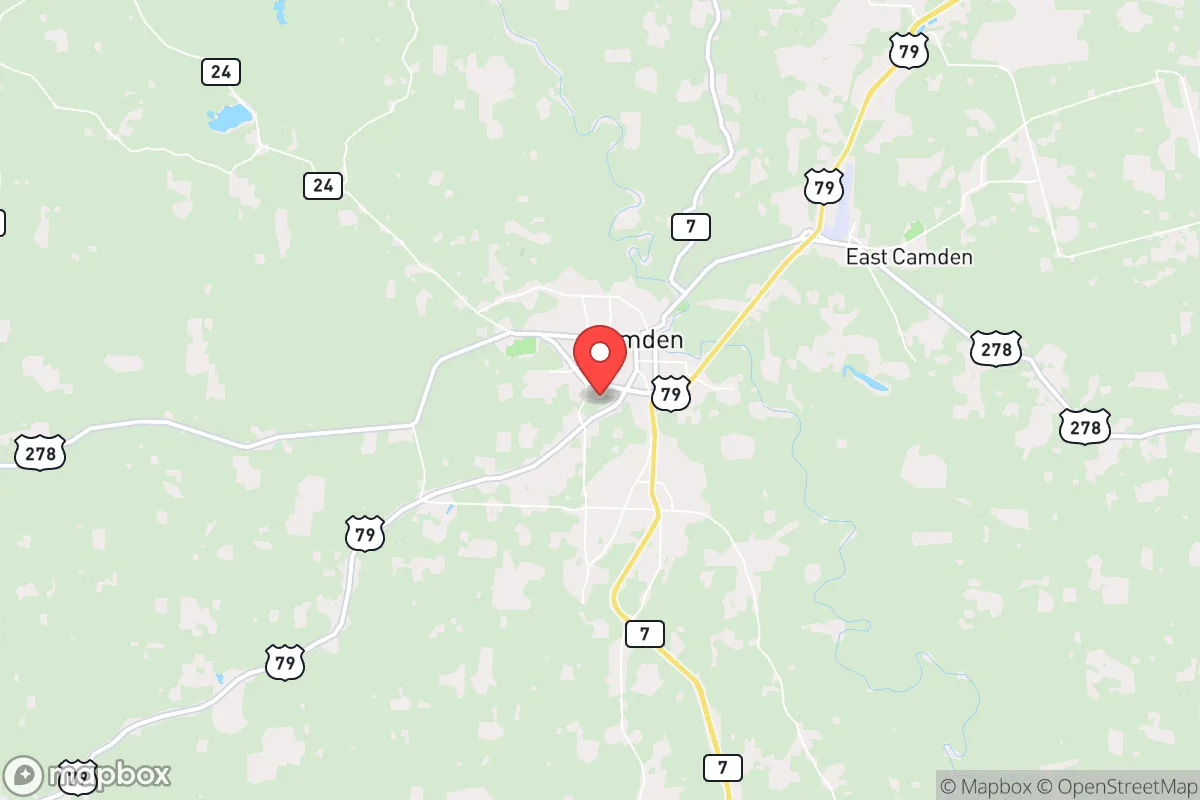
District shown is the primary district for this city’s centroid. Cities may span multiple districts.
Local Political AnalysisPolitical Analysis of Camden, AR
Camden, Arkansas, sits deep in the heart of the state’s 4th Congressional District, and the political climate here is about as solidly conservative as you’ll find anywhere in the South. The Cook PVI of R+20 isn’t just a number—it’s a reflection of a community that has, for generations, valued personal liberty, limited government, and a way of life that doesn’t take kindly to outside interference. You won’t see many yard signs for progressive candidates around here, and that’s not an accident. The political lean here is deeply rooted in a belief that the federal government should stay out of local affairs, especially when it comes to gun rights, school curriculum, and property taxes. If you’re looking for a place where the old-school values of self-reliance and neighborly trust still hold sway, Camden is it.
How it compares
Drive thirty miles north to El Dorado, and you’ll find a similar conservative bent, though it’s a bit more tempered by the oil and gas industry’s corporate influence. Head east toward Monticello, and the politics start to feel a little more mixed, with a few more progressive voices creeping in from the university crowd. But Camden? It’s a different animal. Compared to Little Rock, which feels like a different country politically, Camden is a fortress of traditional values. The contrast is stark: in Little Rock, you see the constant push for new regulations, higher taxes, and social experiments. Here, folks are more concerned with whether the county road is paved and if the local school board is keeping woke ideology out of the classroom. The surrounding Ouachita County is overwhelmingly red, and that’s a comfort for those of us who remember when the government didn’t try to micromanage every aspect of daily life.
What this means for residents
For the people living here, the political climate translates into a tangible sense of freedom. You don’t have to worry about your Second Amendment rights being chipped away at the local level—most folks here own firearms, and it’s a non-issue. Property taxes are kept in check by a county commission that understands the burden of overreach. The school system, while not perfect, still operates with a focus on basic education and local control, not the latest federal mandates. That said, there’s a growing unease. We’ve seen the national trends—the push for critical race theory, the erosion of parental rights, the overreach of health mandates—and it’s a constant battle to keep that from seeping into our small town. The biggest concern for long-time residents is that the state government in Little Rock might cave to pressure from outside groups, bringing those progressive policies down here. So far, we’ve held the line, but it takes vigilance.
Culturally, Camden is a place where church and community are still the bedrock. You won’t find the divisive identity politics that plague bigger cities. The local policy distinctions are subtle but important: the city council rarely passes new ordinances unless absolutely necessary, and there’s a strong preference for letting people live their lives without a lot of red tape. The biggest shift I’ve seen in my years here is the growing wariness of federal grants and programs that come with strings attached. People are starting to realize that “free money” from Washington often means giving up local control. If that trend continues, I expect Camden to double down on its conservative roots, becoming even more resistant to outside influence. It’s a good place to be if you value your privacy and your rights, but you have to stay informed and involved—because the fight to keep it that way never really ends.

State Political ClimatePolitical Climate in Arkansas
State Political AnalysisPolitical Environment in the State
Arkansas has been a reliably red state for decades, with a solid Republican lean that has only deepened since the early 2000s. The state hasn’t voted for a Democratic presidential candidate since Bill Clinton’s 1996 re-election, and by 2024, Donald Trump carried it by over 30 points. The dominant coalition is a mix of rural conservatives, evangelical Christians, and increasingly, suburban families fleeing blue states—though the northwest corner is where the real action is. Over the last 10-20 years, the shift has been dramatic: Democrats once held nearly every statewide office, but now Republicans control the governorship, both U.S. Senate seats, all four U.S. House seats, and supermajorities in the state legislature. This isn’t a purple state flirting with change; it’s a state that doubled down on conservative governance.
Urban vs. rural divide
The political map of Arkansas is a textbook study in the urban-rural split, but with a twist. The state’s two major metros—Little Rock and Northwest Arkansas—pull in opposite directions. Little Rock (Pulaski County) is the lone blue stronghold, voting Democratic by about 15 points in recent cycles, driven by a more diverse population and a concentration of government and healthcare workers. But even that is shrinking as the city’s suburbs, like Benton and Bryant in Saline County, have flipped hard red—Saline County went +35 for Trump in 2024. Meanwhile, Northwest Arkansas, anchored by Fayetteville, Bentonville, and Springdale, is a fascinating mix. Fayetteville (home to the University of Arkansas) is a small blue island in a sea of red, voting Democratic by about 10 points, but the surrounding Washington and Benton Counties are solidly Republican—Benton County went +22 for Trump. The real story is the rural expanse: counties like Van Buren, Stone, and Yell routinely vote 80%+ Republican, powered by gun culture, church attendance, and a deep distrust of federal overreach. The divide isn’t just political; it’s cultural—Little Rock feels like a different country from the Ozarks.
Policy environment
Arkansas’s policy environment is aggressively conservative, with a low-tax, low-regulation posture that attracts businesses and families alike. The state income tax is a flat 4.4% as of 2025, down from 6.9% a decade ago, with a goal of reaching 3.9% by 2027. Property taxes are among the lowest in the nation—about 0.5% of assessed value on average. On education, the state passed the Arkansas LEARNS Act in 2023, a sweeping school choice law that created universal Education Freedom Accounts (vouchers) worth roughly $6,600 per student, usable at private or homeschool settings. This was a major win for parental rights, though it’s still being phased in. Healthcare is a mixed bag: Arkansas expanded Medicaid under the private option model, but the state also passed a near-total abortion ban in 2022 (trigger law) with no exceptions for rape or incest, only to save the mother’s life. Election laws tightened in 2021 with Act 249, requiring voter ID and limiting absentee ballot drop boxes—a move that drew lawsuits but held up in court. The regulatory climate is business-friendly: no state-level minimum wage above the federal $7.25, right-to-work laws, and a tort reform cap on non-economic damages. For a conservative, this is a state that mostly stays out of your way—unless you’re trying to access abortion or expand government programs.
Trajectory & freedom
Arkansas is trending more free on most fronts, especially for conservatives. The LEARNS Act expanded educational freedom dramatically, letting parents pull kids from failing schools without financial penalty. On gun rights, the state passed constitutional carry in 2021 (Act 777), allowing permitless concealed carry for anyone 18 or older who can legally possess a firearm—no training, no background check beyond the purchase. That’s a major win for Second Amendment advocates. On medical autonomy, the state banned COVID-19 vaccine mandates for government employees and contractors in 2023 (Act 402), and the legislature has repeatedly blocked any attempt to impose mask mandates. Property rights got a boost with the 2023 passage of a law limiting county-level zoning authority, preventing local governments from banning short-term rentals like Airbnb. However, there are red flags: the state’s medical marijuana program, approved by voters in 2016, has been hamstrung by a slow rollout and restrictive licensing—only 38 dispensaries for 3 million people. And the state’s tax burden, while falling, still includes a sales tax on groceries (0.125% state rate, plus local add-ons). The trajectory is toward more personal liberty, but the pace is slower than some would like—especially on economic freedom issues like occupational licensing reform.
Civil unrest & political movements
Arkansas is not a hotbed of civil unrest, but there have been flashpoints. The most visible was the 2020 Black Lives Matter protests in Little Rock, which saw several nights of clashes with police and property damage, concentrated around the Capitol and the River Market district. That was a one-off, not a trend. On the right, the Arkansas Freedom Fund and local Moms for Liberty chapters have been active, pushing for school board takeovers and library book challenges—particularly in Bentonville and Rogers, where a 2023 controversy over LGBTQ-themed books in public libraries drew national attention. Immigration politics are muted: Arkansas has no sanctuary cities, and the state passed a 2019 law (Act 1070-style) requiring local law enforcement to cooperate with ICE. There’s been no serious secession or nullification rhetoric, though the legislature did pass a 2021 resolution affirming state sovereignty under the Tenth Amendment. Election integrity is a live issue: the 2020 and 2022 cycles saw no major scandals, but the state’s Republican secretary of state, John Thurston, has pushed for stricter voter roll maintenance and signature verification. A new resident won’t see daily protests or political violence—just a quiet, determined conservative activism at the local level.
Projection
Over the next 5-10 years, Arkansas will likely get more conservative, not less. The key driver is in-migration: Northwest Arkansas is one of the fastest-growing regions in the country, attracting families from California, Illinois, and the Northeast who are fleeing high taxes and progressive policies. These newcomers tend to be fiscally conservative and socially moderate, but they’re not flipping the state blue—they’re reinforcing the Republican majority, albeit with a more libertarian bent. The state’s Hispanic population is growing (now about 8% of the total), concentrated in Springdale and Rogers, but early data shows they’re trending Republican, especially on economic and religious issues. The biggest risk is a demographic shift in Little Rock, where the city’s black population (about 40%) could become more politically active, but that’s unlikely to flip the state given the rural weight. Expect the income tax to drop further, school choice to expand, and gun laws to stay permissive. The wild card is healthcare: if the state’s rural hospitals continue to close (12 have closed since 2010), pressure for Medicaid expansion or a public option could grow, but the legislature will resist. For a conservative moving in now, the Arkansas of 2035 will look very familiar—just more crowded in Bentonville, with lower taxes and the same cultural values.
Bottom line: Arkansas is a safe bet for anyone seeking a state that respects personal freedom, keeps taxes low, and doesn’t meddle in your family’s choices. The political climate is stable and trending in your favor, especially if you value gun rights, school choice, and limited government. The trade-off is a slower pace of life, fewer big-city amenities, and a healthcare system that’s thin in rural areas. If you’re coming from a blue state, you’ll feel the difference immediately—and you’ll probably like it. Just know that the state’s conservatism is genuine, not performative, and it’s backed by a legislature that’s willing to pass laws to protect it. That’s the Arkansas way.
* Values derived from national, state, county, city and local statistics and may differ in a specific area. Last updated: 2026-04-30T02:27:03.000Z
Narrative content on this page is AI-generated and may contain mistakes. Verify any details that matter before acting on them.
ReloMaps may earn a commission from affiliate links at no extra cost to you.

