 Popular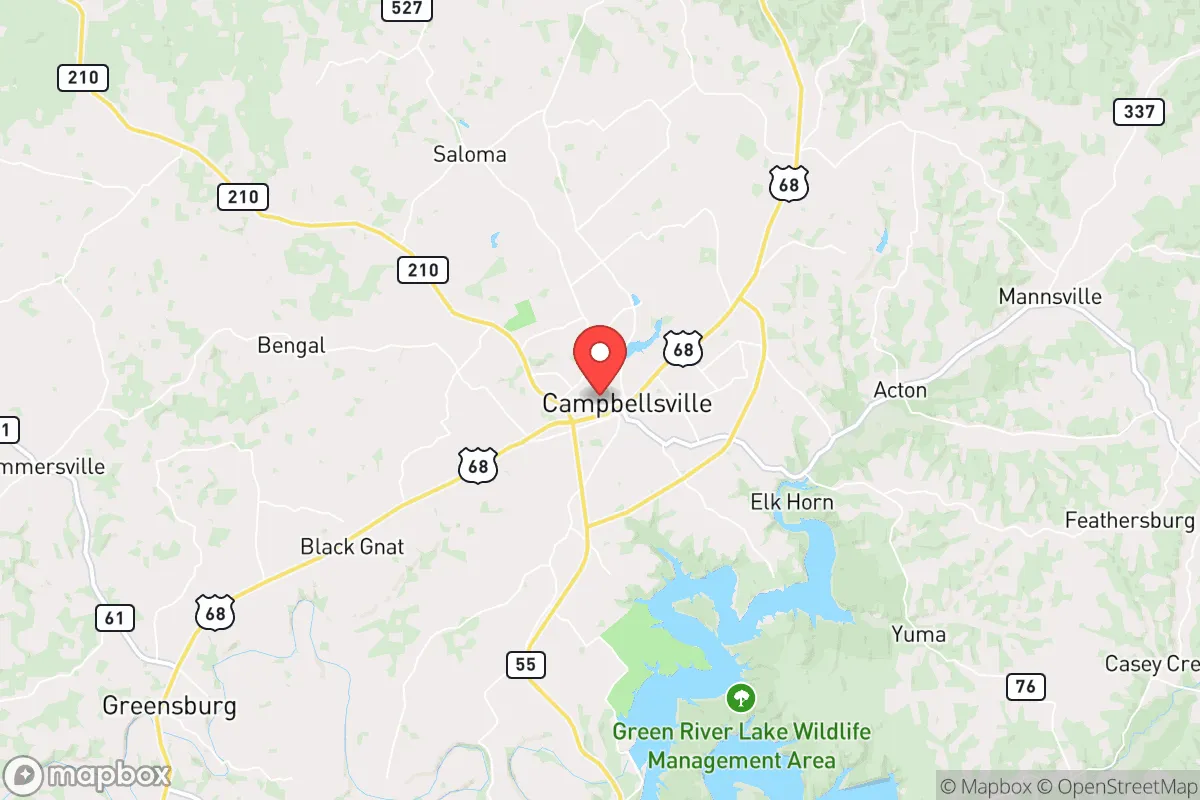
Photo: Wikipedia
Demographics of Campbellsville, KY
Affluence Level in Campbellsville, KY
A low-income area with significant economic hardship. Household wealth and educational attainment are well below national averages.
People of Campbellsville, KY
Campbellsville, Kentucky, is a small city of 11,523 residents where the population is predominantly white (83.3%) and native-born, with a foreign-born share of just 1.4% that is well below the national average. The city’s character is shaped by its role as a regional hub for healthcare, education, and light manufacturing, anchored by Campbellsville University and Taylor Regional Hospital. It is a place where family ties run deep, and the population density of roughly 1,200 people per square mile gives it a compact, walkable feel compared to sprawling suburbs. For a conservative-leaning audience, the city offers a stable, community-oriented environment with a modest but growing diversity that has not fundamentally altered its traditional social fabric.
How the city was settled and grew
Campbellsville was founded in 1817 on land granted to early settlers like Andrew Campbell, for whom the city is named, and grew slowly as a trading post along the Green River. The original population was almost entirely of Scots-Irish and English descent, drawn by fertile farmland and the promise of land grants in the post-Revolutionary War era. These early families built the Downtown Historic District, centered around the Taylor County Courthouse, which remains the city’s core. A second wave arrived after the Louisville and Nashville Railroad reached the area in the 1870s, bringing merchants and craftsmen who established the West Main Street corridor as a commercial and residential hub. By the early 20th century, the city’s population was nearly 100% white, with a small number of African American families concentrated in the South Central Avenue area, near the railroad tracks, where they worked as domestic servants and laborers. The founding of Campbellsville College (now Campbellsville University) in 1906 drew a modest influx of faculty and students, but the city remained a quiet agricultural center through the mid-20th century, reaching about 7,000 residents by 1960.
Modern era (post-1965)
The post-1965 period brought gradual demographic change, though Campbellsville’s population growth has been steady rather than explosive. The city’s black population, now 9.7%, has deep roots in the East 1st Street neighborhood, historically the center of African American life, with its own churches and a small business district that has largely faded. Hispanic residents, at 1.7%, began arriving in the 1990s, drawn by jobs at local manufacturing plants like Fruit of the Loom and later at the Amazon fulfillment center in nearby Shepherdsville; they have settled mostly in the North Columbia Avenue area, where rental housing is more available. East and Southeast Asian residents (0.6%) and Indian-subcontinent residents (0.5%) are a very small presence, primarily connected to Campbellsville University as international students or faculty, and they tend to live in apartments near the campus on University Drive. The city’s foreign-born share of 1.4% is among the lowest in Kentucky, reflecting limited immigration-driven growth. Suburbanization has been modest, with new subdivisions like Green Hills Estates on the city’s west side attracting white families moving from older neighborhoods, while the downtown core has seen some reinvestment but retains its historic character.
The future
Campbellsville’s population is projected to grow slowly, likely reaching 12,500–13,000 by 2040, driven by natural increase and continued in-migration from surrounding rural areas rather than international immigration. The city is not tribalizing into distinct ethnic enclaves; instead, the small Hispanic and Asian populations are assimilating into existing neighborhoods, with no single area exceeding 5% non-white concentration. The black population, concentrated historically in East 1st Street, is slowly dispersing into newer subdivisions as economic mobility increases. The biggest demographic shift will likely be an aging population, as the college-educated share (26.8%) remains below the national average and younger residents often leave for larger cities after graduation. For a conservative-leaning mover, this means a stable, culturally homogeneous community where change is incremental and the traditional social order persists.
Campbellsville is becoming a quietly stable small city where demographic change is slow and assimilation is the norm, not a place of rapid diversification or ethnic clustering. For someone moving in now, it offers a tight-knit, family-oriented environment with a strong sense of local identity, anchored by its university and healthcare sectors, and a population that remains overwhelmingly native-born and white.

* Values derived from national, state, county, city and local statistics and may differ in a specific area. Last updated: 2026-04-21T09:48:39.000Z
Narrative content on this page is AI-generated and may contain mistakes. Verify any details that matter before acting on them.
ReloMaps may earn a commission from affiliate links at no extra cost to you.

