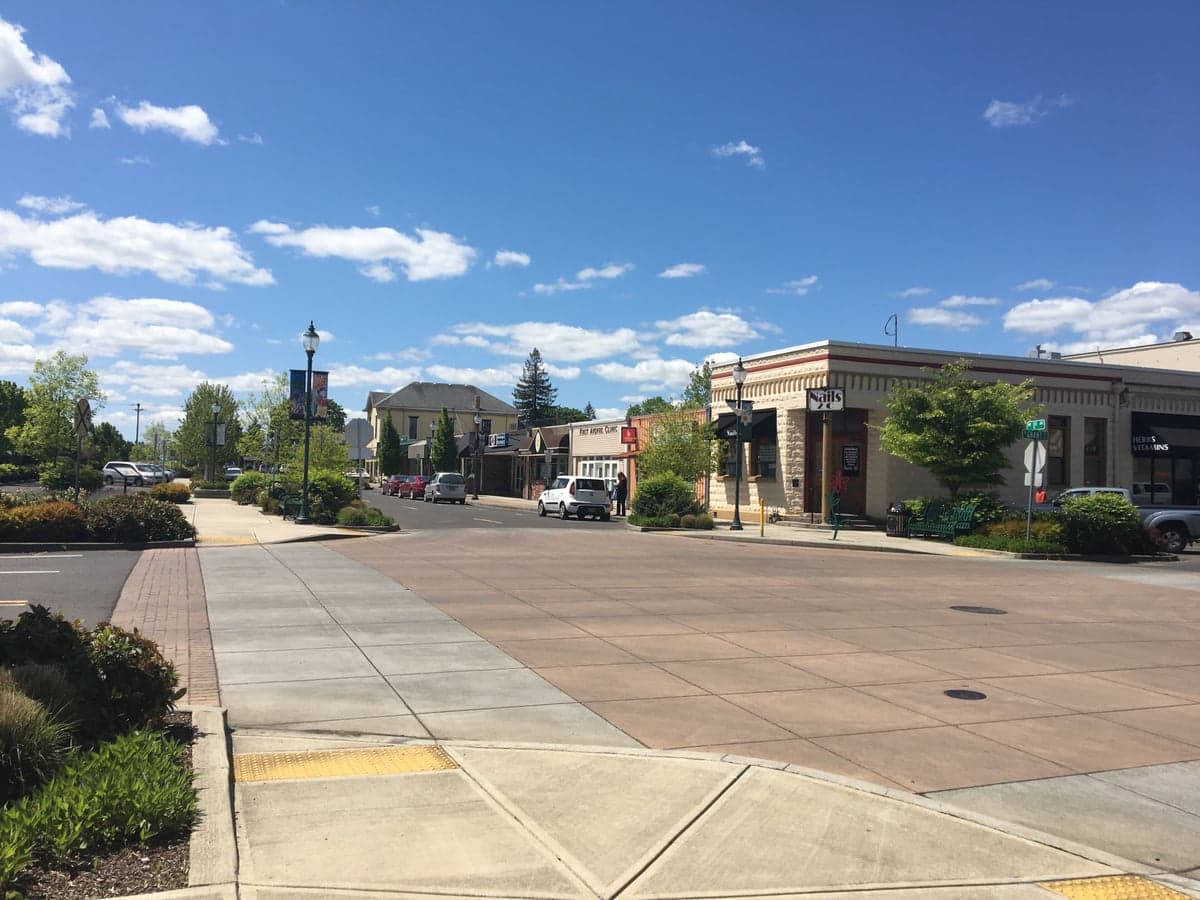
Photo: Wikipedia
Demographics of Canby, OR
Affluence Level in Canby, OR
An upper-middle-class area. Household wealth, education levels, and homeownership run ahead of national benchmarks.
People of Canby, OR
Canby, Oregon, is a predominantly white, family-oriented city of 18,103 residents where 75.0% of the population identifies as white and 17.2% as Hispanic or Latino. The city retains a small-town, agricultural-rooted character, with a foreign-born population of just 4.4% and a college attainment rate of 30.5%. Its people are largely multi-generational Oregonians and newer domestic migrants from the Pacific Northwest, creating a community that values stability, local schools, and proximity to Portland without its urban pace.
How the city was settled and grew
Canby’s original population was drawn by the Donation Land Claim Act of 1850, which granted 320 acres to white settlers willing to farm the fertile Willamette Valley bottomlands. The first wave, primarily Anglo-American farmers from the Midwest and Upper South, arrived in the 1850s and 1860s, establishing homesteads along the Molalla River. The arrival of the Oregon and California Railroad in 1870 turned Canby into a shipping hub for hops, berries, and dairy, attracting a second wave of German and Scandinavian immigrants who worked the fields and built the early commercial core around downtown Canby and the Railroad Avenue district. By the early 1900s, a small Japanese community had formed, working as farm laborers and establishing truck farms in what is now the South Canby area, though many were displaced during World War II internment. The city incorporated in 1893 and remained a quiet agricultural town through the mid-20th century, with population hovering around 1,500 until the post-war era.
Modern era (post-1965)
After the 1965 Hart-Cellar Act, Canby saw little direct immigration from Asia or Latin America compared to larger Oregon cities. The foreign-born share remains low at 4.4%, and East/Southeast Asian residents make up just 1.8% of the population, with no measurable Indian-subcontinent community. The city’s modern growth has been driven by domestic in-migration from Portland and other parts of the Pacific Northwest, as families sought larger lots, lower crime, and better schools. Suburban development accelerated in the 1990s and 2000s, with new subdivisions like Forest Hills and Knott Estates filling with white middle-class families. The Hispanic population, now 17.2%, grew steadily from the 1980s onward, driven by agricultural labor demand in the surrounding nurseries and berry fields. This community concentrated in the North Canby area and along South Redwood Street, where older, more affordable housing stock and proximity to farm work created a distinct enclave. The Black population remains negligible at 0.6%, and the city has not experienced the diversification seen in nearby Oregon City or Woodburn.
The future
Canby’s population is slowly homogenizing in racial terms, with the white share declining from roughly 85% in 2000 to 75% today, while the Hispanic share continues to rise. The Hispanic community is growing through both natural increase and continued migration from Mexico and Central America, but it remains largely concentrated in the older, less expensive neighborhoods of North Canby and the Molalla Avenue corridor. There is little evidence of tribalization into distinct ethnic enclaves beyond this; most newer subdivisions, such as Cedar Creek Estates, are overwhelmingly white. The East/Southeast Asian and Indian populations are not growing measurably, and the foreign-born share is unlikely to rise significantly given the lack of major employers or refugee resettlement programs. Over the next 10–20 years, Canby will likely become a more Hispanic-influenced town, with the Hispanic share potentially reaching 25–30%, while remaining a predominantly white, family-oriented suburb. The city’s character will shift toward a bicultural dynamic rather than a multi-ethnic one.
For a conservative-leaning individual or family moving to Canby now, the city offers a stable, predominantly white community with a growing Hispanic presence that is integrated into the local economy and schools. It is not a diversifying, cosmopolitan suburb but a place where traditional family structures, homeownership, and agricultural heritage remain central. The population trajectory points toward gradual Hispanic growth and continued domestic in-migration from the Portland metro, making Canby a solid, predictable choice for those seeking a small-town Oregon lifestyle without rapid demographic change.

* Values derived from national, state, county, city and local statistics and may differ in a specific area. Last updated: 2026-05-19T08:57:48.000Z
Narrative content on this page is AI-generated and may contain mistakes. Verify any details that matter before acting on them.
ReloMaps may earn a commission from affiliate links at no extra cost to you.

