
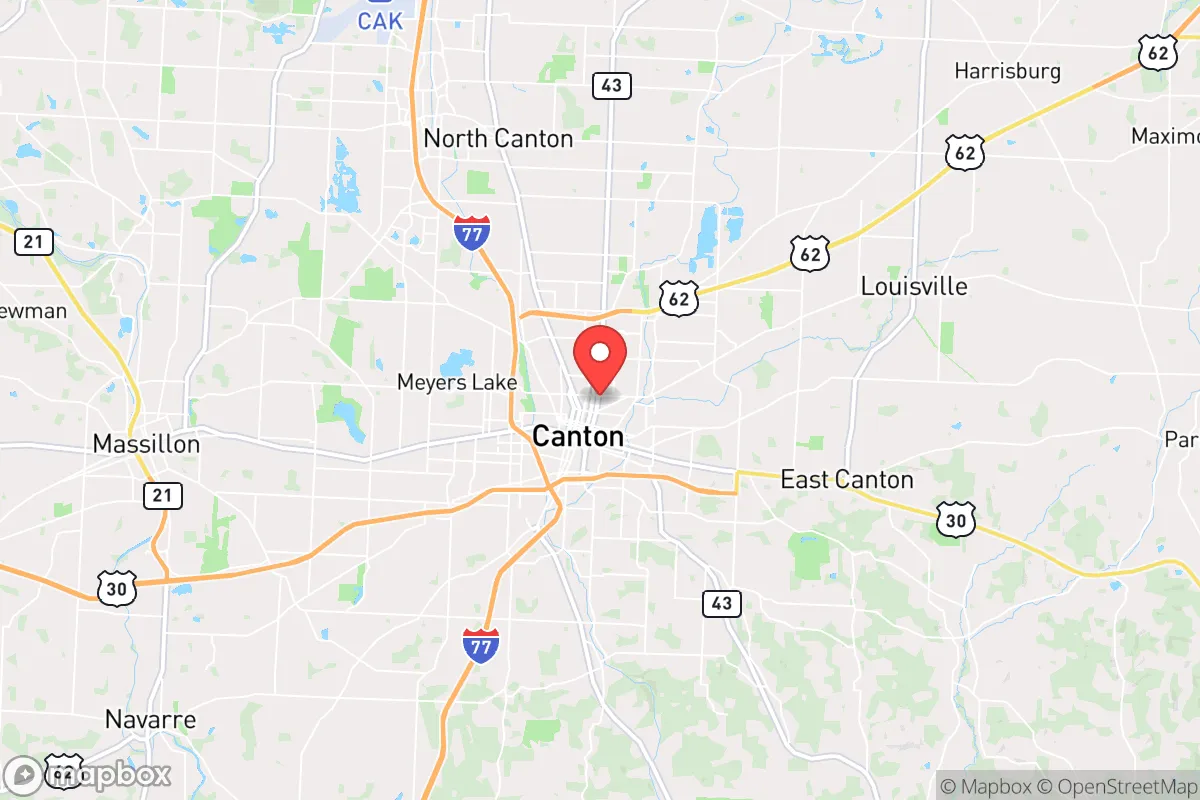
Photo: Wikipedia
Personal Sovereignty in Canton, OH
Viable for self-reliance. Generally workable, though some barriers may limit total independence.
What does Personal Sovereignty tell us?
Personal Sovereignty measures your capacity for self-reliance and independence with minimal government friction. Higher scores mean fewer barriers between you and the way you want to live... but it assumes you have the space you need and good neighbors.
What does this tell us?
Personal Sovereignty measures your capacity for self-reliance and independence with minimal government friction. Higher scores mean fewer barriers between you and the way you want to live... but it assumes you have the space you need and good neighbors.
State Policy
Energy independence: Importer (40% of energy produced in-state)
Personal Liberty
Homesteading

Personal Liberty Analysis
Canton, Ohio, offers a notably high degree of personal sovereignty compared to many urban and coastal jurisdictions, particularly for those prioritizing autonomy over government convenience. The city’s position within Stark County and the broader state of Ohio creates a legal and cultural environment where individual decision-making—on matters of self-defense, property use, and family structure—is generally respected over state or federal mandates. For the strategic relocator with a survivalist or prepper mindset, Canton represents a pragmatic middle ground: it provides access to industrial and medical infrastructure without the suffocating regulatory atmosphere found in cities like Columbus or Cleveland. The key is understanding where local ordinances intersect with state preemption laws, as the balance here leans heavily toward personal liberty, but not without specific caveats.
Tax burden and regulatory posture for independent living
Ohio’s overall tax structure is moderate, but Canton’s specific posture is favorable for those seeking to minimize government extraction from their income and property. The state has a flat income tax rate of 3.5% as of 2026, with no municipal income tax surcharge in Canton beyond the standard 2% city rate—lower than many Ohio cities. Property taxes in Stark County average around 1.5% of assessed value, which is competitive for the Midwest. More critically, Ohio is a right-to-work state in practice (though not by statute), meaning union membership is not a condition of employment, and the regulatory environment for small businesses and home-based enterprises is relatively light. The state’s limited government approach to occupational licensing—Ohio does not require a license for many trades that coastal states mandate—allows for faster self-employment and side-hustle operations. For the prepper, this means fewer bureaucratic hurdles to establishing a workshop, a food preservation business, or a firearms-related service. The regulatory posture is best described as “hands-off until a clear public safety risk emerges,” which aligns well with a survivalist ethos of self-reliance.
Self-defense and gun law specifics in Stark County
Ohio is a constitutional carry state, and Canton residents benefit from this fully. Since 2022, no permit is required to carry a concealed handgun for anyone legally allowed to possess a firearm. Stark County’s sheriff’s office is known for issuing concealed carry permits promptly for those who still want reciprocity with other states, but the legal default is that your right to bear arms is not contingent on government permission. Stand-your-ground laws are in effect, with no duty to retreat in any place where you are lawfully present. Castle doctrine protections extend to vehicles and occupied structures. Magazine capacity, firearm types (including AR-15s), and ammunition are unregulated at the state level. Canton itself has no local ordinances that infringe on these rights—no “assault weapon” bans, no waiting periods, and no storage mandates. For the survivalist, this means you can maintain a fully equipped armory without fear of sudden regulatory changes. The only notable restriction is that firearms are prohibited in certain government buildings and schools, but these are standard exceptions. The legal climate here is among the most permissive in the industrial Midwest, making Canton a stronghold for those who view self-defense as a non-negotiable personal responsibility.
Self-reliance and homesteading viability in the Canton area
The viability of a self-reliant lifestyle in Canton depends heavily on whether you are within city limits or in the surrounding township areas. Inside Canton proper, standard residential lots average 0.15 to 0.25 acres, which limits large-scale gardening or livestock. However, zoning codes in Stark County’s unincorporated areas allow for chickens, goats, and even small-scale aquaculture with minimal permitting. The city itself has relaxed its urban agriculture ordinances in recent years, permitting backyard chickens (hens only, no roosters) and beekeeping on lots of 5,000 square feet or more. Off-grid feasibility is moderate: Ohio’s net metering policy allows solar panel owners to sell excess power back to the grid, but the state’s cloudy climate reduces year-round generation. Rainwater collection is legal and unregulated for non-potable uses. For the serious prepper, the best strategy is to target properties in the townships immediately surrounding Canton—Plain Township, Jackson Township, or Perry Township—where lot sizes of 1 to 5 acres are common and zoning is far more permissive. These areas allow for wood-burning stoves, private wells, and septic systems, enabling a degree of infrastructure independence that city lots cannot match. The soil in Stark County is fertile loam, suitable for vegetable gardens and small orchards, and the growing season runs from April to October.
Personal liberties: parental rights, medical autonomy, and speech
Ohio has become a battleground for parental rights, and the current legal landscape strongly favors family autonomy. The state’s Parents’ Bill of Rights, enacted in 2023, explicitly affirms that parents have the fundamental right to direct the upbringing, education, and healthcare of their children. This includes the right to opt out of any school curriculum or activity without penalty, and to access all educational and medical records. Medical autonomy is similarly robust: Ohio does not mandate COVID-19 or other adult vaccinations, and while school vaccine requirements exist, medical and religious exemptions are broadly available and not subject to bureaucratic harassment. The state’s stance on medical freedom extends to alternative treatments—there are no laws prohibiting the use of off-label medications or experimental therapies for consenting adults. Free speech protections are strong, with no state-level hate speech laws that chill political or religious expression. Property rights are well-guarded: Ohio has strong eminent domain protections, requiring “just compensation” and a demonstrated public necessity, and there are no statewide rent control laws. Canton’s local government has not attempted to override these state-level protections, meaning that your ability to speak, parent, and treat your body as you see fit is largely unencumbered by local overreach.
In the broader context of American personal sovereignty, Canton and its surrounding areas rank in the top tier for the Midwest. The combination of constitutional carry, low taxes, permissive zoning for self-reliance, and strong parental rights creates a legal environment where government is a background presence rather than a daily obstacle. Compared to states like California, New York, or Illinois, where regulatory density can suffocate individual initiative, Canton offers a breathable atmosphere for those who want to live by their own rules. The trade-off is that you are still in a mid-sized city with typical urban challenges—property crime rates are slightly above the national average, and the local government has a history of budget shortfalls that occasionally lead to service reductions. But for the strategic relocator who values autonomy above all else, Canton represents a viable base of operations where you can prepare for an uncertain future without constantly fighting the state. It is not a libertarian utopia, but it is a place where a determined individual can carve out a life largely on their own terms.

* Values derived from national, state, county, city and local statistics and may differ in a specific area. Last updated: 2026-04-21T19:35:24.000Z
Narrative content on this page is AI-generated and may contain mistakes. Verify any details that matter before acting on them.
ReloMaps may earn a commission from affiliate links at no extra cost to you.

