
Photo: Wikipedia
Political ClimatePolitical Climate in Canton, OH
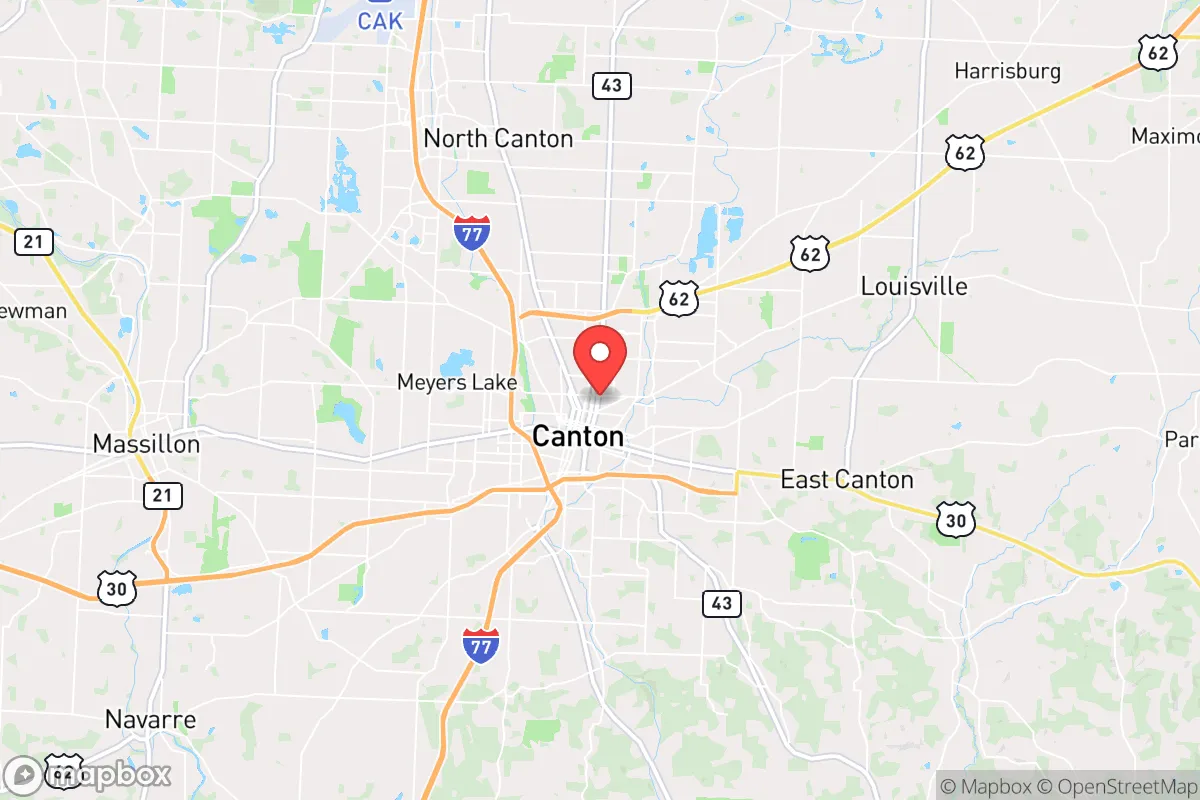
District shown is the primary district for this city’s centroid. Cities may span multiple districts.
Local Political AnalysisPolitical Analysis of Canton, OH
Canton, Ohio, sits in a political tug-of-war that’s gotten a lot more tense over the past decade. The Cook PVI rating of EVEN tells you everything you need to know—this place is a true battleground, and it wasn’t always this way. For years, Stark County was reliably blue-collar Democrat, but the working-class roots here have always been more about common sense and personal liberty than party loyalty. Now, you’re seeing a real shift: the city itself leans left, but the surrounding townships and rural areas—places like Plain Township, Jackson Township, and North Canton—are pushing hard in the other direction. The result is a community that’s split right down the middle, and the tension is palpable.
How it compares
If you drive 20 minutes north to Akron, you’re in a solidly blue stronghold—Summit County hasn’t gone red in decades. Head south to Tuscarawas County, and you’ll find a reliably conservative area that votes like the rest of rural Ohio. Canton is the hinge. It’s not as progressive as Cleveland or Columbus, but it’s not as red as the farm counties either. What’s concerning is how the city council and local school boards have started to mirror the bigger cities’ playbooks—pushing diversity, equity, and inclusion initiatives and talking about “equity” in ways that sound a lot like government overreach. Meanwhile, the county commissioners are still mostly conservative, so you get this weird split where your tax dollars might fund one thing in the city and something totally different just a few miles away.
What this means for residents
For folks who value personal freedoms—like the right to keep and bear arms, or the right to send your kids to school without them being taught that America is fundamentally evil—this political split is exhausting. You have to pay attention to every local election because a single school board race can flip the curriculum. The good news is that the conservative base here is organized and vocal. Groups like the Stark County Republican Party are active, and there’s a strong network of Second Amendment supporters and pro-life advocates. But the bad news is that the progressive side is well-funded and aggressive, often pushing policies that feel like they’re imported from the coasts. For example, the city’s recent push for “equity audits” and “inclusive zoning” has raised eyebrows—many see it as government meddling in neighborhoods that were just fine on their own.
On the cultural front, Canton still has that old-school Ohio vibe—high school football on Friday nights, church on Sunday, and a general distrust of politicians who promise too much. The Pro Football Hall of Fame brings in tourists, but it doesn’t change the local mindset. What’s changing is the influx of people from more liberal areas, drawn by lower housing costs, and that’s slowly shifting the political winds. If you’re looking to move here, keep an eye on the local school board races and city council elections—those are where the real fights are happening. The long-term trajectory depends on whether the conservative majority in the county can hold the line against the progressive push in the city. For now, Canton is a place where you can still have a say, but you’ve got to show up and vote every single time.

State Political ClimatePolitical Climate in Ohio
State Political AnalysisPolitical Environment in the State
Ohio has long been the quintessential bellwether state, but over the past decade it has shifted from a true purple battleground to a solidly red-leaning state, with Republicans now holding all five statewide executive offices, a supermajority in the state legislature, and a 53-45% presidential margin in 2024. The dominant coalition is a mix of working-class voters in small cities and rural areas, suburban conservatives in the Cincinnati and Columbus rings, and a shrinking but still significant union Democratic base in the industrial northeast. Over the last 20 years, the state has moved roughly 10 points to the right in presidential elections, driven by cultural realignment and out-migration from the most Democratic counties.
Urban vs. rural divide
The political map of Ohio is a textbook case of the urban-rural chasm. The three major metros—Cleveland, Columbus, and Cincinnati—anchor the Democratic vote, but with very different intensities. Cuyahoga County (Cleveland) delivered a 66-33% Democratic margin in 2024, while Franklin County (Columbus) was closer to 58-40%. Cincinnati’s Hamilton County is the most competitive, flipping between parties and currently trending left. Meanwhile, the rural and exurban counties are overwhelmingly Republican. Mercer County in the west voted 80-18% Republican, and counties like Auglaize, Holmes, and Putnam routinely hit 75%+ GOP. The real story is the suburbs: Delaware County (north of Columbus) went from a 52-48% GOP lean in 2000 to a 60-38% GOP margin in 2024, while Lake County (east of Cleveland) flipped from blue to red over the same period. The I-71 corridor from Cincinnati to Cleveland is the political spine, with the rural counties on either side providing the GOP’s firewall.
Policy environment
Ohio’s policy environment is broadly conservative but with notable populist and pragmatic wrinkles. The state has a flat income tax rate of 3.5% (down from 4.8% in 2020), with a phase-out plan that could eliminate it entirely by 2030. Property taxes are moderate, but school funding remains a perennial issue after the Ohio Supreme Court declared the system unconstitutional four times. The regulatory posture is business-friendly, with right-to-work laws not passed but a strong tort reform environment. On education, Ohio has a robust school choice program: over 200,000 students use vouchers or EdChoice scholarships, and the state has one of the largest charter school sectors in the Midwest. Healthcare policy is mixed—Medicaid expansion was accepted under Kasich and remains in place, but the state has not pursued a state-based exchange. Election laws have tightened: SB 1 (2025) requires photo ID for all voting, limits drop boxes, and shortens the absentee window. Voter turnout remains high, but the changes have drawn legal challenges.
Trajectory & freedom
On the freedom front, Ohio has been a mixed bag, but the trajectory since 2020 is clearly toward more personal liberty in several key areas. Constitutional carry (HB 227) became law in 2022, allowing permitless carry of firearms for adults 21 and older. The state also passed a “stand your ground” law in 2021. On parental rights, HB 8 (2024) requires schools to notify parents of any changes in a student’s health or well-being and bans transgender athletes from female sports. Medical autonomy took a hit with the 2023 Issue 1 vote, which enshrined abortion access in the state constitution—a major setback for conservatives. However, the legislature responded by passing a law requiring parental consent for minors and banning most abortions after 24 weeks. Property rights are strong, with no statewide rent control and limited eminent domain abuse. The biggest concern for freedom-minded residents is the growing state debt burden—Ohio’s net tax-supported debt is over $25 billion—and the creeping influence of federal funding strings on state policy.
Civil unrest & political movements
Ohio has seen its share of political flashpoints. The 2020 protests in Columbus and Cincinnati over George Floyd’s death led to curfews and property damage, but the state avoided the worst of the violence seen in Portland or Seattle. The most significant movement in recent years has been the “Ohio Stands” coalition, a grassroots network of conservative activists that mobilized against COVID-19 mandates and school closures. They successfully pressured the legislature to pass HB 215 (2021), which banned vaccine passports and limited the governor’s emergency powers. Immigration politics are relatively quiet compared to border states, but Clark County (Springfield) became a national flashpoint in 2024 after a surge of Haitian migrants strained local resources, leading to a city council resolution declaring a “humanitarian crisis.” Election integrity remains a hot-button issue: the 2024 election saw over 100,000 absentee ballots rejected for missing signatures or ID issues, fueling ongoing distrust. No serious secession or nullification rhetoric exists, but the “Ohio First” movement in the legislature has pushed for more state control over federal lands and regulations.
Projection
Over the next 5-10 years, Ohio is likely to become more Republican, but with a twist. The in-migration from blue states is accelerating—Ohio gained over 100,000 net new residents from California, New York, and Illinois between 2020 and 2025—and these newcomers tend to be conservative-leaning, often citing lower taxes and gun rights as reasons. However, the Columbus metro is growing fast and diversifying, with Franklin County’s Democratic margin increasing by 3 points since 2016. The rural counties are emptying out, which will eventually reduce the GOP’s raw vote advantage. The wild card is the state’s aging population: Ohio has the 5th oldest median age in the country, and older voters are the most reliable Republican bloc. Expect the legislature to continue pushing tax cuts, school choice expansion, and election integrity measures. The biggest risk is a future Democratic governor who could veto conservative legislation, but the supermajority can override that. For a conservative moving in now, the state will feel reliably red for at least another decade, with the main battles being internal GOP fights over spending and education.
For a new resident, the bottom line is this: Ohio offers a solidly conservative policy environment with low taxes, strong gun rights, and robust school choice, but you’ll need to navigate the urban-rural divide carefully. If you’re looking for a place where your values are reflected in state law and your vote actually counts, Ohio is one of the best bets in the Midwest. Just be prepared for the occasional blue island in Columbus or Cleveland, and keep an eye on the state debt—it’s the one freedom issue that hasn’t been addressed.
* Values derived from national, state, county, city and local statistics and may differ in a specific area. Last updated: 2026-04-21T19:35:24.000Z
Narrative content on this page is AI-generated and may contain mistakes. Verify any details that matter before acting on them.
ReloMaps may earn a commission from affiliate links at no extra cost to you.

