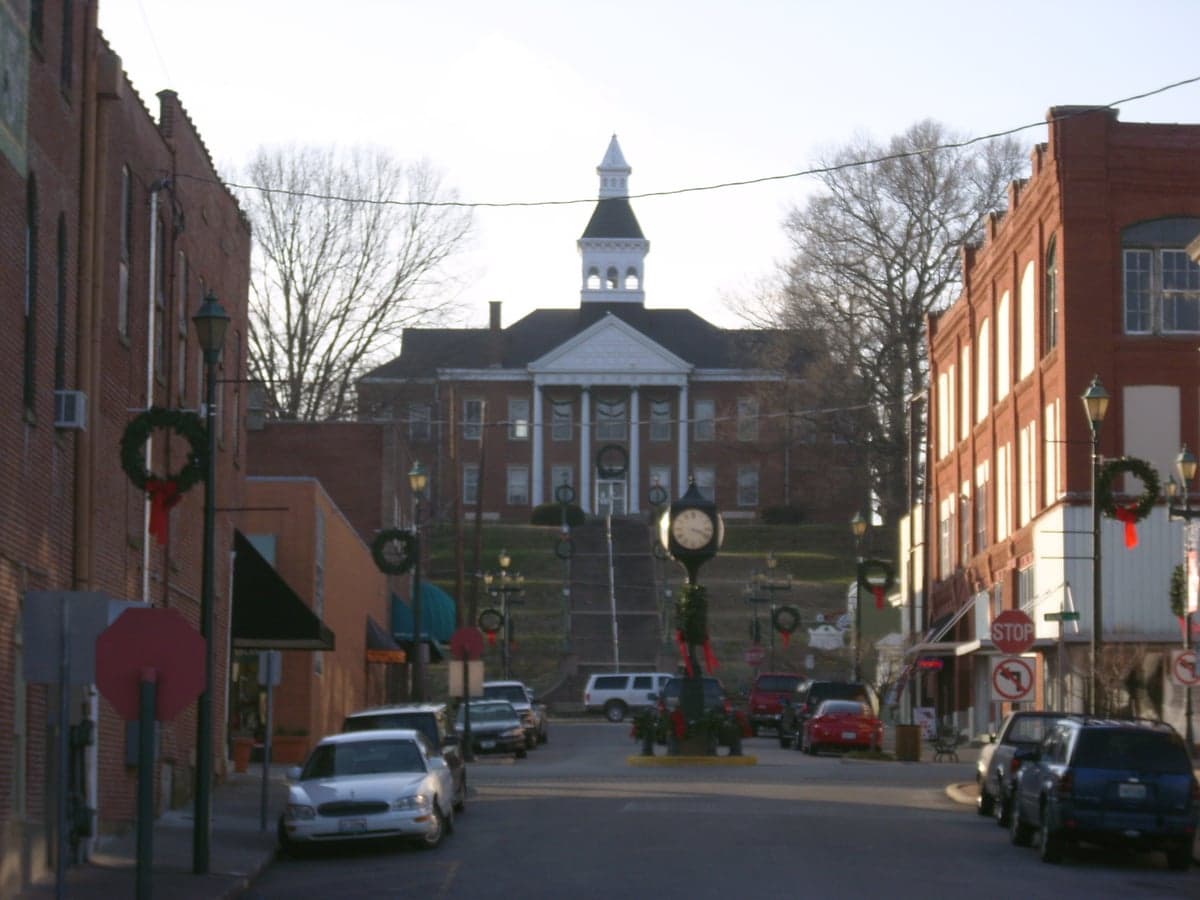
Photo: Wikipedia
Demographics of Cape Girardeau, MO
Affluence Level in Cape Girardeau, MO
A middle-class area roughly in line with national averages across income, home values, education, and employment.
People of Cape Girardeau, MO
The people of Cape Girardeau, Missouri, today number roughly 40,000, forming a community that is predominantly white (74.6%) with a significant Black minority (15.0%) and small but growing Asian (1.6%) and Indian (1.0%) populations. The city’s character is rooted in its Mississippi River history and its role as a regional hub for healthcare, education, and retail, anchored by Southeast Missouri State University and Saint Francis Medical Center. With a foreign-born share of just 2.1% and a college-educated rate of 36.6%, Cape Girardeau remains a culturally traditional, mid-sized Midwestern city where family stability and local institutions define daily life.
How the city was settled and grew
Cape Girardeau’s population history begins with French Canadian traders and settlers who established a trading post around 1733, drawn by the strategic river bluff. The city was officially platted in 1806 by Louis Lorimier, a French-Canadian trader, and the early population was a mix of French Creoles, German immigrants, and Anglo-American settlers arriving via the Ohio and Mississippi rivers. German Catholics and Lutherans formed a major wave in the 1840s–1860s, settling in what is now Old Town Cape, the historic downtown district where their churches and brick storefronts still stand. The city’s growth accelerated after the Civil War as the railroad arrived in the 1870s, connecting Cape Girardeau to St. Louis and Memphis. This brought a second wave of German and Irish laborers, who built homes in the South Cape neighborhood near the rail yards. By 1900, the population was overwhelmingly white, with a small Black community concentrated in the North End along the river, working as stevedores and domestic laborers. The mid-20th century saw steady growth from regional in-migration, as the city became a medical and educational center, with new subdivisions like West Park and Broadway filling with white middle-class families moving from rural areas.
Modern era (post-1965)
After the 1965 Hart-Cellar Act, Cape Girardeau’s foreign-born population remained very low, but domestic migration reshaped the city. The most significant shift was the growth of the Black population, which rose from roughly 8% in 1970 to 15.0% today, driven by African American families moving from rural Southeast Missouri and the Mississippi Delta for jobs at Procter & Gamble’s plant (opened 1981) and the expanding healthcare sector. This population concentrated in the North End and parts of East Cape, where older housing stock and lower property values offered entry points. The white population suburbanized westward into West Cape and the Gordonville Road corridor, creating a de facto racial divide along the Interstate 55 corridor. The Asian population (1.6%) is largely tied to Southeast Missouri State University, with faculty and students from China, South Korea, and Vietnam settling near campus in Old Town Cape and the University Heights area. The Indian population (1.0%) is smaller but similarly university-linked, with families concentrated in the same campus-adjacent neighborhoods. The Hispanic population (3.4%) grew modestly after 2000, with Mexican and Central American workers arriving for construction and agricultural jobs, settling in South Cape and along the Kingshighway commercial strip.
The future
Cape Girardeau’s population is projected to remain stable or grow slowly, with the city’s role as a regional medical and educational center continuing to attract domestic migrants from rural Missouri and Illinois. The white population share is slowly declining as the Black and Hispanic shares inch upward, but the city is not experiencing rapid diversification. The Asian and Indian populations are likely to plateau, as they are heavily tied to the university, which has limited enrollment growth. The foreign-born share (2.1%) is unlikely to rise significantly, as the city lacks the industrial or agricultural base to attract large new immigrant streams. The most notable trend is the aging of the white population in West Cape and Broadway, while younger families—both white and Black—are moving into South Cape and East Cape for more affordable housing. The city is not tribalizing into distinct ethnic enclaves but is experiencing a mild suburban-style sorting by income and housing age.
For someone moving in now, Cape Girardeau is a stable, culturally traditional city where the population is slowly diversifying but remains overwhelmingly native-born and Midwestern. The key neighborhoods to watch are Old Town Cape for university-linked professionals and retirees, West Cape for established families, and South Cape for younger households seeking affordability. The city’s future is one of gradual, moderate change—not a demographic revolution—making it a predictable choice for those seeking a low-crime, family-oriented community with solid schools and a regional economy.

* Values derived from national, state, county, city and local statistics and may differ in a specific area. Last updated: 2026-10-10T16:26:49.000Z
Narrative content on this page is AI-generated and may contain mistakes. Verify any details that matter before acting on them.
ReloMaps may earn a commission from affiliate links at no extra cost to you.

