Photo: Wikipedia
Demographics of Carlisle, PA
Affluence Level in Carlisle, PA
A middle-class area roughly in line with national averages across income, home values, education, and employment.
People of Carlisle, PA
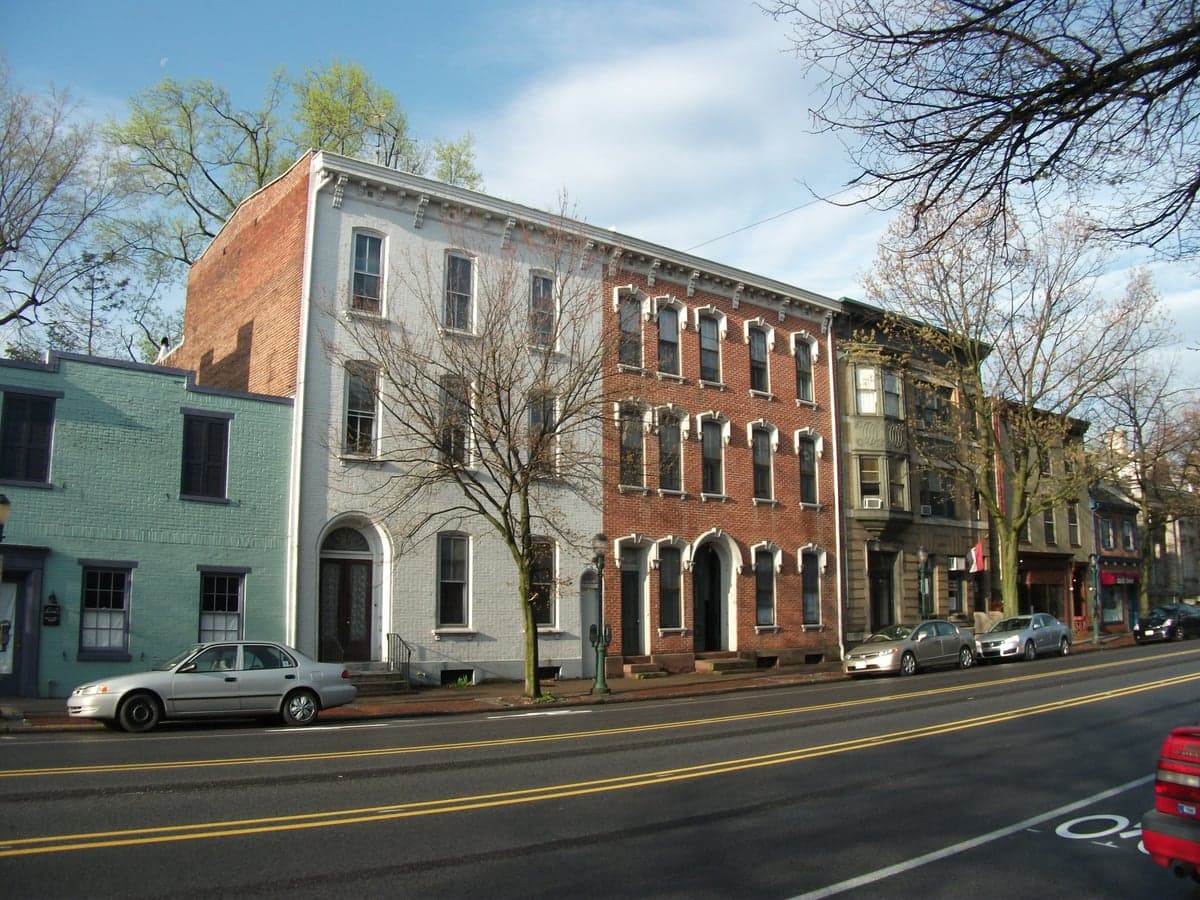
The people of Carlisle, Pennsylvania today form a compact, historically rooted community of 21,335 residents, characterized by a predominantly white population (74.8%) with notable Black (9.9%) and Hispanic (8.7%) minorities, a modest 5.0% foreign-born share, and a college-educated rate of 37.8% that reflects the influence of Dickinson College and the U.S. Army War College. Distinctive identity markers include a strong military presence tied to the Carlisle Barracks, a resilient downtown core, and a civic culture shaped by centuries of German, Scotch-Irish, and African American settlement. The city feels more like a stable, small-scale county seat than a rapidly diversifying metro suburb, with neighborhood patterns still echoing the ethnic and industrial waves of the 19th and early 20th centuries.
How the city was settled and grew
Carlisle was founded in 1751 as the seat of Cumberland County, strategically located along the Great Philadelphia Wagon Road that funneled settlers westward. The original population was overwhelmingly Scotch-Irish and German, drawn by fertile farmland and the promise of land grants from the Penn family. The Scotch-Irish built their early homes and churches in the West End and along the High Street corridor, while German Lutherans and Reformed congregations clustered near the Square and in the North Hanover Street area, where their stone houses and meetinghouses still stand. The arrival of the Cumberland Valley Railroad in 1837 turned Carlisle into a regional manufacturing and shipping hub, attracting Irish laborers who settled in the South Side along the railroad tracks, and later German and Italian immigrants who filled jobs in the town's iron foundries, carriage works, and shoe factories. By 1900, the city's population had swelled to over 9,000, with distinct ethnic enclaves: the Irish in the South Side, Germans in the East End near the Carlisle Iron Works, and a small but growing Black community concentrated in the West South Street neighborhood, drawn by domestic work and railroad labor. The Carlisle Indian Industrial School (1879–1918) at the Carlisle Barracks brought Native American students from across the country, but few stayed after the school's closure, leaving little permanent demographic imprint.
Modern era (post-1965)
The post-1965 period brought modest demographic shifts rather than dramatic transformation. The Hispanic population, now 8.7%, began growing in the 1980s and 1990s, driven by Mexican and Central American immigrants who found work in agriculture (mushroom farming in nearby Chester County), construction, and food processing. These families settled primarily in the South Side and along the West Pomfret Street corridor, where rental housing is more affordable and Spanish-language churches and bodegas have emerged. The Black population, 9.9%, has remained relatively stable since the 1970s, with the historic West South Street neighborhood still serving as the cultural anchor, though some families have moved to newer subdivisions in the North Middleton Township fringe. The Asian population (East/Southeast Asian, 2.8%) is a recent addition, largely tied to professional and academic roles at Dickinson College and the U.S. Army War College, with families living scattered across the College Hill area and newer developments near Trindle Road. The Indian-subcontinent population (0.1%) is negligible, mostly transient professionals at the War College. Suburbanization after 1970 drew many white families to surrounding townships (North Middleton, South Middleton), leaving Carlisle's core older and more diverse, but the city has not experienced the rapid ethnic succession seen in larger Pennsylvania cities like Harrisburg or Lancaster.
The future
Carlisle's population is likely to remain stable or grow slowly, with gradual diversification rather than rapid change. The Hispanic share is the fastest-growing segment, projected to reach 12–14% by 2040, driven by family reunification and continued labor demand in warehousing and logistics (the borough sits at the I-81/I-76 crossroads). This growth will likely concentrate in the South Side and West End, where housing is older and cheaper, potentially creating a more distinct Hispanic enclave. The Black population is expected to plateau or decline slightly as younger families move to more affordable suburbs. The East/Southeast Asian population may grow modestly if Dickinson College and the War College continue to recruit internationally, but will remain a thin, professional layer rather than a concentrated community. The white population will continue to age in place, with younger white families often choosing the surrounding townships over the city itself. The city is not tribalizing into hostile enclaves, but neighborhood-level sorting by income and ethnicity is likely to intensify, with the College Hill and North Hanover Street areas remaining predominantly white and professional, while the South Side becomes more Hispanic and working-class.
For someone moving in now, Carlisle offers a stable, walkable small city with a strong sense of place, but one where demographic change is slow and neighborhood character varies noticeably. The city is becoming slightly more diverse and slightly more stratified, but it remains a place where long-term residents—whether Scotch-Irish descendants, Black families with deep roots, or newer Hispanic arrivals—still share a common civic identity centered on the Square, the Barracks, and the school system. The future is one of gradual, manageable change, not upheaval.

* Values derived from national, state, county, city and local statistics and may differ in a specific area. Last updated: 2026-05-01T00:36:49.000Z
Narrative content on this page is AI-generated and may contain mistakes. Verify any details that matter before acting on them.
ReloMaps may earn a commission from affiliate links at no extra cost to you.

