
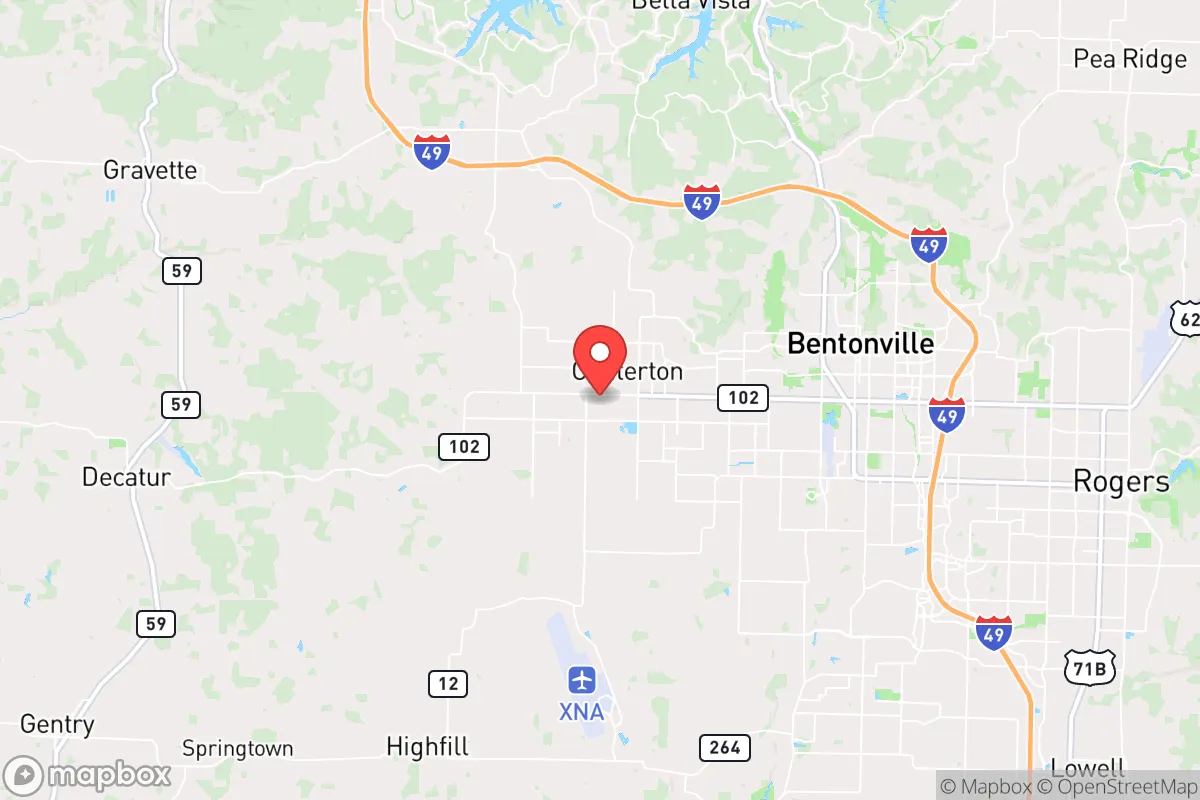
Photo: Wikipedia
Demographics of Centerton, AR
Affluence Level in Centerton, AR
An upper-middle-class area. Household wealth, education levels, and homeownership run ahead of national benchmarks.
People of Centerton, AR
The people of Centerton, Arkansas, today number 20,212 and form a rapidly growing, predominantly white-collar suburb of Bentonville, with a distinctive blend of native Arkansans and out-of-state transplants drawn by the Walmart ecosystem. The city's character is defined by its high proportion of families (median age around 34), a 40.6% college-educated rate that reflects its professional workforce, and a notable 6.1% foreign-born population that includes both Indian and East/Southeast Asian professionals. Unlike older Ozark towns, Centerton feels purpose-built for the 21st century, with new subdivisions and commercial corridors that signal a community still defining its identity.
How the city was settled and grew
Centerton was founded in 1900 as a railroad stop on the St. Louis–San Francisco Railway, drawing its first residents—mostly white farmers of Scots-Irish and English descent—to the surrounding apple orchards and timberland. The original town plat centered on what is now the Downtown Centerton Historic District, where the first general store, blacksmith shop, and schoolhouse served a population that barely reached 300 by 1920. These early families, names like Bolding and Hargis, built simple frame houses along Main Street and North Main Avenue, many of which still stand as private residences. The population remained small and homogeneous through the mid-20th century, with the 1960 census recording just 523 residents, almost entirely white and native-born. The apple industry declined after World War II, and Centerton settled into a quiet farming community until the Walmart effect began reshaping Northwest Arkansas in the 1980s.
Modern era (post-1965)
The 1965 Hart-Cellar Act had little immediate impact on Centerton, but the domestic migration wave that followed Walmart's 1962 founding in nearby Bentonville transformed the city after 1990. The first major influx came in the 1990s and 2000s as Walmart's corporate headquarters expanded, drawing white-collar professionals from across the United States—many from the Midwest and Northeast—who sought affordable housing within a short commute. These newcomers settled in subdivisions like Briarwood and Hunter's Ridge, where three- and four-bedroom homes on quarter-acre lots became the standard. A second, smaller wave arrived after 2010, driven by Walmart's technology and logistics divisions, which brought a measurable Indian-subcontinent population (now 3.8% of the city) and East/Southeast Asian professionals (1.9%), concentrated in newer developments such as Willow Creek and Stone Meadows. The Hispanic population grew to 13.3%, largely through construction and service-sector employment, with families settling in the South Centerton area near Highway 72. The Black population, at 6.4%, reflects both domestic migration from other states and a smaller number of African-American professionals in the Walmart supply chain. Today, Centerton's white population (58.4%) is a mix of longtime Ozark families and recent transplants, while the foreign-born share (6.1%) is almost entirely composed of college-educated professionals in tech, logistics, and management roles.
The future
Centerton's population is heading toward continued growth and moderate diversification, but not toward the deep ethnic enclaves seen in larger cities. The city's housing stock—almost entirely single-family homes in master-planned subdivisions—tends to attract families who prioritize schools and commute times over ethnic clustering, so Indian and East/Southeast Asian professionals are dispersing across neighborhoods like Briarwood and Stone Meadows rather than forming distinct ethnic blocks. The Hispanic population, while growing, is also geographically spread, with no single barrio emerging. The white share is declining gradually as in-migration diversifies, but Centerton remains a majority-white, family-oriented suburb. Over the next 10–20 years, the city will likely homogenize around a professional-class identity—college-educated, politically moderate to conservative, and oriented toward the Walmart economy—rather than tribalize into ethnic enclaves. The main demographic tension will be between longtime residents who remember the farming town and newcomers who see Centerton as a bedroom community for Bentonville and Rogers.
For someone moving in now, Centerton is becoming a stable, upwardly mobile suburb where the population is defined more by occupation and education than by ethnicity. The city offers a predictable, family-friendly environment with good schools and a short commute to Walmart's headquarters, but little of the ethnic diversity or urban energy found in larger Northwest Arkansas towns like Springdale or Fayetteville. It is a place where the people are building a community around corporate employment and suburban comfort, not around deep historical roots or immigrant traditions.

* Values derived from national, state, county, city and local statistics and may differ in a specific area. Last updated: 2026-04-30T02:24:39.000Z
Narrative content on this page is AI-generated and may contain mistakes. Verify any details that matter before acting on them.
ReloMaps may earn a commission from affiliate links at no extra cost to you.

