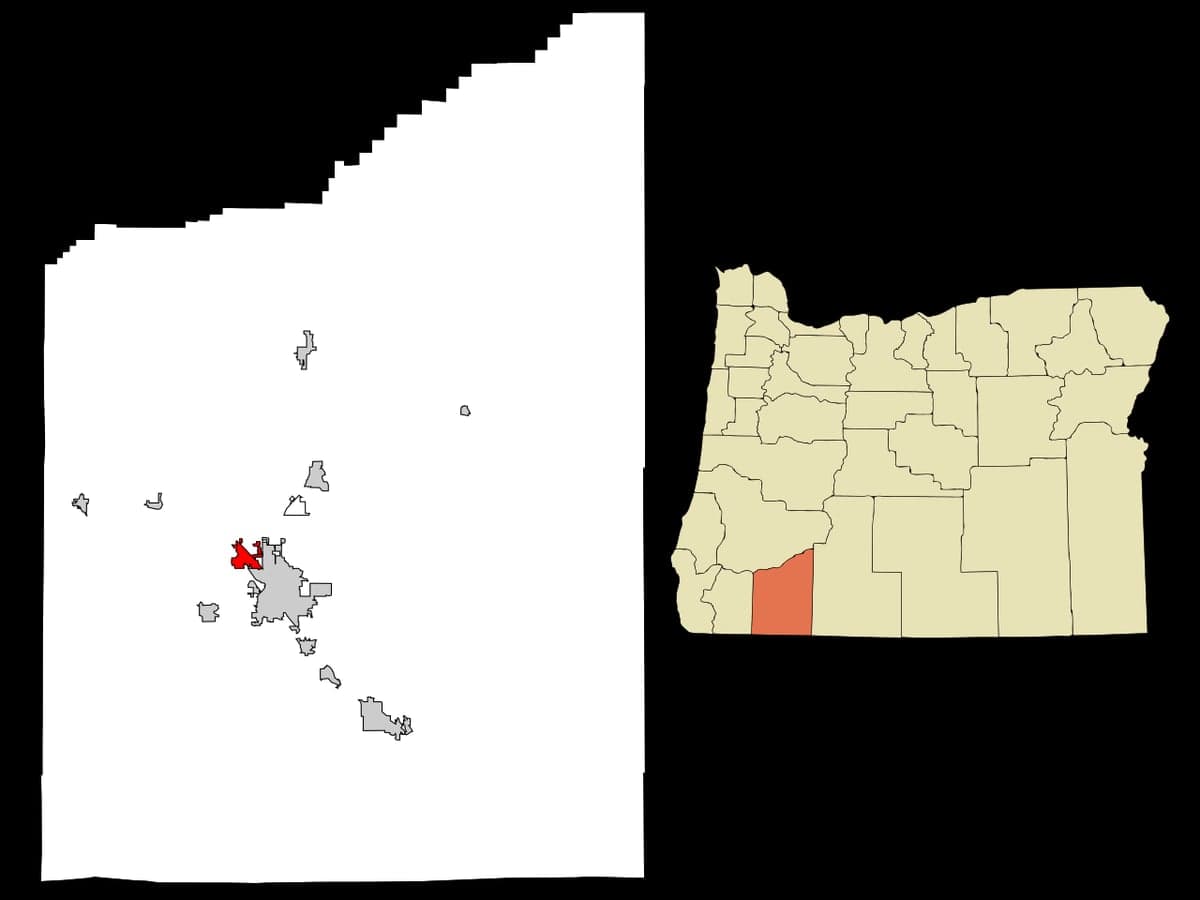
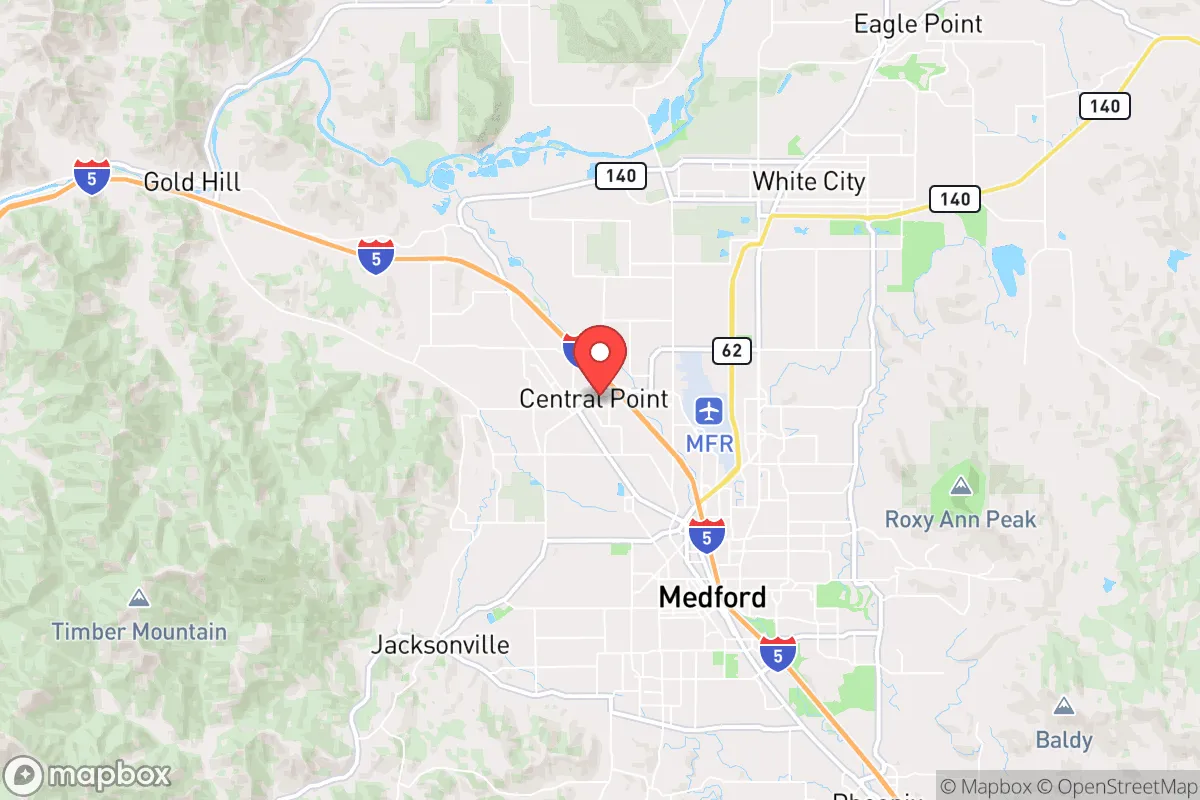
Photo: Wikipedia
Personal Sovereignty in Central Point, OR
Viable for self-reliance. Generally workable, though some barriers may limit total independence.
What does Personal Sovereignty tell us?
Personal Sovereignty measures your capacity for self-reliance and independence with minimal government friction. Higher scores mean fewer barriers between you and the way you want to live... but it assumes you have the space you need and good neighbors.
What does this tell us?
Personal Sovereignty measures your capacity for self-reliance and independence with minimal government friction. Higher scores mean fewer barriers between you and the way you want to live... but it assumes you have the space you need and good neighbors.
State Policy
Energy independence: Importer (35% of energy produced in-state)
Personal Liberty
Homesteading

Personal Liberty Analysis
Central Point, Oregon, offers a notably higher degree of personal sovereignty than many other communities in the Pacific Northwest, largely due to its location in Jackson County—a region that consistently pushes back against state-level overreach from Salem and Portland. While Oregon’s overall political trajectory raises legitimate concerns for those prioritizing autonomy, Central Point sits in a pocket where local governance, cultural norms, and practical realities still allow for a meaningful degree of self-determination. For the single individual or parent looking to minimize government intrusion into daily life, this town represents a strategic compromise: access to the economic and infrastructure benefits of the Rogue Valley without the regulatory chokehold found in the Willamette Valley or the Portland metro area.
Tax burden and regulatory posture in Jackson County
Oregon’s lack of a state sales tax is a genuine advantage for sovereignty-minded residents, as it eliminates one layer of transactional government surveillance and keeps the cost of goods predictable. However, the trade-off comes in the form of relatively high state income taxes—Oregon’s top marginal rate hits 9.9%, which is among the highest in the nation. Property taxes in Jackson County, including Central Point, are moderate by Oregon standards, averaging around 0.85% of assessed value, which is lower than Multnomah County’s 1.1% but higher than some rural eastern Oregon counties. The regulatory posture in Central Point itself is more business-friendly than in Ashland or Medford proper. The city has a streamlined permitting process for home-based businesses and small-scale agriculture, and the county commission has a track record of opposing state mandates on land use and environmental regulations. That said, Oregon’s statewide land-use laws—particularly the Urban Growth Boundary (UGB) restrictions—still apply, meaning you cannot simply build whatever you want wherever you want. For a prepper or survivalist, this is the single biggest regulatory friction point: you cannot legally homestead on raw land outside the UGB without going through a lengthy and expensive conditional use process. Inside city limits, zoning is generally permissive for accessory dwelling units (ADUs) and workshops, but don’t expect to run a full-scale off-grid operation on a standard residential lot without neighbor complaints and code enforcement visits.
Self-defense rights and Oregon’s gun law landscape
Oregon’s gun laws have become a flashpoint for sovereignty concerns, and Central Point sits squarely in the middle of that fight. The state passed Measure 114 in 2022, which mandated permit-to-purchase requirements, a ban on magazines over 10 rounds, and universal background checks. However, as of early 2026, the law remains tied up in court challenges, and enforcement is inconsistent across counties. Jackson County has been a vocal opponent: the sheriff has publicly stated he will not enforce magazine bans or permit requirements he deems unconstitutional, and the county commission passed a Second Amendment Sanctuary resolution. What this means on the ground is that gun owners in Central Point enjoy de facto greater freedom than those in Portland or Eugene, where local police actively enforce state restrictions. You can still purchase standard-capacity magazines at local gun shops, and concealed carry permits are issued routinely with minimal wait times. Open carry is legal without a permit in Oregon, though local ordinances in Medford and Ashland restrict it in certain public spaces. For the survivalist, the practical takeaway is that Central Point offers a relatively safe harbor for firearm ownership, but you should monitor the legal landscape closely—a future court ruling or legislative action could change the enforcement posture overnight. The local gun culture is strong, with multiple ranges and training facilities within a 20-minute drive, and the community is generally supportive of self-defense rights.
Self-reliance and homesteading viability in Central Point
For those serious about self-reliance, Central Point’s appeal lies in its balance of suburban convenience and rural access. Standard residential lots in the city proper range from 6,000 to 12,000 square feet, which is enough for a substantial garden, a few fruit trees, and a small chicken coop—but not enough for livestock like goats or pigs without a special permit. The real opportunity lies just outside city limits in the unincorporated areas of Jackson County, where zoning allows for 2- to 5-acre parcels with minimal restrictions on agricultural use. These parcels are still within a 10-minute drive of Central Point’s grocery stores and schools, making them viable for a suburban homesteading lifestyle. Off-grid feasibility is mixed: Oregon’s building codes require connection to the electrical grid for new construction in most zones, but solar panels with battery backup are widely accepted as supplemental systems. Water rights are a critical consideration—Oregon’s water laws are complex and heavily regulated, and drilling a new well requires a permit from the Water Resources Department, which can take months. Rainwater catchment is legal but limited to 5,000 gallons of storage without a permit. For the prepper, the key constraint is that true off-grid independence is difficult to achieve legally within commuting distance of Central Point; you would need to look further east toward Klamath Falls or Lakeview for that level of autonomy. However, for a 90% self-reliant lifestyle—growing food, raising poultry, storing water, and generating backup power—Central Point’s outskirts are workable.
Personal liberties: parental rights, medical autonomy, speech, and property
Parental rights in Oregon have been under pressure from state-level policies, but Jackson County has pushed back. The county school board has resisted mandatory critical race theory and gender ideology curricula, and Central Point’s school district (Central Point School District 6) allows parents to opt their children out of any sex education or health instruction they find objectionable. Homeschooling is straightforward: Oregon requires only a simple notice of intent and annual standardized testing, with no curriculum approval or home visits. Medical autonomy is a mixed bag. Oregon has legalized physician-assisted suicide and recreational marijuana, which some sovereignty-minded individuals view as expansions of personal choice. However, the state also mandates childhood vaccinations for school attendance (with medical and religious exemptions available), and COVID-era mandates left a bitter taste for many. The local medical community in Central Point is generally respectful of patient choice, and there are several naturopathic and functional medicine practitioners within the Rogue Valley. Free speech protections are robust in Jackson County; local government meetings are often contentious and public comment periods are genuinely open, unlike in some larger cities where they are restricted. Property rights are the weakest link in Oregon’s sovereignty framework. The state’s land-use system, established in the 1970s, gives the state government significant control over what you can do with your land. You cannot subdivide rural property without state approval, and building a second dwelling on agricultural land is nearly impossible. This is a major frustration for families who want to create multi-generational compounds or rent out a cabin for income. Central Point’s city council has been more accommodating than the county on accessory dwellings, but the state-level constraints remain a real limitation.
Overall, Central Point offers a sovereignty profile that is strong for the Pacific Northwest but modest compared to states like Idaho, Montana, or Texas. The tax burden is manageable if you can structure your income to avoid the top state brackets, and the local political climate provides a buffer against the worst of Salem’s overreach. The gun rights environment is favorable for now, the homesteading potential is real on the outskirts, and parental rights are still respected in practice. The biggest trade-offs are Oregon’s land-use restrictions and the ever-present risk of state-level legislative creep. For the strategic relocator who wants to stay in the West but avoid the chaos of California or the Portland metro, Central Point is a solid defensive play—not a libertarian paradise, but a place where a determined individual can still live largely on their own terms. Keep an eye on the 2026 elections and any court rulings on Measure 114; those will tell you whether this window of relative freedom is widening or closing.

* Values derived from national, state, county, city and local statistics and may differ in a specific area. Last updated: 2026-05-03T16:58:06.000Z
Narrative content on this page is AI-generated and may contain mistakes. Verify any details that matter before acting on them.
ReloMaps may earn a commission from affiliate links at no extra cost to you.

