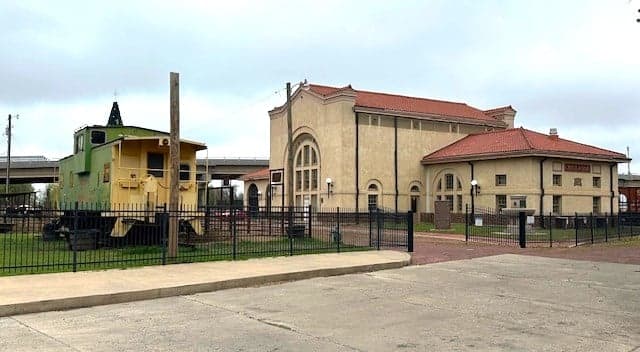
Photo: Wikipedia
Strategic Assessment of Chickasha, OK
Meaningful friction. Expect exposure to either population pressure, blast zones, or natural disaster risk. Consider buying a retreat property.
What does the Strategic Assessment tell us?
Our Strategic Assessment grades tactical survivability of an area. Major population centers, military targets, fallout zones, natural disasters, and border exposure all drive risk — lower exposure means a more defensible position in a crisis.
This is heavily inspired by Joel Skousen's Strategic Relocation book. Highly recommended you checkout the book ($)What does this tell us?
Our Strategic Assessment grades tactical survivability of an area. Major population centers, military targets, fallout zones, natural disasters, and border exposure all drive risk — lower exposure means a more defensible position in a crisis.
This is heavily inspired by Joel Skousen's Strategic Relocation book. Highly recommended you checkout the book ($)Strategic Pillars

Key Distances
Regional Safe Places
Below is our recommended "safe zones" in Oklahoma and the surrounding area based on our strategic heuristics. For most people, it's unrealistic to live in a “safe zone” full-time due to work, family or other personal reasons. They tend to be more rural. However, many of these areas are perfect for second homes and retreat properties that double as a vacation home or even a short-term rental.
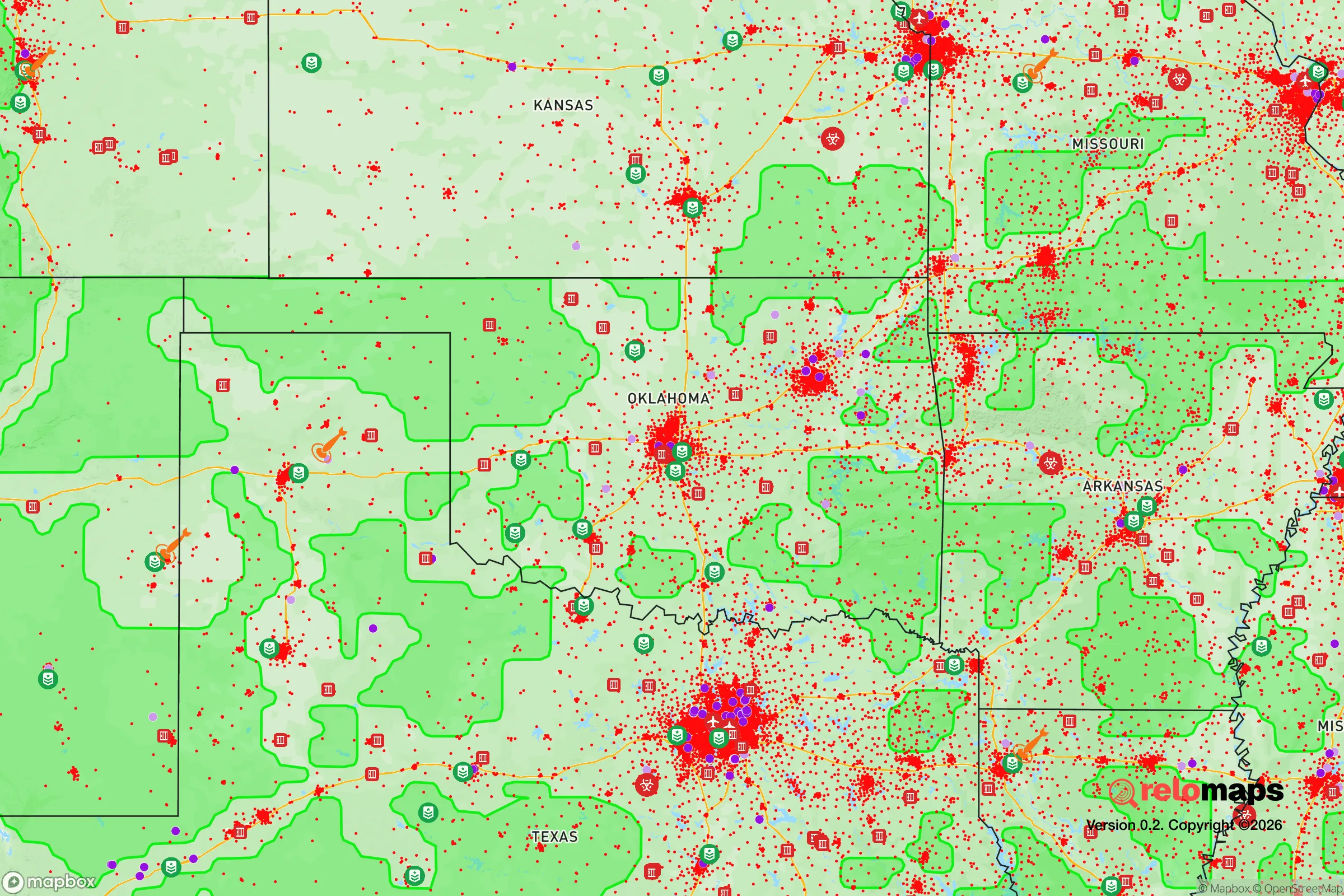
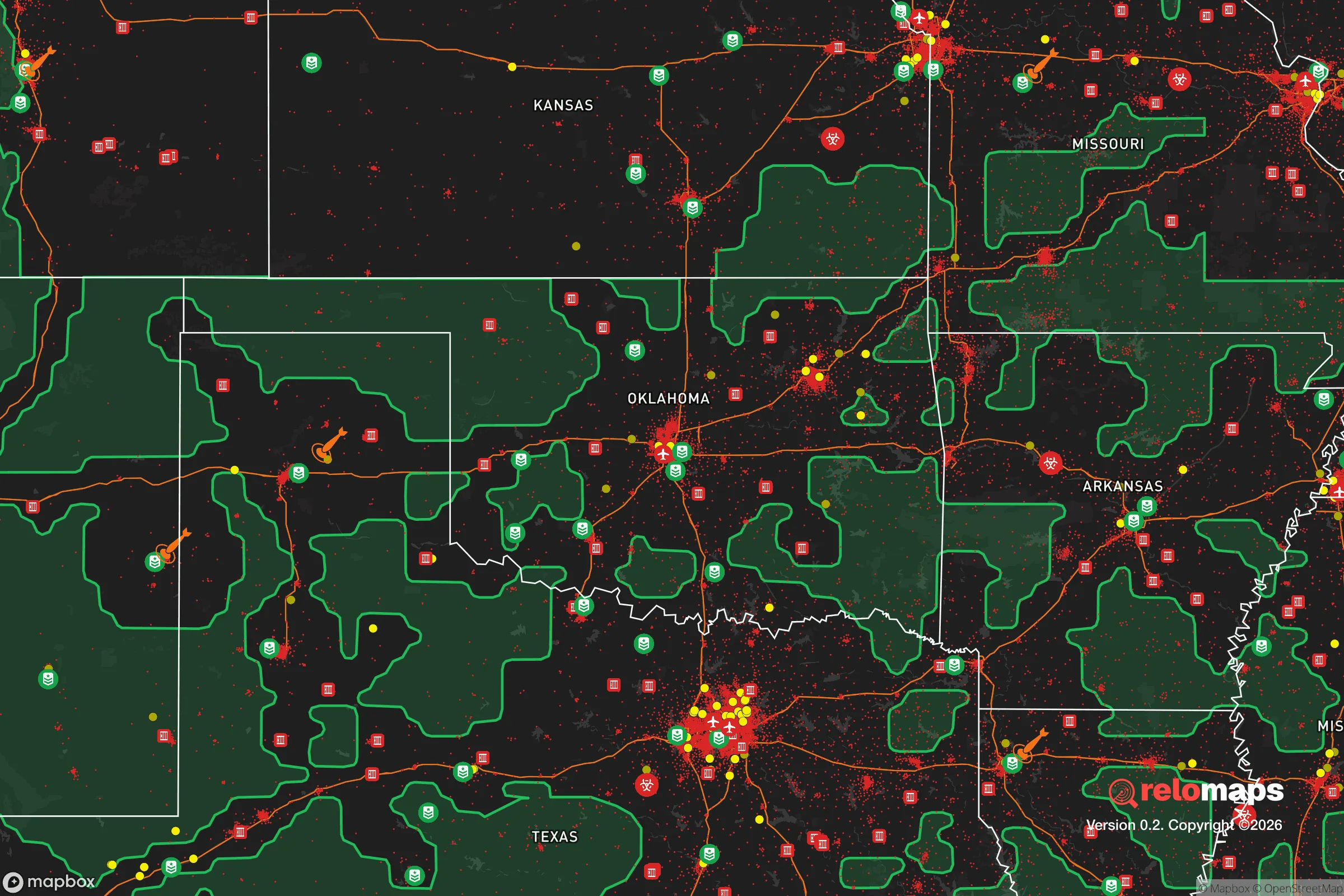


Important Note: For informational purposes only. This does not mean nothing bad ever happens in the green zones. Please use common sense. This is based on public data and modeled with AI. We tried to take a conservative approach but mistakes happen. We update this regularly as new information becomes available.
Solar Generator Recommendations
Backup power matters more here than in safer locations. We've picked three solar generators across budgets and capacity tiers — start with the budget unit if you only need a few essentials, or step up if you want to run a fridge and HVAC for days at a time.

Jackery Portable Power Station Explorer 300
Budget OptionPower on the Go: Weighing only 11 lbs, it's convenient to set up and store with book-sized foldable solar panels

BLUETTI Portable Power Station AC180
Designed for both indoor and outdoor scenarios, AC180 is highly capable as it has a robost capacity and continuous output power.

EF ECOFLOW DELTA Pro Ultra Power Station
Upgraded PickEcoFlow DELTA Pro Ultra is a whole-home energy system designed to grow with your family. Integrated with the Smart Home Panel 2, it scales to meet your evolving energy needs — keeping your home powered, intelligent, and secure through every stage of life.
We earn a commission, at no additional cost to you.
Strategic Assessment Analysis
Chickasha, Oklahoma, sits in a sweet spot for the prepper-minded relocator: close enough to Oklahoma City for supply runs and medical access, but far enough out that you won't be caught in the blast radius of a major event or the crush of a panicked evacuation. The town's position along the Washita River and its historic role as a railroad and agricultural hub give it a built-in resilience that many bedroom communities lack. For someone thinking about long-term stability, civic unrest, or even a major disaster scenario, Chickasha offers a surprisingly solid foundation—provided you understand both its strengths and its soft spots.
Geographic position and natural advantages for long-term stability
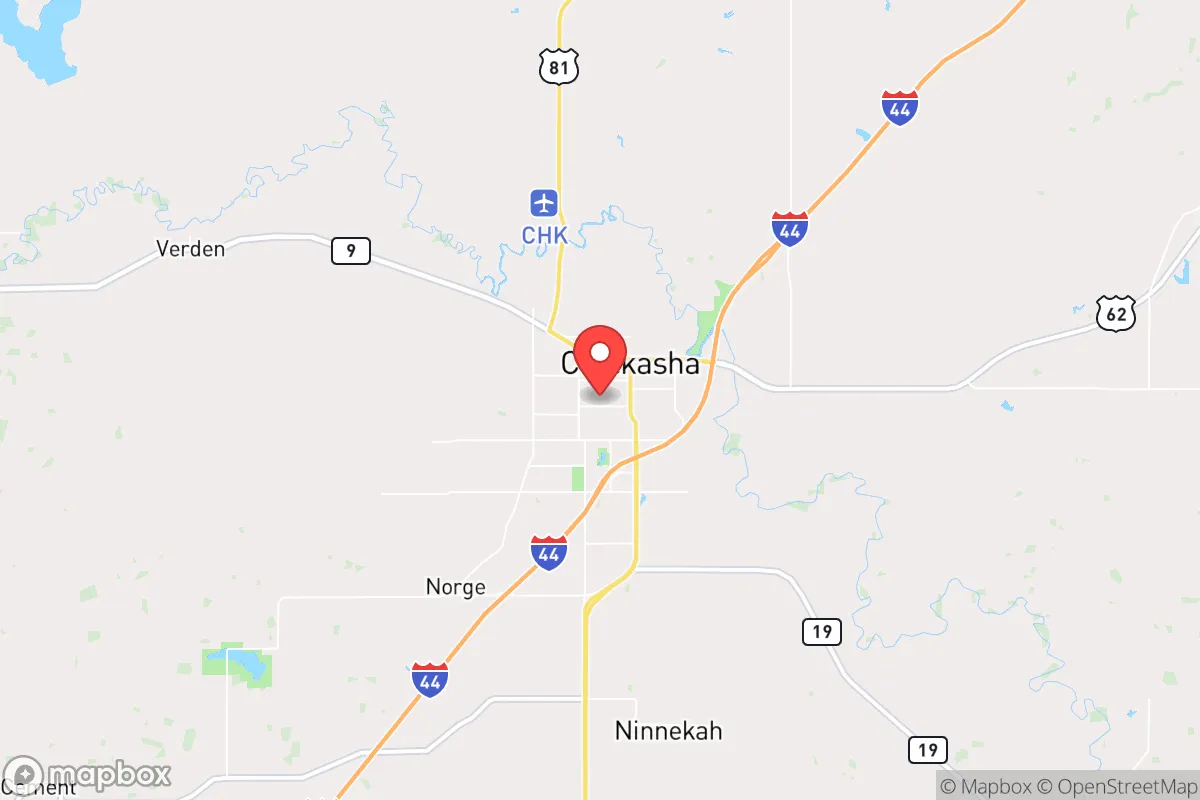
Chickasha sits in Grady County, roughly 40 miles southwest of downtown Oklahoma City. That distance is critical: it's far enough to avoid the immediate fallout zone of a major urban disaster—whether that's a nuclear event, a coordinated attack, or simply the collapse of civil order in a metro of 1.4 million people—but close enough that you can still access specialty medical care, heavy equipment, or bulk supplies if the roads are open. The Washita River runs through town, providing a surface water source that, with proper filtration, could sustain a household. The surrounding terrain is gently rolling prairie and farmland, which means good drainage, decent soil for gardening, and few natural barriers that would trap you in a crisis. The climate is continental: hot summers, cold winters, and a reliable spring rainy season that fills ponds and aquifers. Tornado risk is real—Grady County sits in the heart of Tornado Alley—but that's a known, manageable hazard for anyone with a storm shelter and a plan. The area's agricultural base means that even if supply chains falter, local food production (cattle, wheat, hay, and some row crops) can keep a community fed longer than a purely suburban or exurban location.
Risks, exposures, and proximity to fallout-relevant landmarks
The biggest strategic concern for Chickasha is its proximity to Tinker Air Force Base, located about 35 miles northeast near Oklahoma City. Tinker is a major strategic asset—home to the Air Force Sustainment Center and a hub for logistics and maintenance of the B-1, B-52, and KC-135 fleets. In a major conflict or escalation, Tinker is a high-priority target. While Chickasha is outside the likely blast radius of a conventional or even low-yield nuclear strike on Tinker, fallout patterns depend heavily on wind direction. Prevailing winds in Oklahoma are from the south and southwest, which means that in many scenarios, Chickasha could be upwind of Tinker—a significant advantage. But if the wind shifts to the north or northeast, the town could be in the fallout plume. That's not a dealbreaker, but it means a prepper here needs a fallout shelter with at least two weeks of supplies, not just a storm cellar. Other nearby infrastructure worth noting: the Oklahoma City metro has major rail yards, fuel depots, and interstate junctions (I-35, I-40, I-44) that could become chokepoints or targets during civil unrest. Chickasha itself has a small rail line and a regional airport, but nothing that would draw a deliberate strike. The town's population of roughly 16,000 means it's small enough to avoid the worst of urban chaos but large enough to have a police force, a hospital (Grady Memorial), and some basic infrastructure. The risk of localized unrest or resource scarcity during a national crisis is moderate—comparable to most small towns in the Plains.
Practical resilience for a relocator: food, water, energy, and defensibility
For someone serious about self-sufficiency, Chickasha has real advantages. The water situation is workable: the Washita River is perennial, and the city's municipal water comes from the Fort Cobb Reservoir and the Rush Springs Aquifer. A well-drilled property outside city limits gives you independent water access, and the water table in Grady County is generally reliable at depths of 100-200 feet. Rainwater catchment is also viable, given the area's 34 inches of annual precipitation. Food production is straightforward: the growing season runs from April to October, and the soil—mostly silt loam and clay loam—supports gardens, orchards, and small livestock. Local farmers' markets and co-ops exist, but for a prepper, the real value is in establishing your own supply chain before a crisis hits. Energy resilience is mixed. The grid is served by OG&E, and outages during ice storms or tornadoes are common—sometimes lasting days. Solar is a strong option here: Grady County gets about 230 sunny days per year, and net metering is available, though policies could shift. A backup generator with a buried propane tank is a near-necessity for anyone wanting true off-grid capability. Defensibility is where Chickasha gets interesting. The town is laid out on a grid around the Washita, with a few natural chokepoints—bridges and railroad crossings—that could be monitored or controlled. The surrounding countryside is open farmland, which means long sightlines and limited cover for anyone approaching. A rural property with a good well, solar array, and a storm shelter doubles as a defensible position. The local gun culture is strong, and Oklahoma has constitutional carry, so you won't face legal hurdles to self-defense. The Grady County Sheriff's Office is professional but small; in a widespread crisis, you should expect to rely on yourself and your neighbors.
The overall strategic picture for Chickasha is one of moderate risk and high reward for the conservative-minded relocator. It's not a remote mountain redoubt—you're still within a day's drive of a major metro and a strategic military target. But it's far enough out to avoid the worst of urban collapse, and the local resources (water, farmland, community resilience) are real. The key is preparation: a fallout shelter, a well, solar or generator backup, and a network of like-minded locals. If you're looking for a place that balances access to civilization with genuine survivability, Chickasha deserves a hard look. Just don't expect to coast—this is a place that rewards effort, not luck.

* Values derived from national, state, county, city and local statistics and may differ in a specific area. Last updated: 2026-04-25T13:52:07.000Z
Narrative content on this page is AI-generated and may contain mistakes. Verify any details that matter before acting on them.
ReloMaps may earn a commission from affiliate links at no extra cost to you.

