Photo: Wikipedia
Political ClimatePolitical Climate in Chickasha, OK
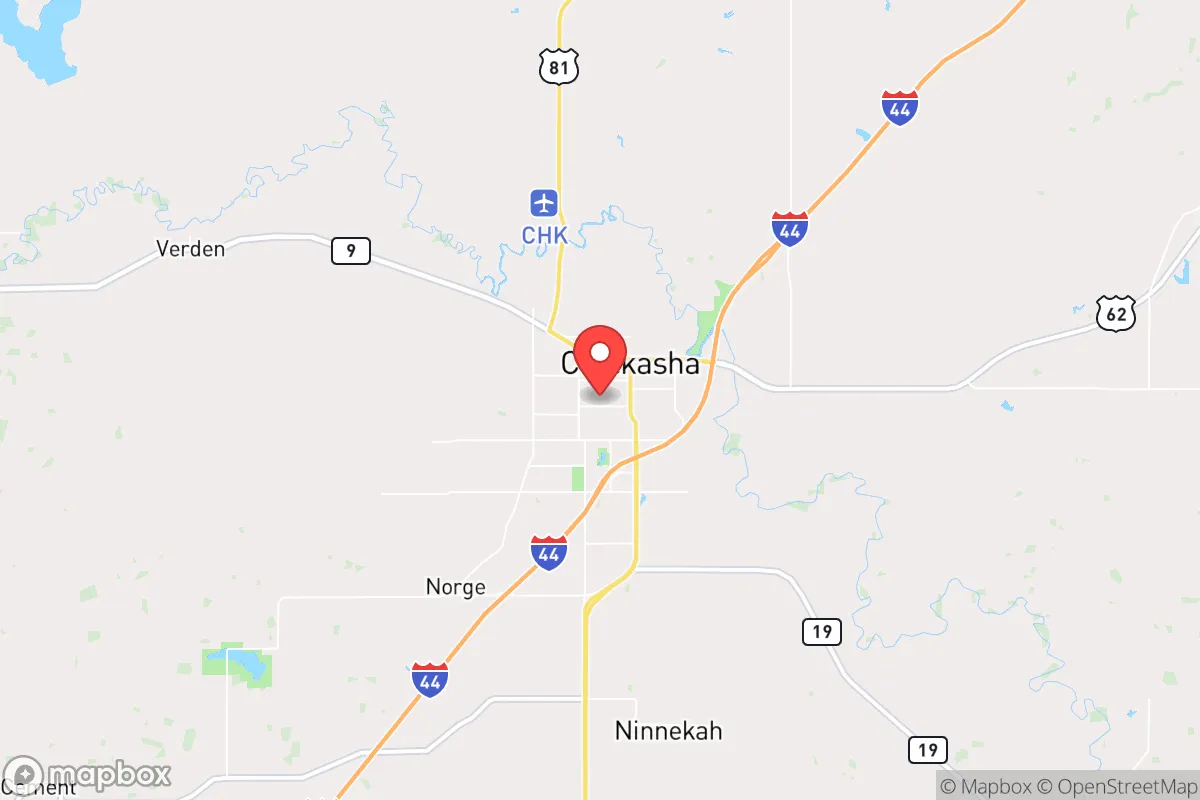
District shown is the primary district for this city’s centroid. Cities may span multiple districts.
Local Political AnalysisPolitical Analysis of Chickasha, OK
Chickasha is about as solidly conservative as they come in Oklahoma, and that's been the case for as long as anyone around here can remember. With a Cook PVI of R+17, the area votes reliably Republican in nearly every election, and you don't see much of the political hand-wringing you'd find in places like Norman or Oklahoma City. The local culture is built on traditional values, personal responsibility, and a healthy skepticism of government telling folks how to live their lives. If you're looking for a place where the political winds don't shift with every national trend, Chickasha is a breath of fresh air.
How it compares
Drive thirty minutes east to Norman, and you'll hit a completely different political planet—a college town that's been trending blue for years, with all the progressive activism and government expansion that comes with it. Chickasha, by contrast, has held steady. The surrounding Grady County votes overwhelmingly Republican, and the city council and county commission reflect that. Even compared to other conservative towns in the region, like Duncan or Lawton, Chickasha feels more grounded. There's less of the "we need to keep up with the big cities" mentality. People here are more concerned with protecting their Second Amendment rights and keeping property taxes low than with chasing the latest social experiments coming out of Washington or the state capitol.
What this means for residents
For the average person living in Chickasha, the conservative tilt means a government that mostly stays out of your way. You won't see mask mandates or business shutdowns like you did in some parts of the country during the pandemic—local leaders trusted folks to make their own decisions. The school board isn't pushing critical theory or gender ideology on elementary kids, and the local sheriff isn't going to enforce federal gun laws that don't sit right with the Constitution. That said, there's always a concern that outside money and outside activists could try to change things. The biggest threat to the way of life here isn't from within—it's from state-level politicians who might cave to pressure from coastal donors or federal overreach that tries to dictate how we run our farms, our churches, and our families.
What daily life is like for families
If you're raising kids here, you'll find a community that still believes in neighborhood watch, church potlucks, and letting kids play outside without a government program attached. The local economy is built on agriculture and small business, not government contracts or tech startups, so there's less of the "progressive transplant" influx you see in places like Edmond or Tulsa. People wave at each other on the street, and the biggest political arguments tend to be about school bond issues or road repairs—not culture war nonsense imported from cable news. The long-term outlook is cautiously optimistic, as long as the state keeps pushing back against federal mandates and the county stays focused on local control. But if you see the city council start flirting with "equity" initiatives or the school board adopting curriculum from out-of-state consultants, that's the canary in the coal mine. For now, though, Chickasha remains a place where common sense still rules, and that's worth holding onto.

State Political ClimatePolitical Climate in Oklahoma
State Political AnalysisPolitical Environment in the State
Oklahoma has been a reliably red state for decades, but the political climate here is more layered than the simple "deep red" label suggests. The state leans Republican by about 20 points in presidential elections, with Donald Trump winning by 33 points in 2020 and 34 points in 2024, but that margin masks a growing urban-rural split and a quiet but real shift among suburban voters. Over the last 10-20 years, Oklahoma has moved from a moderate, Democrat-friendly state (voting for Clinton in 1996) to a solidly conservative one, driven by rural turnout and the collapse of the old Democratic machine in eastern Oklahoma. However, the Oklahoma City and Tulsa metros are now the real battlegrounds for the state’s future direction.
Urban vs. rural divide
The political map of Oklahoma is stark. The two major metros—Oklahoma City and Tulsa—are the only places where Democrats can compete, and even then, it’s mostly in the urban cores. Oklahoma County (Oklahoma City) voted for Trump by only 4 points in 2024, down from 12 points in 2016, driven by rapid growth in the city’s central districts and suburbs like Edmond and Norman. Tulsa County went for Trump by 15 points in 2024, but the city of Tulsa itself is a blue island, with precincts near downtown and the Pearl District flipping hard to the left. Meanwhile, rural counties like Cimarron, Texas, and Beaver in the Panhandle routinely give Trump 85-90% of the vote. The real story is the suburban ring around Oklahoma City—places like Yukon, Mustang, and Moore—which are still solidly red but are seeing in-migration from blue states, slowly shifting the margins. If you’re moving to Oklahoma, your experience of the political climate will depend entirely on whether you’re in the city, the suburbs, or the sticks.
Policy environment
Oklahoma’s policy environment is aggressively conservative, and that’s a feature, not a bug, for most residents. The state has a flat income tax of 4.75%, with a plan to drop it to 3.99% by 2027, and no estate tax. Sales taxes are high (averaging 8.9% statewide), but property taxes are among the lowest in the nation—about 0.9% of assessed value. The regulatory posture is business-friendly, with right-to-work laws and a tort reform system that caps non-economic damages. On education, Oklahoma has a robust school choice program: the Oklahoma Parental Choice Tax Credit gives up to $7,500 per child for private school tuition, and the state has one of the highest charter school densities in the country. Healthcare is a mixed bag—Medicaid expansion passed via ballot initiative in 2020, but the state legislature has resisted further expansion of government-run care. Election laws are strict: voter ID is required, and the state purges inactive voters regularly. For a conservative-leaning family, the policy environment is a strong draw—low taxes, school choice, and limited government interference in daily life.
Trajectory & freedom
Oklahoma has been on a trajectory of expanding personal freedom, particularly in the last five years. The state passed constitutional carry (permitless carry) in 2019, meaning no license needed to carry a firearm. In 2022, Governor Kevin Stitt signed the Oklahoma Heartbeat Act, banning abortion after six weeks, and in 2024, the state enacted a near-total ban with no exceptions for rape or incest. Parental rights were strengthened with the 2022 Parents’ Bill of Rights, which requires schools to notify parents of any changes in a child’s services or mental health. On medical autonomy, Oklahoma banned gender transition procedures for minors in 2023 (SB 613) and prohibited public funding for such care. Property rights got a boost with the 2023 “Take Ownership” law, which limits eminent domain for private economic development. The state also passed a law in 2024 requiring all public schools to display the Ten Commandments, though that’s being challenged in court. The trajectory is clearly toward more freedom in the traditional sense—less government overreach on guns, education, and medical decisions—but critics argue it’s also toward less personal autonomy for those who don’t align with the majority. For a new resident, expect the trend to continue: more school choice, more gun rights, and more state-level resistance to federal mandates.
Civil unrest & political movements
Oklahoma has seen its share of political flashpoints, but they’re not the kind you see in Portland or Seattle. The most visible movement is the rise of the “Oklahoma Freedom Caucus,” a hardline conservative group in the state legislature that has pushed for further tax cuts, school choice expansion, and anti-ESG investing laws. On the left, the “Oklahoma Poor People’s Campaign” and the “Tulsa Race Massacre Centennial Commission” have kept racial justice issues alive, but they’re small and localized. Immigration politics are hot: in 2024, the state passed HB 4156, which makes it a state crime to be in Oklahoma illegally, and Governor Stitt has deployed the National Guard to the Texas border. There’s been no serious secession or nullification rhetoric, but the state has sued the Biden administration multiple times over environmental regulations and vaccine mandates. Election integrity controversies flared in 2020 when Trump’s team challenged results in a few counties, but Oklahoma’s paper ballot system and strict voter ID laws meant no major disputes. The most visible protest in recent years was the 2022 teacher walkout, which drew 30,000 to the Capitol, but that was about funding, not culture war issues. For a new resident, the political atmosphere is generally calm—you won’t see daily protests, but you will hear passionate debates about school choice and gun rights at the local diner.
Projection
Over the next 5-10 years, Oklahoma is likely to become even more conservative, but with a twist. The in-migration from blue states—especially Texas and California—is accelerating, with places like Broken Arrow, Edmond, and Bixby seeing explosive growth. These newcomers are often conservative-leaning but bring a more suburban, libertarian vibe that could push the state toward even lower taxes and more school choice, but also toward a more moderate stance on social issues like marijuana (already legal for medical use) and criminal justice reform. The rural counties will continue to dominate the legislature, but the urban-suburban growth in Oklahoma City and Tulsa will slowly shift the political center of gravity. Expect more fights over property taxes (rural homeowners want caps, urban newcomers want services) and education funding (rural schools are struggling, suburban schools are booming). The biggest wildcard is the state’s budget: oil and gas revenues are volatile, and if they drop, the tax cuts could stall. For a family moving in now, expect to find a state that is still deeply red but with a growing libertarian streak—less government in your wallet and your home, but more government in your classroom and your doctor’s office.
Bottom line: Oklahoma is a safe bet for a conservative-leaning family or individual who values low taxes, school choice, and gun rights, and who doesn’t mind a slower pace of life. The political climate is stable, the government is generally hands-off on personal freedoms, and the culture wars are real but not disruptive. If you’re moving here, you’ll find a state that’s proud of its independence and suspicious of federal overreach—and that’s exactly how most folks here like it.
* Values derived from national, state, county, city and local statistics and may differ in a specific area. Last updated: 2026-04-25T13:52:07.000Z
Narrative content on this page is AI-generated and may contain mistakes. Verify any details that matter before acting on them.
ReloMaps may earn a commission from affiliate links at no extra cost to you.

