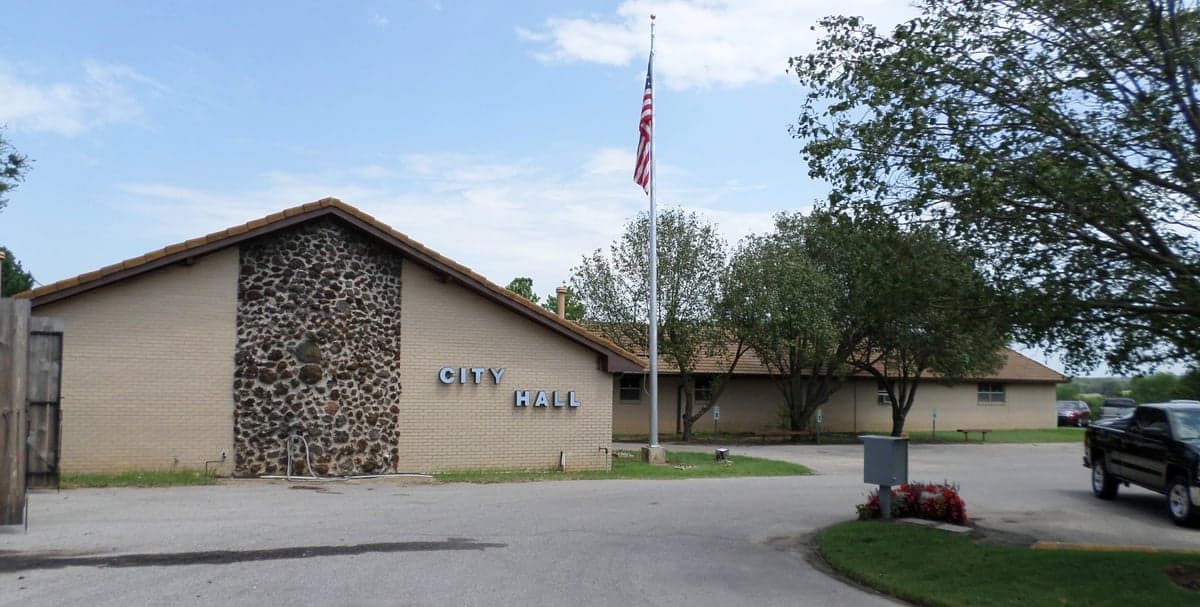
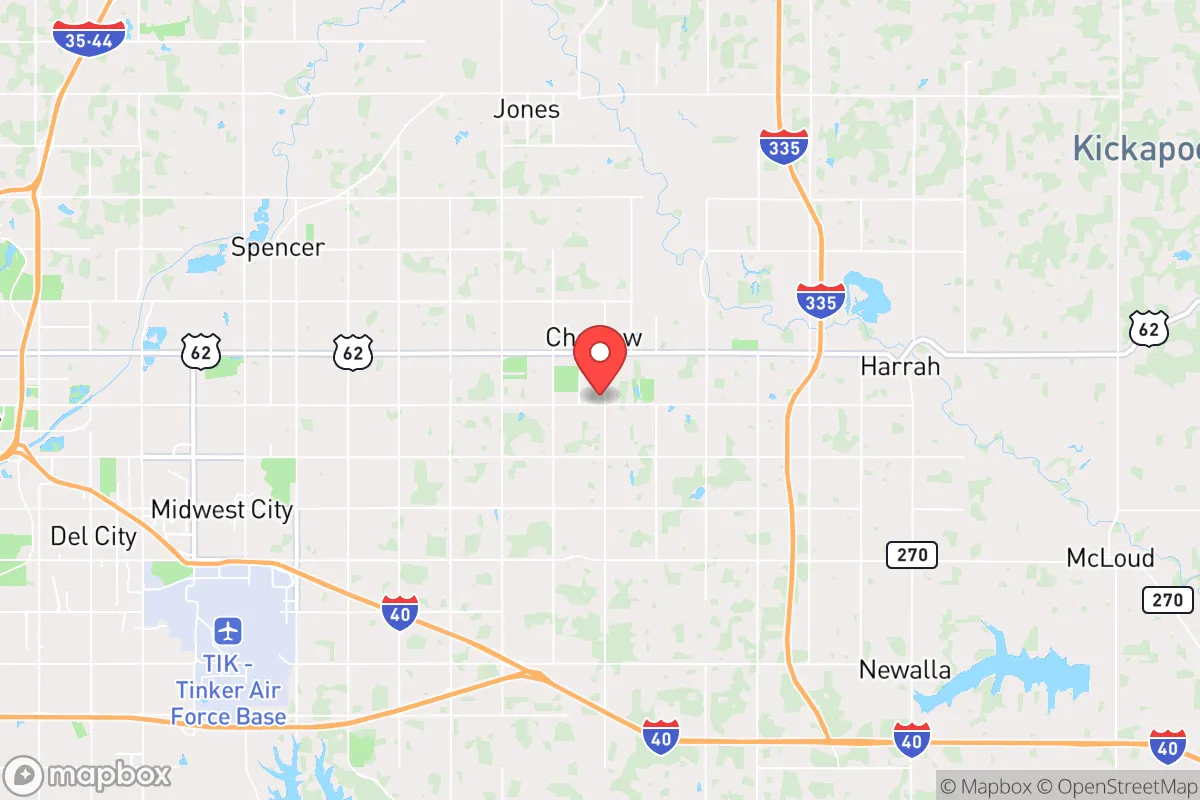
Photo: Wikipedia
Demographics of Choctaw, OK
Affluence Level in Choctaw, OK
An upper-middle-class area. Household wealth, education levels, and homeownership run ahead of national benchmarks.
People of Choctaw, OK
The people of Choctaw, Oklahoma today number 12,208, forming a predominantly white (79.4%) community with a notably small foreign-born population (0.1%). The city retains a distinct rural-suburban character, with a lower college attainment rate (30.3%) than the national average and a population density that feels more small-town than suburban sprawl. Its identity is shaped by deep-rooted family histories, a strong sense of local independence, and a demographic profile that has remained remarkably stable over recent decades.
How the city was settled and grew
Choctaw’s settlement story begins not with its namesake tribe but with the 1889 Land Run, which opened unassigned lands in central Oklahoma to non-Native homesteaders. The original population was overwhelmingly white, drawn by the promise of 160-acre homesteads under the Homestead Act. The town was platted in 1890 along the Choctaw, Oklahoma and Gulf Railroad line, and early settlers clustered around the original townsite near what is now NE 23rd Street and Choctaw Road. The historic Old Town District — centered on Main Street and the original depot — became the commercial and social hub for these first families, many of whom were farmers and ranchers from the Midwest and Upper South. By the 1920s, the community had grown slowly, supported by cotton farming, cattle ranching, and a small but steady oil and gas industry. The Harrah-Choctaw Road corridor saw the first wave of residential expansion in the 1940s and 1950s, as returning WWII veterans and their families built modest homes on former farmland. This period cemented the city’s identity as a quiet, working-class bedroom community for nearby Oklahoma City and Tinker Air Force Base.
Modern era (post-1965)
After the 1965 Hart-Cellar Act, Choctaw experienced virtually none of the immigration-driven diversification seen in larger metro areas. The foreign-born population remains at 0.1%, and the city’s racial composition has shifted only modestly. The most notable change has been the growth of the Hispanic population to 7.5%, concentrated primarily in the South Choctaw area near SE 15th Street and Choctaw Road, where newer housing developments and rental properties have attracted young families. East and Southeast Asian residents (2.4%) are scattered across the city, with a small cluster near the Indian Meridian corridor in newer subdivisions built in the 2000s. The Black population remains very small (0.9%), and Indian subcontinent residents are negligible (0.1%). Domestic in-migration has been the primary driver of population growth, with families moving from Oklahoma City’s eastern suburbs seeking larger lots and lower property taxes. The Lake Hiwassee area in the city’s northeast has absorbed much of this growth, with new single-family subdivisions marketed to commuters working at Tinker Air Force Base or in Oklahoma City’s energy sector. The Briarwood Estates neighborhood, developed in the 1990s and 2000s, represents the city’s most affluent enclave, attracting professionals and small business owners.
The future
Choctaw’s population is projected to grow modestly, likely reaching 14,000–15,000 by 2035, driven by continued suburban spillover from Oklahoma City. The city is not homogenizing into a single demographic block but rather developing distinct enclaves: the historic Old Town District remains older and whiter, the Lake Hiwassee area is attracting younger families (including a growing share of Hispanic residents), and Briarwood Estates is becoming more diverse in income but not significantly in race. The Hispanic population is the fastest-growing segment, but it is assimilating into the broader community rather than forming a distinct ethnic enclave. The East and Southeast Asian population is plateauing, with no new immigration wave expected. The foreign-born share will likely remain below 1% for the foreseeable future. The city’s political character — conservative, with a strong independent streak — is unlikely to shift significantly, as in-migrants tend to share similar values. The main demographic tension will be between long-time residents who value the rural character and newcomers who want more amenities and services.
For someone moving in now, Choctaw offers a stable, predominantly white community with a strong sense of local identity and minimal ethnic or cultural friction. The city is becoming slightly more diverse in its Hispanic population but remains one of the least diverse suburbs in the Oklahoma City metro. The trade-off is clear: a quiet, safe, and affordable environment with limited demographic change, but also limited cultural variety and a population that skews older and less educated than the national average. It is a place for those who value continuity over change.

* Values derived from national, state, county, city and local statistics and may differ in a specific area. Last updated: 2026-04-21T11:17:08.000Z
Narrative content on this page is AI-generated and may contain mistakes. Verify any details that matter before acting on them.
ReloMaps may earn a commission from affiliate links at no extra cost to you.

