Photo: Wikipedia
Demographics of Chula Vista, CA
Affluence Level in Chula Vista, CA
A middle-class area roughly in line with national averages across income, home values, education, and employment.
People of Chula Vista, CA
The people of Chula Vista today form a dense, majority-Hispanic city of 275,030, where East and Southeast Asian communities make up a significant 13.9% share and the White non-Hispanic population has shrunk to 15.9%. With 11.3% foreign-born and 32.3% college-educated, the city is a working-to-middle-class suburban hub with a distinctly bicultural character—more Mexican-American and Filipino-American than any other single identity. Its population is younger than the county median, family-oriented, and increasingly concentrated in newer master-planned neighborhoods east of the I-805.
How the city was settled and grew
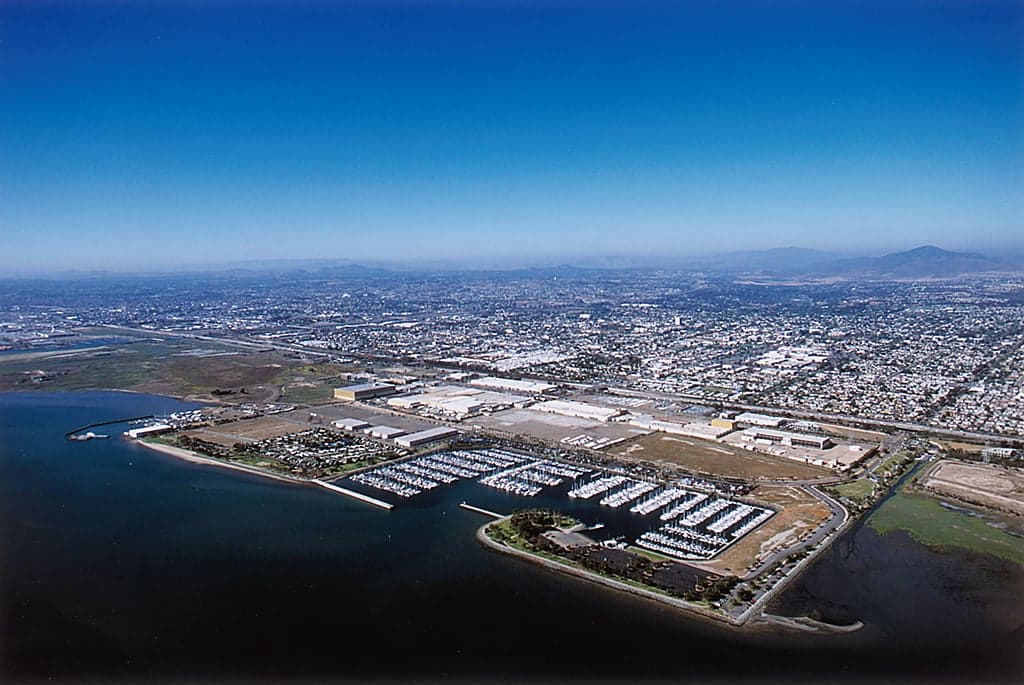
Chula Vista was not a Spanish mission town or a Gold Rush settlement. It was founded in 1888 as a speculative real estate venture by the Santa Fe Railroad, which subdivided the original Southwest Chula Vista neighborhood—the historic core near the bay—and marketed lots to Midwestern Anglo farmers and retirees. The city’s early economy rested on lemon and olive orchards, and later on the Rohr Aircraft Corporation (now part of Northrop Grumman), which opened in 1929 and drew a wave of white defense workers during World War II. The Montgomery neighborhood, just north of the original townsite, was built out in the 1940s and 1950s for these aerospace employees, creating a solidly middle-class, Anglo suburb. A second major employer, the U.S. Navy’s Fleet Anti-Submarine Warfare Training Center (now Naval Base San Diego’s satellite facilities), brought additional military families to the Hilltop district, which remains a stable, older residential area. Through the 1960s, Chula Vista was roughly 85% White non-Hispanic, a quiet bedroom community for San Diego’s defense sector.
Modern era (post-1965)
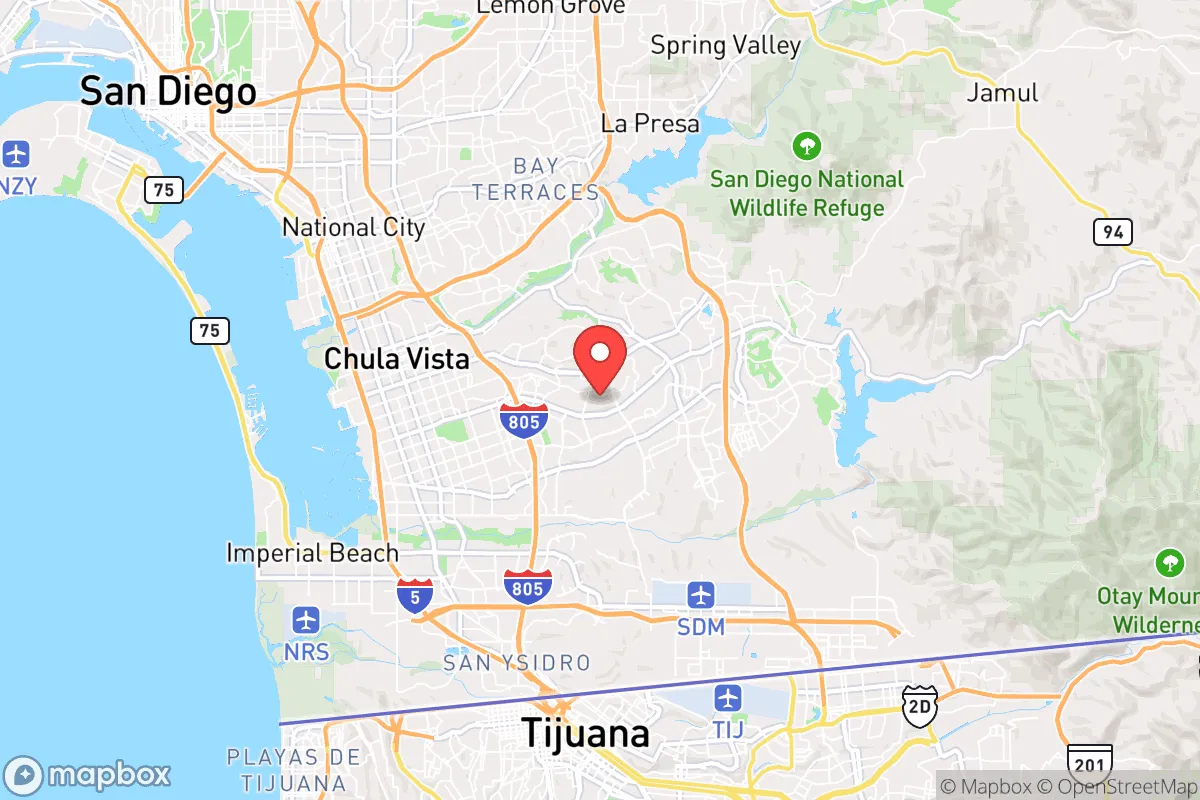
The 1965 Hart-Cellar Immigration Act, combined with the 1970s closure of the bracero program, reshaped Chula Vista’s population dramatically. Mexican immigrants, many from the border cities of Tijuana and Mexicali, began settling in the older Southwest Chula Vista and Castle Park neighborhoods, drawn by affordable housing and proximity to the San Ysidro port of entry. By 1990, the Hispanic share had risen past 50%, and the White non-Hispanic share had fallen below 40%. A second major wave arrived from the Philippines and Vietnam after the 1975 Fall of Saigon, clustering in the Eastlake area—a master-planned community that opened in the 1980s—and in the Otay Ranch district, which began development in the 1990s. These East and Southeast Asian communities, now 13.9% of the city, are heavily Filipino and Vietnamese, with smaller Chinese and Korean populations. The Black population, at 5.0%, is modest and largely concentrated in the central Loma Verde and Palomar neighborhoods, reflecting a pattern of secondary migration from Los Angeles and San Diego proper. The Indian subcontinent population (0.5%) remains small and dispersed, not forming a distinct ethnic enclave. The White non-Hispanic population, now 15.9%, has aged in place in Hilltop and Montgomery, with younger white families increasingly choosing Eastlake or Otay Ranch for newer housing stock.
The future
Chula Vista’s population is not homogenizing; it is tribalizing into distinct geographic enclaves by ethnicity and income. Southwest Chula Vista and Castle Park remain heavily Mexican-American and working-class, while Eastlake and Otay Ranch are majority Hispanic but with a substantial East/Southeast Asian minority and a growing number of white and Black professionals. The city’s foreign-born share (11.3%) is lower than San Diego’s overall (23%), suggesting that second- and third-generation Hispanic families are driving growth more than new immigration. The college-educated share (32.3%) is rising as Otay Ranch and Eastlake attract educated professionals, but the city still trails the county average (45%). Over the next 10–20 years, the Hispanic share is likely to plateau near 65–70% as the Asian share edges up slightly, while the White non-Hispanic share continues a slow decline. The city’s biggest demographic challenge is not ethnic change but generational retention: younger adults often leave for San Diego or other metros, and the city is working to add high-wage jobs in the Millenia tech park to keep them.
For a conservative-leaning mover, Chula Vista is becoming a denser, more diverse, and more politically moderate suburb—less white and less Republican than its 1960s self, but still family-oriented, relatively affordable by coastal San Diego standards, and anchored by stable neighborhoods like Hilltop and Eastlake. The city’s future is one of managed growth and ethnic coexistence, not rapid transformation, making it a predictable choice for those who value community stability over urban dynamism.

* Values derived from national, state, county, city and local statistics and may differ in a specific area. Last updated: 2026-04-24T09:52:18.000Z
Narrative content on this page is AI-generated and may contain mistakes. Verify any details that matter before acting on them.
ReloMaps may earn a commission from affiliate links at no extra cost to you.

