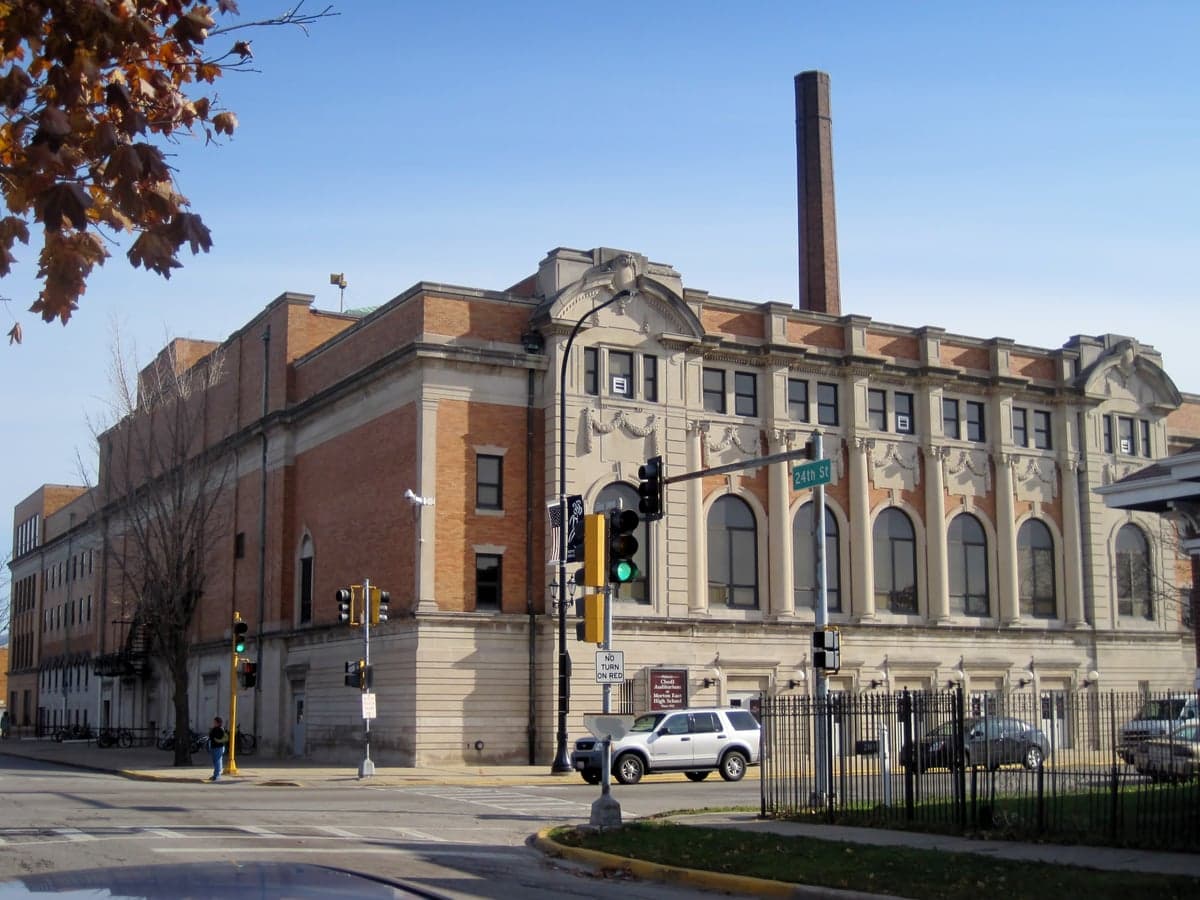
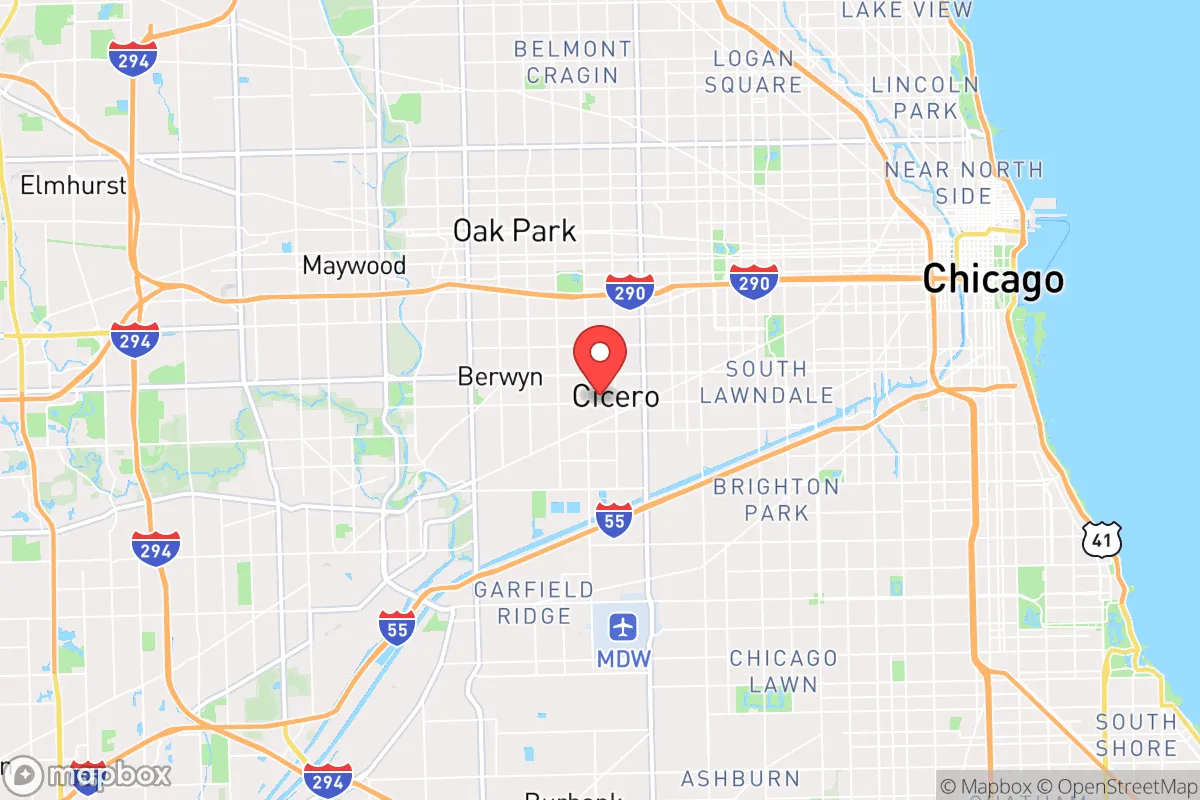
Photo: Wikipedia
Demographics of Cicero, IL
Affluence Level in Cicero, IL
A middle-class area roughly in line with national averages across income, home values, education, and employment.
People of Cicero, IL
The people of Cicero, Illinois today form one of the most densely concentrated Hispanic communities in the Midwest, with 88.8% of the 83,223 residents identifying as Hispanic or Latino. This is a working-class, family-oriented suburb where Spanish is heard as often as English, and where foreign-born residents make up nearly a quarter (23.8%) of the population. The city’s identity is overwhelmingly Mexican-American, shaped by decades of chain migration, industrial employment, and affordable housing stock that drew generations of families from Mexico and the southwestern United States.
How the city was settled and grew
Cicero was originally settled in the 1830s as a farming township on the western edge of Chicago, named after the Roman orator. Its first major growth spurt came after the Great Chicago Fire of 1871, when displaced residents and industries relocated to the open land along the Chicago, Burlington & Quincy Railroad corridor. The Western Electric Company’s Hawthorne Works, opened in 1905 in the Hawthorne district (the area around 22nd Street and Cicero Avenue), became the city’s economic engine, employing tens of thousands of workers. This factory drew a wave of Eastern European immigrants—primarily Poles, Czechs, and Slovaks—who settled in the Grant Park neighborhood and the South Cicero area near the plant. By 1920, Cicero was a heavily Catholic, working-class suburb of European immigrants and their children, with a small but established African American community concentrated near the 19th Street corridor.
The 1920s and 1930s saw the arrival of Italian and Irish families, many moving from Chicago’s Near West Side into the Central Cicero blocks around 26th Street. Al Capone’s brief residency in the city during the 1920s cemented Cicero’s reputation as a rough-and-tumble industrial suburb, but the population remained overwhelmingly white ethnic through the 1950s. The post-World War II era brought a second wave of European immigrants, including more Poles and Ukrainians, who filled the bungalows and two-flats in the North Cicero area near the Eisenhower Expressway.
Modern era (post-1965)
The demographic transformation of Cicero began in earnest after the 1965 Hart-Cellar Immigration Act, which opened the door to large-scale immigration from Mexico. Mexican families, initially drawn to the same industrial jobs that had attracted Europeans, began settling in the South Cicero and Hawthorne neighborhoods in the 1970s. By the 1980s, white flight accelerated as European-origin families moved to outer suburbs like Berwyn and Brookfield, and the Hispanic share of the population jumped from under 10% in 1970 to over 50% by 1990. The 26th Street commercial corridor became the city’s main Hispanic business district, lined with taquerias, bakeries, and bodegas.
The 1990s and 2000s saw near-total replacement of the non-Hispanic white population. Today, only 7.4% of residents are non-Hispanic white, while the Black population stands at 3.1% and East/Southeast Asian residents at 0.3%. The Indian-subcontinent population is negligible at 0.1%. The college-educated share is just 11.0%, reflecting a population that remains heavily blue-collar and tied to manufacturing, warehousing, and construction jobs. The Grant Park neighborhood, once a Polish stronghold, is now almost entirely Mexican-American, while the 19th Street corridor retains a small but stable African American enclave.
The future
Cicero’s population is likely to remain overwhelmingly Hispanic for the foreseeable future, but the character of that community is shifting. The foreign-born share (23.8%) is high but has plateaued since 2010, as second- and third-generation Mexican-Americans now make up a growing majority. The city is not tribalizing into distinct ethnic enclaves—rather, it is homogenizing into a single Mexican-American cultural identity, with smaller pockets of Puerto Ricans and Central Americans. The Black population has been stable at around 3% for two decades, suggesting little in-migration from Chicago’s West Side. The tiny Asian and Indian populations show no signs of growth, as Cicero lacks the professional job base or school reputation to attract those groups.
The next 10-20 years will likely see continued slow population decline (Cicero peaked at 85,616 in 2020) as younger families move to cheaper exurbs like Joliet or to southwestern suburbs with newer housing stock. The city’s aging housing stock—much of it built before 1950—and high property taxes will limit its appeal to middle-class families. However, Cicero’s dense, walkable neighborhoods and proximity to Chicago’s industrial job base will continue to attract recent immigrants and working-class families priced out of the city.
Cicero is becoming a stable, second-generation Mexican-American suburb—less a port of entry than a settled community. For a conservative-leaning individual or family moving in now, the city offers low home prices, strong Catholic parish life, and a tight-knit social fabric, but also limited economic mobility, low educational attainment, and a population that is culturally homogeneous. It is a place for those who value community continuity over diversity or upward mobility.

* Values derived from national, state, county, city and local statistics and may differ in a specific area. Last updated: 2026-04-29T19:08:57.000Z
Narrative content on this page is AI-generated and may contain mistakes. Verify any details that matter before acting on them.
ReloMaps may earn a commission from affiliate links at no extra cost to you.

