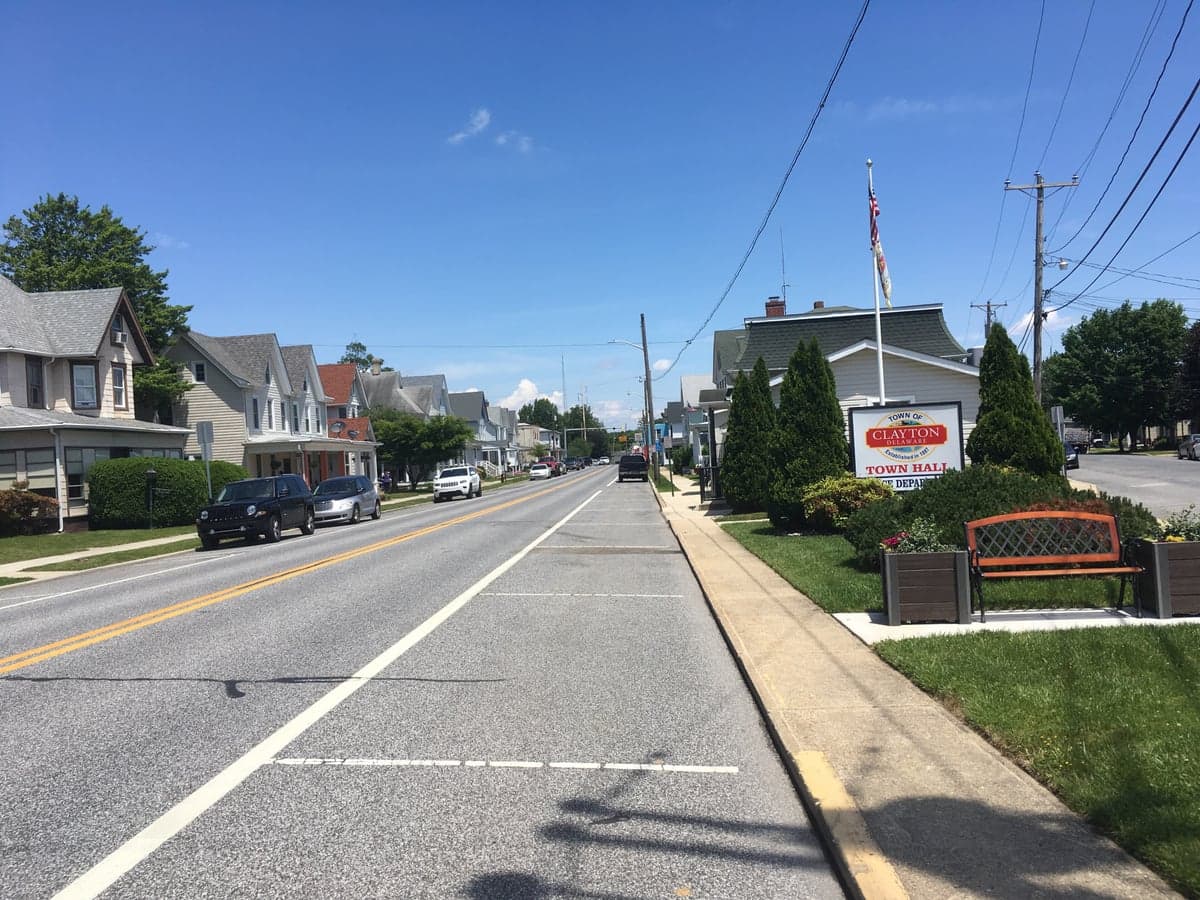
Photo: Wikipedia
Demographics of Clayton, DE
Affluence Level in Clayton, DE
An upper-middle-class area. Household wealth, education levels, and homeownership run ahead of national benchmarks.
People of Clayton, DE
The people of Clayton, Delaware today form a majority-minority community of 4,086 residents, defined by a near-even split between Black (44.4%) and White (41.2%) populations, with a growing Hispanic share (9.6%) and a small East/Southeast Asian presence (2.7%). The foreign-born share is low at 3.1%, and the college-educated rate sits at 28.7%, reflecting a working-class, family-oriented town with deep roots in local agriculture and regional commuting. Distinctive identity markers include a strong sense of small-town independence, a history of racial integration in schools and neighborhoods, and a population that is younger than the state median, with many households tied to the Dover Air Force Base and Wilmington-area employment.
How the city was settled and grew
Clayton was founded in 1855 as a railroad stop on the Delaware Railroad, which connected the agricultural interior to Wilmington and Philadelphia. The original population was a mix of white farmers and free Black families who had worked the land since the early 1800s, many of whom settled in what is now Historic Clayton along Main Street and Commerce Street. The town was formally incorporated in 1887, and its early growth was driven by the canning industry—specifically tomato and peach packing—which attracted both white and Black laborers from surrounding Kent County. By the early 1900s, a small but stable Black community had formed in the South Clayton area, centered around the former Clayton Colored School on South Main Street. The town remained a rural crossroads through the mid-20th century, with population hovering around 500 until the 1960s, when the expansion of Dover Air Force Base and the construction of Route 1 began drawing new residents from both the Mid-Atlantic and the South.
Modern era (post-1965)
After the 1965 Hart-Cellar Act, Clayton saw modest immigration, primarily from Mexico and Central America, with Hispanic families settling in the West Clayton corridor near the railroad tracks and along Smyrna Road. The larger demographic shift, however, came from domestic in-migration: Black families from the rural South and from Wilmington moved into Clayton Manor and the Fox Run subdivision during the 1980s and 1990s, drawn by affordable housing and proximity to jobs at the Dover Air Force Base and the state government complex in Dover. White families, meanwhile, began moving into newer subdivisions like Clayton Greens and Heritage Creek on the town's northern and eastern edges, creating a pattern of modest racial clustering by neighborhood. The Hispanic population grew steadily but remained concentrated in West Clayton and along the Route 300 corridor, where several small grocery stores and churches serve the community. The East/Southeast Asian population, at 2.7%, is largely composed of Filipino and Vietnamese families connected to the military base, living in scattered subdivisions rather than a single ethnic enclave. The Indian subcontinent population is effectively zero, reflecting the absence of the tech and medical professional migration seen in larger Delaware cities.
The future
Clayton's population is trending toward further diversification, with the Hispanic share likely to grow as families expand and new arrivals from Central America settle in the affordable West Clayton area. The Black and White shares are converging, and the town is not homogenizing into a single identity but rather developing distinct enclaves: Historic Clayton remains predominantly White and older, South Clayton and Clayton Manor are majority Black and younger, and West Clayton is becoming a Hispanic-majority corridor. The East/Southeast Asian population is stable but small, tied to military rotations rather than organic growth. The foreign-born share (3.1%) is low and likely to remain so, as Clayton lacks the industrial or service-sector jobs that drive large-scale immigration in other Delaware towns. The college-educated rate (28.7%) is below the state average, but new subdivisions like Heritage Creek are attracting some white-collar commuters to Wilmington and Dover, which could slowly raise the education and income profile over the next decade.
Clayton is becoming a more racially balanced, working-class town where distinct neighborhoods reflect different waves of settlement, but where overall integration in schools and public life is high. For someone moving in now, the town offers affordable housing, a central location between Dover and Wilmington, and a community where no single racial group dominates—but where the character of daily life varies noticeably by which subdivision you choose.

* Values derived from national, state, county, city and local statistics and may differ in a specific area. Last updated: 2026-04-29T22:34:11.000Z
Narrative content on this page is AI-generated and may contain mistakes. Verify any details that matter before acting on them.
ReloMaps may earn a commission from affiliate links at no extra cost to you.

