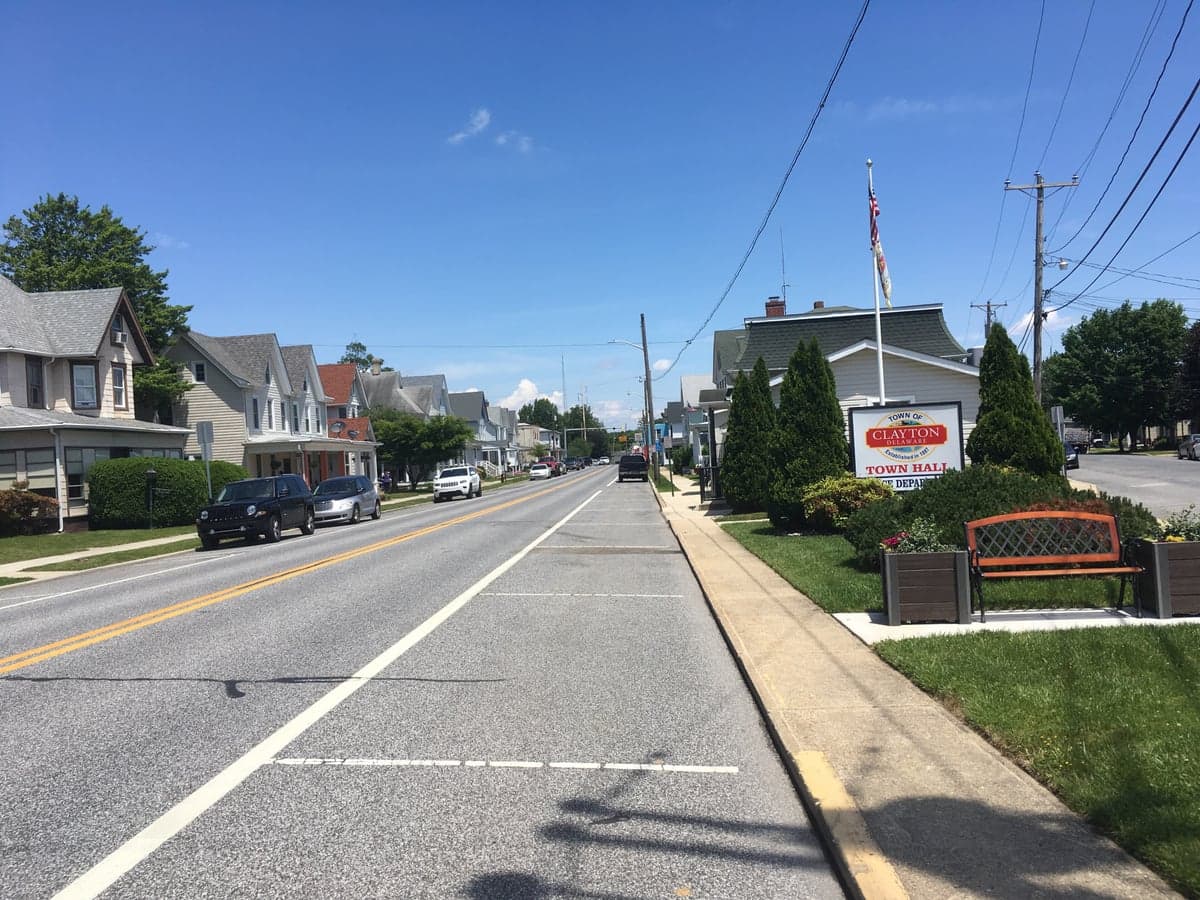
Photo: Wikipedia
Personal Sovereignty in Clayton, DE
Viable for self-reliance. Generally workable, though some barriers may limit total independence.
What does Personal Sovereignty tell us?
Personal Sovereignty measures your capacity for self-reliance and independence with minimal government friction. Higher scores mean fewer barriers between you and the way you want to live... but it assumes you have the space you need and good neighbors.
What does this tell us?
Personal Sovereignty measures your capacity for self-reliance and independence with minimal government friction. Higher scores mean fewer barriers between you and the way you want to live... but it assumes you have the space you need and good neighbors.
State Policy
Energy independence: Importer (2% of energy produced in-state)
Personal Liberty
Homesteading

Personal Liberty Analysis
Clayton, Delaware offers a notably higher degree of personal sovereignty than many Mid-Atlantic alternatives, largely due to its position in Kent County—a region where state-level overreach is somewhat buffered by local rural governance and a community culture that prizes self-reliance. While Delaware is not a free-for-all libertarian paradise, Clayton provides a strategic foothold for those seeking to minimize government intrusion into daily life, particularly when compared to the regulatory-heavy environments of neighboring New Castle County or the urban corridors of the Northeast. The town’s small size (roughly 3,000 residents) and agricultural roots mean that local officials are more accessible and less inclined toward the kind of top-down mandates that plague larger jurisdictions.
Tax burden and regulatory posture: How Delaware’s policies affect Clayton residents
Delaware’s tax structure is a double-edged sword for sovereignty-minded individuals. On the plus side, there is no state or local sales tax, which means every dollar you earn stays in your pocket at the point of purchase—a significant advantage for preppers stockpiling supplies or families buying bulk goods. Property taxes in Clayton are among the lowest in the region, with Kent County’s effective rate hovering around 0.55% of assessed value, roughly half of what you’d pay in nearby Maryland or Pennsylvania. However, Delaware does impose a progressive state income tax that tops out at 6.6% for high earners, and the state’s corporate-friendly reputation masks a growing regulatory appetite. The regulatory posture in Clayton itself is light: zoning is minimal, building permits are straightforward, and there is no county-level health department breathing down your neck for small-scale farming or home-based businesses. But be aware that the state government in Dover has shown a tendency to adopt California-style environmental mandates, including recent pushes to restrict gas-powered lawn equipment and phase out certain pesticides. For now, Clayton’s rural character insulates it from the worst of this, but vigilance is warranted.
Self-defense and gun law specifics: What Clayton residents need to know
Delaware is a shall-issue state for concealed carry, meaning that if you meet the basic requirements—age 21, clean background, completed a certified training course—the state must issue your permit. There is no discretionary “may-issue” nonsense like you’d find in New Jersey or Maryland. Open carry is legal without a permit for anyone 18 or older, though local ordinances in Clayton are silent on the matter, so common sense applies. The state does have a magazine capacity ban (rounds limited to 17 for handguns and 15 for long guns) and an “assault weapons” registry that grandfathers in pre-2022 purchases, which is a genuine infringement on the Second Amendment. However, enforcement in Kent County is lax compared to New Castle County, and local sheriffs are generally pro-2A. Stand-your-ground laws are in effect, and there is no duty to retreat in your home or vehicle. For preppers, the key takeaway is that Clayton allows you to keep a firearm for self-defense without bureaucratic harassment, but you’ll want to stock up on standard-capacity magazines before any future bans take effect. The state’s background check system is universal, so private sales must go through a dealer—a nuisance, but not a dealbreaker.
Self-reliance and homesteading viability: Lot sizes, zoning, and off-grid feasibility
Clayton’s zoning is a strong point for those looking to live off the grid or pursue serious homesteading. The town’s agricultural and rural residential zones allow for lots as small as one acre for single-family homes, but many parcels in the surrounding area are 2–5 acres or larger, giving you room for gardens, livestock, and solar panels. There are no county-level bans on rainwater collection, and Delaware law actually encourages it through a tax credit program for cisterns. Chickens are permitted without a permit on lots over half an acre, and goats or sheep are allowed on larger parcels with minimal hoop-jumping. The real prize is the lack of restrictive HOA covenants in most of Clayton’s older neighborhoods—many newer subdivisions do have them, so you’ll need to vet your specific property. Off-grid solar is feasible: net metering is available through Delaware’s electric cooperatives, and there are no state-level prohibitions on battery storage or generator use. Water wells are common in rural areas, and septic systems are standard, meaning you can truly disconnect from municipal utilities if you choose. The only regulatory friction point is the state’s building code, which requires permits for structural changes, but enforcement is complaint-driven rather than proactive. For a prepper, Clayton offers a rare combination of affordable land and permissive zoning that is increasingly hard to find within commuting distance of major East Coast job centers.
Personal liberties: Parental rights, medical autonomy, speech, and property
On parental rights, Delaware is a mixed bag. The state has a relatively robust homeschool statute that requires only a simple notification and an annual assessment—no curriculum approval, no home visits, no government oversight of your teaching materials. This is a significant win for families who want to shield their children from progressive indoctrination in public schools. However, Delaware has also adopted the “Child Abuse Prevention and Treatment Act” framework, which gives social services broad latitude to investigate parental decisions, including medical choices. Medical autonomy is under pressure: Delaware has mandatory vaccine requirements for school attendance (though philosophical exemptions exist for homeschoolers), and the state’s COVID-era mandates were heavy-handed, including a temporary ban on ivermectin prescriptions. On the positive side, there is no state-level mask or vaccine mandate currently in effect, and local health officials in Kent County are less aggressive than their counterparts in New Castle. Free speech is protected under the First Amendment, and Clayton’s small-town atmosphere means you can speak your mind at town council meetings without fear of cancellation. Property rights are strong: eminent domain is rarely used for private development, and there are no rent control laws or restrictive land use policies that would prevent you from building a bunker or a workshop on your own land. The biggest threat to personal liberty in Delaware is the state’s increasing reliance on data collection and surveillance—the DMV shares information with federal databases, and license plate readers are common on major highways. But in Clayton, you can still live a low-profile life without the state tracking your every move.
Overall, Clayton, DE ranks as a solid B+ for personal sovereignty when compared to other East Coast relocation options. It lacks the constitutional carry and zero income tax of a place like Texas or Wyoming, but it offers a far more permissive environment than anything in New York, New Jersey, or Maryland. The combination of low property taxes, permissive zoning for homesteading, shall-issue concealed carry, and strong homeschool protections makes it a viable base for those who want to live free while still having access to jobs in Wilmington, Philadelphia, or Baltimore. The state-level threats—magazine bans, potential vaccine mandates, and creeping environmental regulations—are real but manageable if you stay engaged locally. For a prepper or survivalist, Clayton is not a bug-out location, but it is a defensible, affordable, and legally permissive place to build a life of self-reliance. Just keep an eye on Dover, and be ready to vote with your feet if the state goes further off the rails.

* Values derived from national, state, county, city and local statistics and may differ in a specific area. Last updated: 2026-04-29T22:34:11.000Z
Narrative content on this page is AI-generated and may contain mistakes. Verify any details that matter before acting on them.
ReloMaps may earn a commission from affiliate links at no extra cost to you.

