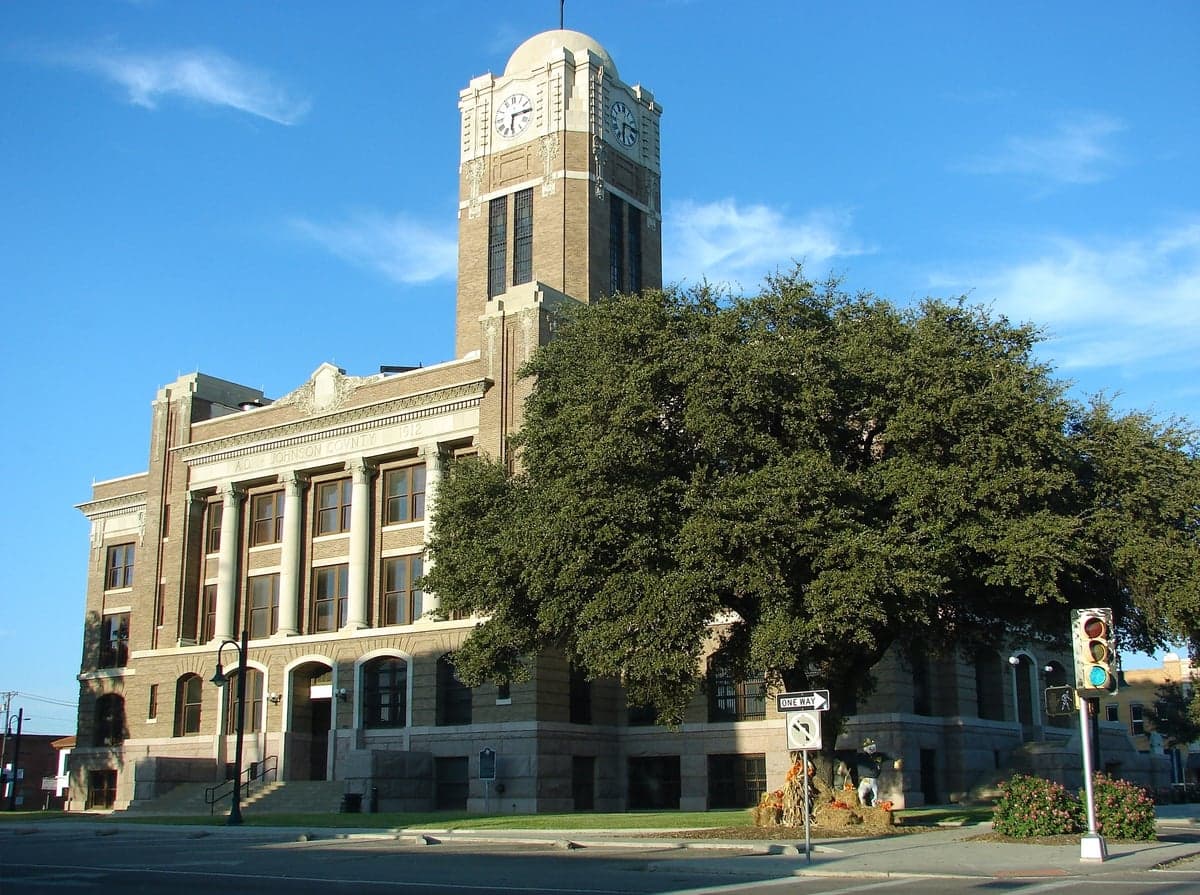
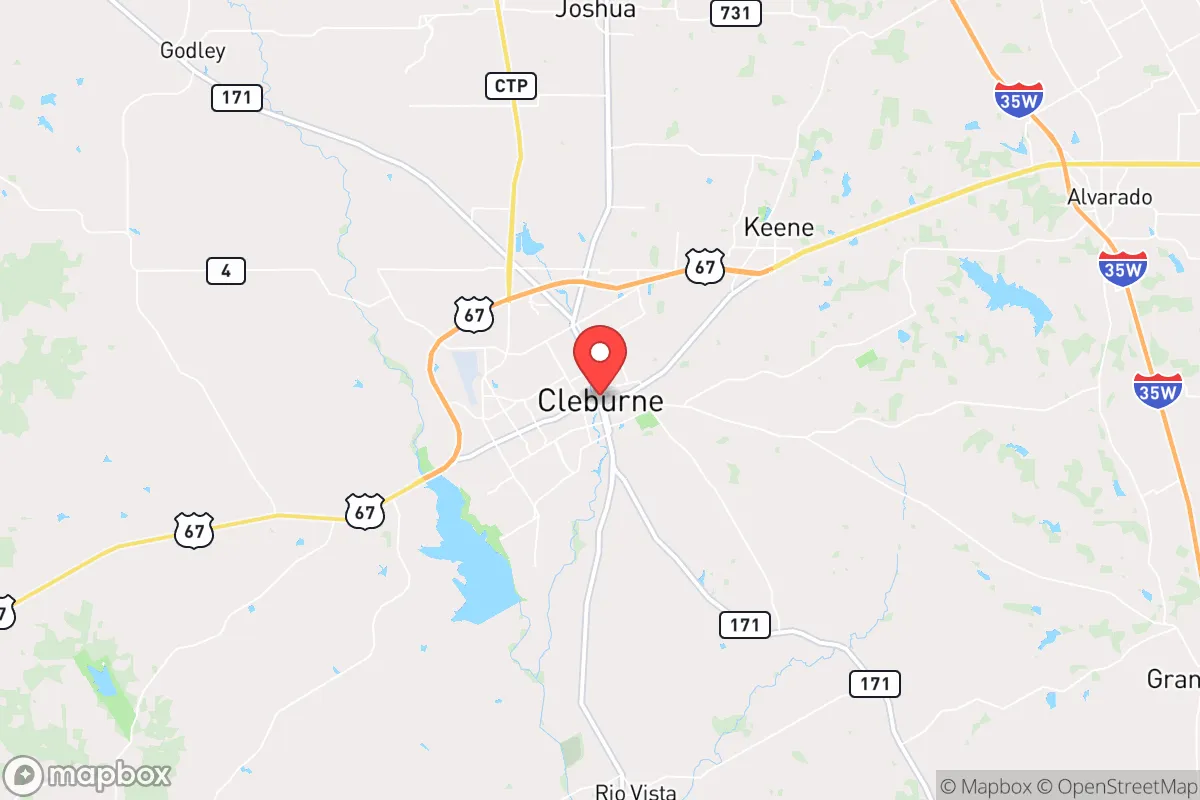

Photo: Wikipedia
Demographics of Cleburne, TX
Affluence Level in Cleburne, TX
A middle-class area roughly in line with national averages across income, home values, education, and employment.
People of Cleburne, TX
The people of Cleburne, Texas today number 32,966, forming a community that is predominantly white (57.8%) with a substantial and growing Hispanic population (31.5%) and smaller Black (5.2%) and East/Southeast Asian (0.5%) communities. The city retains a distinctly working-class, family-oriented character, with only 18.0% of adults holding a college degree and a foreign-born share of 4.6% that is well below the national average. Cleburne’s identity is rooted in its railroad and agricultural past, and its population today reflects a blend of long-established Anglo families, a rising Hispanic workforce, and a small but stable Black community concentrated in specific historic neighborhoods.
How the city was settled and grew
Cleburne was founded in 1867 as a railroad town on the tracks of the Gulf, Colorado and Santa Fe Railway, named after Confederate General Patrick Cleburne. The original white settlers were primarily Anglo farmers and merchants from the U.S. South, drawn by cheap land and the promise of rail access to markets. The city’s early growth was fueled by cotton farming and the railroad depot, which made Cleburne a regional shipping hub. The first wave of Black residents arrived during Reconstruction, many as freedmen seeking work on farms and railroads, and they settled in the West End neighborhood, historically known as "Freedmantown," which remains the core of Cleburne’s Black community today. By the early 1900s, a small Mexican-origin population began arriving to work in cotton fields and on railroad maintenance crews, clustering in the South Side area near the rail yards. The city’s population grew steadily through the 1920s, then plateaued during the Great Depression and Dust Bowl years, with many families leaving for California. Post-World War II, Cleburne saw a modest suburban expansion as returning veterans and their families moved into new subdivisions like Briarwood Estates and Meadowbrook, which were built on former farmland and attracted mostly white, middle-class residents.
Modern era (post-1965)
After the 1965 Hart-Cellar Act, Cleburne did not experience the large-scale immigration seen in major Texas cities. The foreign-born population remained low, and the city’s Hispanic growth came primarily from domestic migration—U.S.-born families moving from South Texas and Mexico for construction and service jobs. The South Side neighborhood expanded as Hispanic families bought homes and established small businesses, while the West End remained predominantly Black but saw population decline as younger generations moved to Dallas-Fort Worth suburbs. The 1980s and 1990s brought a wave of white flight from nearby Fort Worth, with families seeking lower taxes and smaller schools, settling in newer subdivisions like Lakewood Estates and Hidden Creek. The Asian population remained negligible, with only a handful of East/Southeast Asian families, mostly professionals in healthcare and education, living scattered across the city rather than in a defined enclave. The Indian subcontinent population is virtually nonexistent (0.1%). By 2020, Cleburne’s demographic profile had shifted from roughly 80% white in 1990 to 58% white today, with the Hispanic share nearly tripling, driven by natural increase and continued domestic migration.
The future
Cleburne’s population is trending toward greater Hispanic plurality, with projections suggesting the Hispanic share could approach 40-45% by 2040 if current growth rates hold. The white population is aging and declining in absolute numbers, while the Black population is stable but not growing. The city is not tribalizing into distinct enclaves—neighborhoods like the South Side are becoming more mixed as younger white families move into previously Hispanic areas—but the West End remains a historically Black anchor. The foreign-born share is likely to rise slowly as Hispanic families sponsor relatives, but Cleburne will remain a predominantly native-born city. The biggest demographic wildcard is whether the Dallas-Fort Worth exurban boom will push more white and Asian professionals into Cleburne’s newer subdivisions, which could accelerate the college-educated share above its current 18%. For now, the city is becoming more Hispanic and more working-class, with a stable Black community and a very small Asian presence.
Cleburne is becoming a more diverse, working-class exurb of Fort Worth, with a growing Hispanic majority and a shrinking but still dominant white population. For a conservative-leaning family or individual moving in, the city offers a low-cost, family-oriented environment where the population is increasingly Hispanic but still culturally conservative, with strong ties to agriculture and the railroad. The key trend to watch is whether the next decade brings more white-collar migration from the Metroplex or reinforces Cleburne’s blue-collar identity.

* Values derived from national, state, county, city and local statistics and may differ in a specific area. Last updated: 2026-04-18T19:45:08.000Z
Narrative content on this page is AI-generated and may contain mistakes. Verify any details that matter before acting on them.
ReloMaps may earn a commission from affiliate links at no extra cost to you.

