
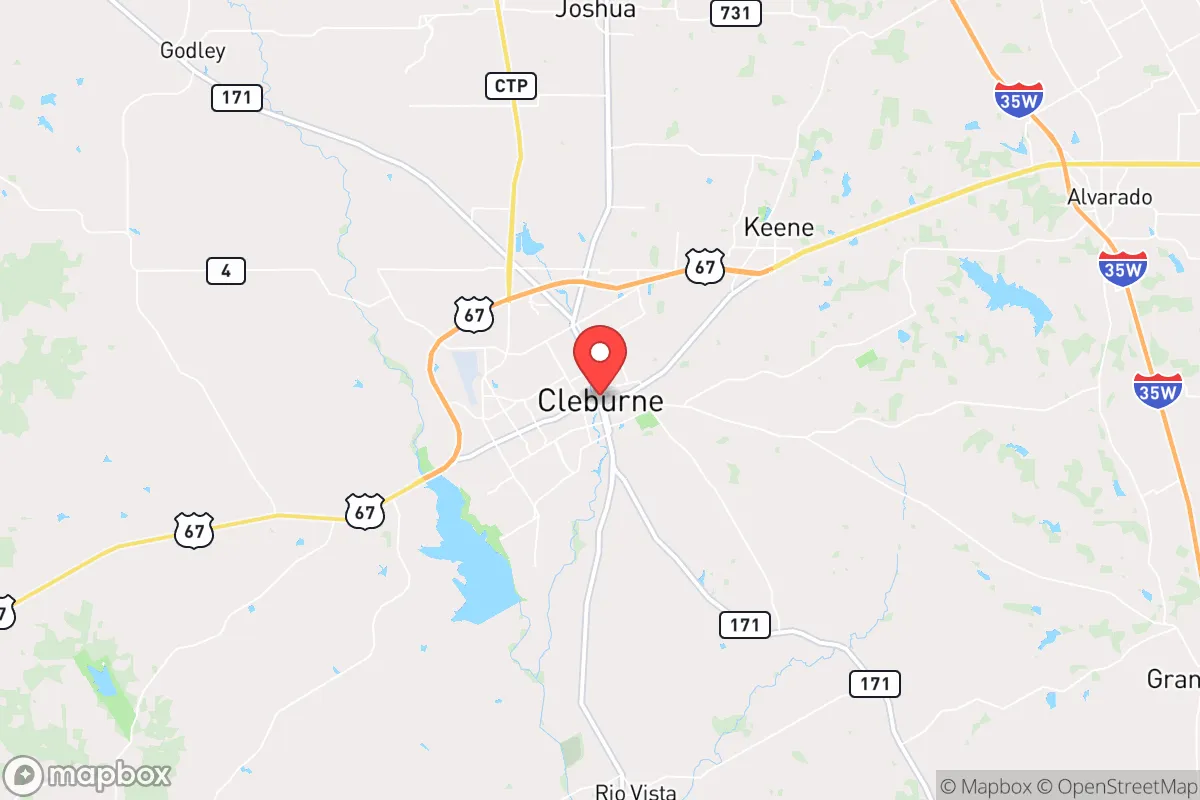
Photo: Wikipedia
Personal Sovereignty in Cleburne, TX
Strong independent fundamentals that actively favor personal liberty and low regulation.
What does Personal Sovereignty tell us?
Personal Sovereignty measures your capacity for self-reliance and independence with minimal government friction. Higher scores mean fewer barriers between you and the way you want to live... but it assumes you have the space you need and good neighbors.
What does this tell us?
Personal Sovereignty measures your capacity for self-reliance and independence with minimal government friction. Higher scores mean fewer barriers between you and the way you want to live... but it assumes you have the space you need and good neighbors.
State Policy
Energy independence: Net exporter (220% of energy produced in-state)
Personal Liberty
Homesteading

Personal Liberty Analysis
Cleburne, Texas, offers a notably high degree of personal sovereignty, largely because it sits in a state that actively resists federal overreach and a county that values local control. For those concerned with preserving autonomy in an era of expanding government mandates, this Johnson County seat provides a practical environment where individual choices—from homeschooling to firearm ownership—face fewer legal hurdles than in many other parts of the country. The city’s political culture, shaped by a strong conservative majority, reinforces a hands-off approach to personal and family decisions, making it a viable option for preppers, homesteaders, and anyone prioritizing self-reliance.
Tax burden and regulatory posture: how Cleburne compares to blue-state environments
Texas’s lack of a state income tax is the most immediate financial advantage for those seeking to keep more of their earnings. In Cleburne, this is paired with property taxes that, while not low by national standards (around 2.2–2.5% of assessed value), are predictable and fund local services without the creeping expansion of state-level welfare programs. The regulatory climate in Johnson County is notably light: no county-level business licensing requirements beyond basic state permits, no zoning overlays that restrict home-based enterprises in most residential areas, and a building code that is less prescriptive than in major metro areas like Dallas or Fort Worth. For someone running a side business, storing supplies, or operating a small farm, this means fewer inspections, less paperwork, and lower compliance costs. The state’s right-to-work laws and absence of collective bargaining for public employees further reduce the influence of organized labor on local policy, keeping the regulatory burden on individuals and small businesses minimal.
Self-defense and gun law specifics: what the Second Sanctuary status means for residents
Cleburne and Johnson County have declared themselves Second Amendment Sanctuary jurisdictions, meaning local law enforcement is instructed not to enforce any future state or federal gun control measures deemed unconstitutional. This is not symbolic posturing; it has real implications for daily life. Texas law already allows permitless carry of handguns for anyone 21 or older who is not legally prohibited, and Cleburne’s city council has consistently opposed any local ordinances that would restrict open or concealed carry in parks, government buildings, or public spaces. For the prepper mindset, this means you can legally keep a firearm in your vehicle, on your person, or in your home without jumping through bureaucratic hoops. The county sheriff’s office is known for issuing licenses to carry (LTC) efficiently, and there are no local waiting periods or magazine capacity limits. Stand-your-ground laws apply fully, and the Castle Doctrine protects the use of deadly force against intruders in your home, vehicle, or workplace. For those concerned about federal overreach, the sanctuary status provides a layer of local resistance that is actively enforced.
Self-reliance and homesteading viability: lot sizes, zoning, and off-grid feasibility
Cleburne’s zoning code is permissive enough to support serious self-reliance. Within city limits, residential lots typically range from one-quarter to one-half acre, but the city’s extraterritorial jurisdiction (ETJ) and unincorporated areas of Johnson County offer parcels from one to ten acres at prices significantly lower than the Dallas-Fort Worth metroplex. Raising chickens, goats, or even a small number of cattle is allowed on lots of one acre or more in most county areas, and the city’s animal ordinances are lenient compared to suburban restrictions. Off-grid living is feasible but requires attention to state-level regulations: rainwater collection is legal and encouraged (Texas has a specific exemption for rainwater harvesting from property tax), and solar panel installation is not subject to HOA restrictions in unincorporated areas. However, the county does enforce septic system permits and well-drilling regulations, so full independence from municipal water and sewer requires a permit process that, while not onerous, does involve state oversight. For those willing to work within these parameters, Cleburne offers a realistic path to reducing reliance on grid utilities and municipal services.
Personal liberties: parental rights, medical autonomy, speech, and property protections
Texas law strongly favors parental rights in education and healthcare. Cleburne Independent School District (CISD) has a conservative school board that has resisted federal curriculum mandates and supports parental opt-out options for sex education and certain health screenings. Homeschooling is straightforward: no state registration, no required curriculum approval, and no standardized testing mandates—just a simple notice of intent. Medical autonomy is more complex: while Texas does not have a state-level vaccine mandate for adults, employers and private businesses can impose their own requirements, though Cleburne’s business community is largely aligned with conservative values and rarely enforces such policies. The state’s ban on COVID-19 vaccine passports for government services and its prohibition of mask mandates in schools reflect a broader resistance to federal health directives. Property rights are robust: Texas has strong eminent domain protections, and Johnson County has not pursued aggressive condemnation for private development. Free speech is protected by state law that prohibits local governments from restricting speech based on content, and Cleburne has no local ordinances that limit political signage or public assembly beyond standard time-place-manner restrictions.
Overall, Cleburne ranks among the more sovereignty-friendly small cities in Texas, particularly for those who prioritize gun rights, low taxes, and minimal government interference in family and business decisions. It lacks the extreme off-grid freedom of remote West Texas counties but offers a practical balance of rural self-reliance and access to urban infrastructure. For a single individual or parent looking to build a life with maximum personal autonomy—where the government stays out of your home, your business, and your children’s education—Cleburne provides a solid foundation that is increasingly rare in the United States. The key trade-off is that you must actively engage with local politics to maintain this environment, as the same permissive laws can be reversed if the county’s political composition shifts. For now, it remains a stronghold of personal liberty in a state that still values it.

* Values derived from national, state, county, city and local statistics and may differ in a specific area. Last updated: 2026-04-18T19:45:08.000Z
Narrative content on this page is AI-generated and may contain mistakes. Verify any details that matter before acting on them.
ReloMaps may earn a commission from affiliate links at no extra cost to you.

