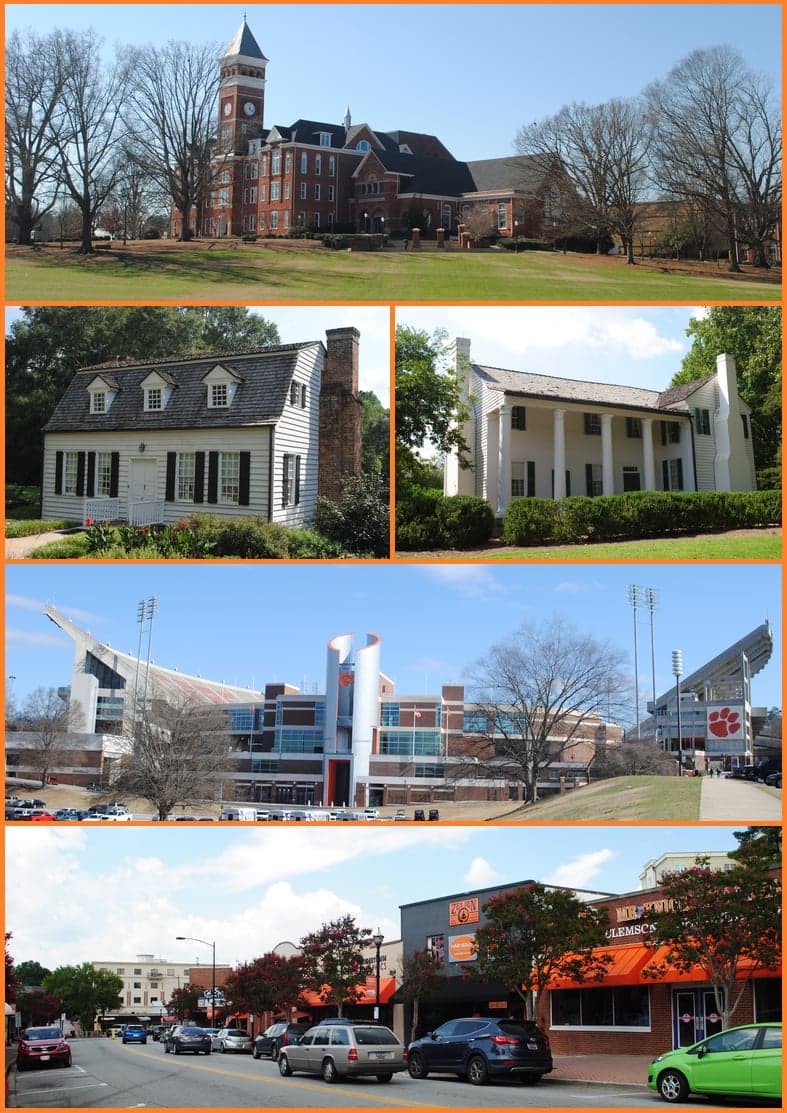
Photo: Wikipedia
Demographics of Clemson, SC
Affluence Level in Clemson, SC
A below-average socioeconomic profile. Incomes, home values, and educational attainment trail the U.S., with higher poverty and unemployment.
People of Clemson, SC
The people of Clemson, SC today number 17,759 and form a dense, highly educated college town with a distinctly conservative-leaning character shaped by its agricultural and military roots. The city is overwhelmingly white (77.2%), with a notable Black population (8.5%) and growing Indian-subcontinent (3.0%) and East/Southeast Asian (2.0%) communities, while the foreign-born share sits at 4.5% and Hispanic residents make up 3.4%. With 59.0% of adults holding a college degree, Clemson’s population is defined by its dual identity as both a university hub and a family-oriented Southern community where generational ties to the region run deep.
How the city was settled and grew
Clemson’s population history begins not with a town but with a plantation and a land grant. The area was originally part of the Cherokee hunting grounds before European settlers arrived in the late 1700s, and by the early 19th century, it was dominated by cotton plantations worked by enslaved Black laborers. The city’s modern identity was forged in 1889 when Thomas Green Clemson, a former U.S. superintendent of agriculture, bequeathed his Fort Hill plantation to the state of South Carolina to establish an agricultural college. The first students arrived in 1893, and the population grew slowly around the campus, with faculty and staff settling in what is now the Old Central neighborhood near College Avenue. The early 20th century brought a second wave: military personnel and their families during World War II, when Clemson College hosted Army Air Corps training. These families clustered in the Woodland Hills area, a post-war subdivision built to accommodate the influx. By 1950, the population had reached roughly 3,000, still overwhelmingly white and native-born, with a small Black community concentrated in the Eastside area near the railroad tracks.
Modern era (post-1965)
The 1965 Hart-Cellar Act had a modest direct effect on Clemson, as the city’s foreign-born share remains low at 4.5%, but the indirect impact of national immigration patterns reshaped the university’s graduate programs. Starting in the 1970s, Clemson University began recruiting international students, particularly in engineering and the sciences. Indian-subcontinent students and faculty arrived in noticeable numbers, settling in the University Village and Heritage at Clemson apartment complexes near campus. East/Southeast Asian families followed in the 1990s and 2000s, drawn by tech and research positions, and now form a 2.0% share. The domestic population also shifted: suburbanization accelerated after 1980, with white families moving into newer developments like Keowee Key (technically in nearby Seneca but serving Clemson commuters) and Calhoun Hills. The Black population, historically centered in the Eastside, has remained stable at 8.5%, though some families have moved into mixed-income subdivisions like Shiloh Farms. The Hispanic share (3.4%) grew slowly, primarily through construction and service-sector workers, with a small cluster near the Pendleton Road corridor. Overall, the city has become more diverse since 2000, but the white majority remains dominant, and the university’s gravitational pull keeps the population young and transient—about 40% of residents are between 18 and 24.
The future
Clemson’s population is heading toward slow, steady diversification rather than rapid change. The foreign-born share (4.5%) is likely to rise modestly as the university continues recruiting international graduate students, particularly from India and East Asia, but the city lacks the industrial base or urban amenities to attract large immigrant waves. The Indian-subcontinent community (3.0%) is the fastest-growing ethnic group, driven by tech and academic hires, and is expected to concentrate further in the University Village area and newer apartment complexes near the Clemson Research Park. The East/Southeast Asian share (2.0%) will grow more slowly, plateauing as second-generation graduates often leave for larger job markets. The Hispanic population (3.4%) is likely to increase gradually through service-sector growth, but without major agricultural or manufacturing employers, it will remain a small share. The Black population (8.5%) is stable, with no signs of significant in-migration or out-migration. The white majority (77.2%) will shrink slightly as other groups grow, but Clemson is not homogenizing—rather, it is becoming a series of distinct enclaves: the university core remains young and transient, the historic white neighborhoods like Old Central and Woodland Hills are aging, and the newer subdivisions attract families seeking good schools and low crime. The city is not tribalizing into ethnic neighborhoods in the traditional sense, but income and education levels are creating de facto divides between student-heavy rentals and owner-occupied family areas.
For someone moving in now, Clemson is a stable, conservative-leaning college town where the population is slowly diversifying without dramatic social upheaval. The university anchors the economy and culture, meaning the city will always have a transient student population, but the permanent residents—mostly white, college-educated, and family-oriented—are deeply rooted. New arrivals, especially from Indian and East Asian backgrounds, will find growing professional communities but should expect to integrate into a predominantly white, Southern social fabric. The city’s future is one of gradual demographic layering, not replacement, making it a predictable and safe choice for those seeking a traditional small-town atmosphere with a touch of global influence.

* Values derived from national, state, county, city and local statistics and may differ in a specific area. Last updated: 2026-04-30T01:18:24.000Z
Narrative content on this page is AI-generated and may contain mistakes. Verify any details that matter before acting on them.
ReloMaps may earn a commission from affiliate links at no extra cost to you.

