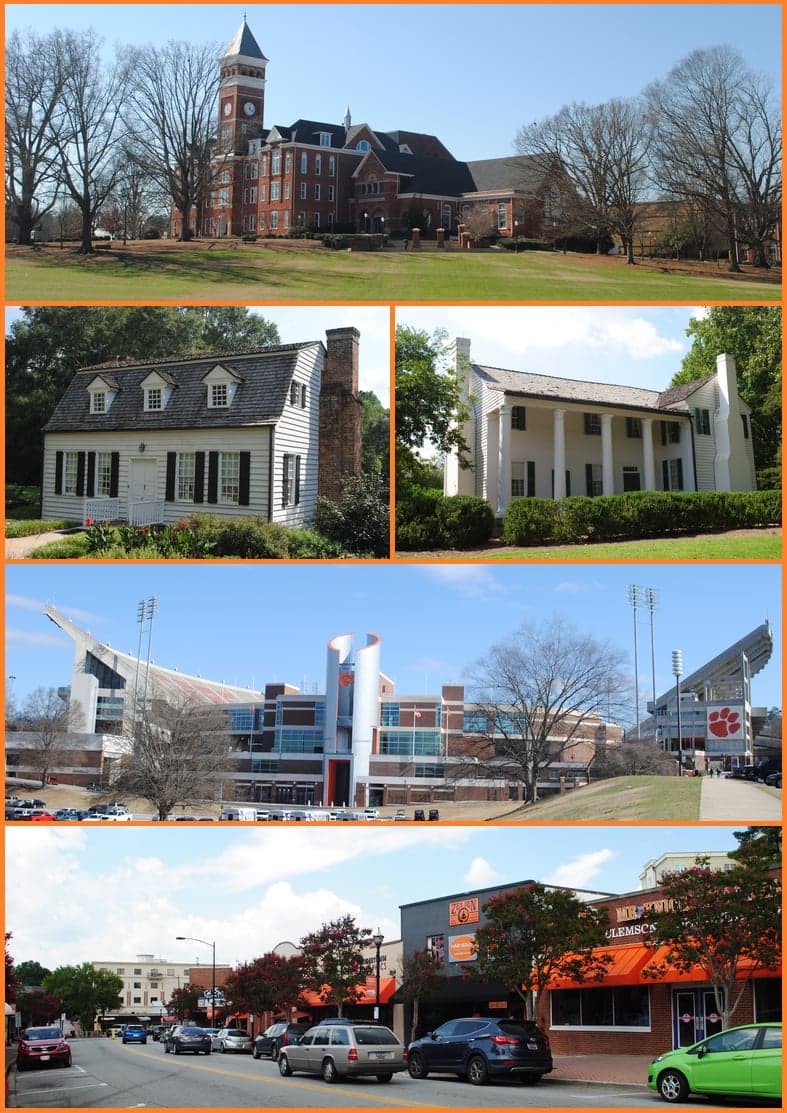
Photo: Wikipedia
Personal Sovereignty in Clemson, SC
Viable for self-reliance. Generally workable, though some barriers may limit total independence.
What does Personal Sovereignty tell us?
Personal Sovereignty measures your capacity for self-reliance and independence with minimal government friction. Higher scores mean fewer barriers between you and the way you want to live... but it assumes you have the space you need and good neighbors.
What does this tell us?
Personal Sovereignty measures your capacity for self-reliance and independence with minimal government friction. Higher scores mean fewer barriers between you and the way you want to live... but it assumes you have the space you need and good neighbors.
State Policy
Energy independence: Importer (25% of energy produced in-state)
Personal Liberty
Homesteading

Personal Liberty Analysis
Clemson, South Carolina, offers a notably high degree of personal sovereignty compared to many parts of the country, particularly the Northeast and West Coast, due to a state-level legal framework that prioritizes individual autonomy over government reach. For the survivalist or prepper, this means fewer layers of bureaucratic friction when it comes to securing your family, your property, and your way of life. The local culture in Pickens County leans heavily toward self-reliance, and the state’s constitutional and statutory protections create a buffer against the kind of overreach that erodes personal freedoms. While no place is a libertarian utopia, Clemson’s environment is one where a strategic-minded individual can operate with a wide latitude of personal control.
Tax burden and regulatory posture: How South Carolina’s fiscal climate protects your autonomy
South Carolina’s tax structure is designed to keep more money in your pocket and less in government coffers, which directly supports personal sovereignty. The state has a flat income tax rate of 6.4%, but crucially, there is no state-level tax on Social Security benefits, and retirees can deduct up to $15,000 of other retirement income per person. For a prepper looking to build financial resilience, this means your savings and investments aren’t constantly eroded by state levies. Property taxes in Pickens County are among the lowest in the region, with an effective rate around 0.55% of assessed value, and the state’s “homestead exemption” can further reduce the burden for those over 65 or disabled. On the regulatory side, South Carolina is a “right-to-work” state with minimal business licensing hurdles, and there are no state-level environmental regulations that exceed federal standards in a way that would restrict private land use for homesteading or off-grid improvements. The state’s posture is one of “leave us alone,” which translates into fewer permits required for building, fencing, or installing alternative energy systems compared to states like California or New York. This fiscal and regulatory restraint is a core pillar of the sovereignty environment here.
Self-defense and gun law specifics: Constitutional carry and castle doctrine in Pickens County
For anyone serious about personal security, Clemson sits in a state with some of the strongest firearm protections in the nation. South Carolina is a constitutional carry state as of 2024, meaning any law-abiding adult 18 or older can carry a concealed or open firearm without a permit. This eliminates a common point of government intrusion—the permitting process—and affirms the right to self-defense as inherent, not granted by the state. The state also has a robust “Stand Your Ground” law with no duty to retreat, and a castle doctrine that presumes a reasonable fear of death or great bodily injury if someone unlawfully enters your home, vehicle, or occupied structure. Pickens County’s sheriff’s office is known for a pro-2A stance, and local gun culture is strong, with multiple ranges and gun shops within a 15-minute drive of Clemson’s downtown. There are no state-level magazine capacity bans, no “assault weapon” restrictions, and no red flag laws on the books. For the prepper, this means you can stockpile, train, and carry without fear of sudden legislative changes that could criminalize your gear. The only notable limitation is that open carry is legal but requires a permit for handguns in vehicles—a minor nuance in an otherwise very free environment.
Self-reliance and homesteading viability: Lot sizes, zoning, and off-grid feasibility near Clemson
Clemson’s immediate urban core is dense and subject to city zoning, but the surrounding unincorporated areas of Pickens County and neighboring Anderson County offer significant opportunities for self-reliant living. Minimum lot sizes in rural zones are typically 1 to 3 acres, with many parcels available for under $15,000 per acre as of 2026. Zoning in these areas is permissive: you can keep chickens, goats, and even a few head of cattle without special permits, and there are no county-level restrictions on rainwater collection or composting toilets. Off-grid feasibility is high, as South Carolina has no state law prohibiting solar panel installation or battery storage, and net metering is available through Duke Energy, though the rates are less favorable than a decade ago. The biggest practical hurdle is well and septic permitting, which requires county health department approval, but these are routine and not ideologically driven. For the serious prepper, the ability to buy a few acres, drill a well, install solar, and build a workshop without endless red tape is a major draw. The local climate—mild winters and long growing seasons—also supports year-round food production, and there are active homesteading communities in nearby Six Mile and Liberty that share resources and knowledge.
Personal liberties: Parental rights, medical autonomy, speech, and property protections
South Carolina has a strong track record on several fronts that matter to those wary of government overreach. Parental rights are explicitly protected under state law, with a 2023 statute affirming that parents have the fundamental right to direct the upbringing, education, and healthcare of their children. This means no forced curriculum on sensitive topics without parental opt-out, and no state-mandated medical interventions for minors without consent. Medical autonomy is less robust—there is no state-level protection for alternative treatments or vaccine exemptions beyond the standard religious and medical ones—but the state did pass a law in 2022 prohibiting COVID-19 vaccine mandates by public entities. Free speech is well-protected; there are no hate speech laws that criminalize political or religious expression, and the state’s public universities, including Clemson University, have generally upheld First Amendment principles despite occasional administrative friction. Property rights are a standout: South Carolina has a strong “right to farm” law that protects agricultural operations from nuisance lawsuits, and eminent domain is tightly constrained, requiring a public purpose and just compensation. The state also has a “stand your ground” component that extends to property defense, reinforcing the idea that your land is your castle. The main area of concern is the state’s surveillance posture—South Carolina has a statewide license plate reader network and participates in fusion centers—but these are less intrusive than in many states and haven’t been used for political targeting.
Overall, Clemson’s personal sovereignty environment ranks well above average for the Southeast, and significantly above the national median. The combination of constitutional carry, low taxes, permissive zoning for homesteading, and strong parental and property rights creates a buffer against the creeping government overreach that many preppers and conservatives fear. The main trade-offs are the presence of a large public university (which brings some progressive cultural influence) and the state’s reliance on Duke Energy, a monopoly utility that can complicate off-grid ambitions. But for a single individual or family looking to relocate to a place where you can live largely on your own terms, with minimal state interference in your daily life, Clemson is a strategic choice that balances access to amenities with a high degree of personal freedom. It’s not a survivalist compound in the wilderness, but it’s a solid base of operations for those who value autonomy above convenience.

* Values derived from national, state, county, city and local statistics and may differ in a specific area. Last updated: 2026-04-30T01:18:24.000Z
Narrative content on this page is AI-generated and may contain mistakes. Verify any details that matter before acting on them.
ReloMaps may earn a commission from affiliate links at no extra cost to you.

