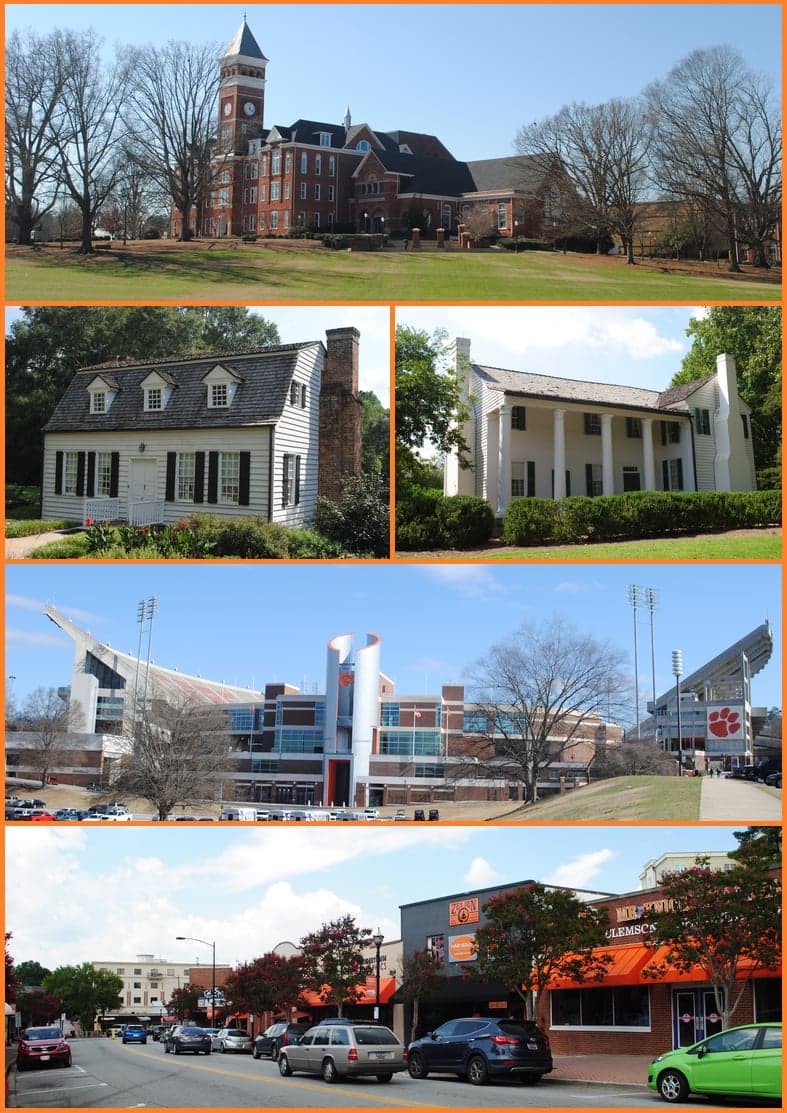
Photo: Wikipedia
Political ClimatePolitical Climate in Clemson, SC
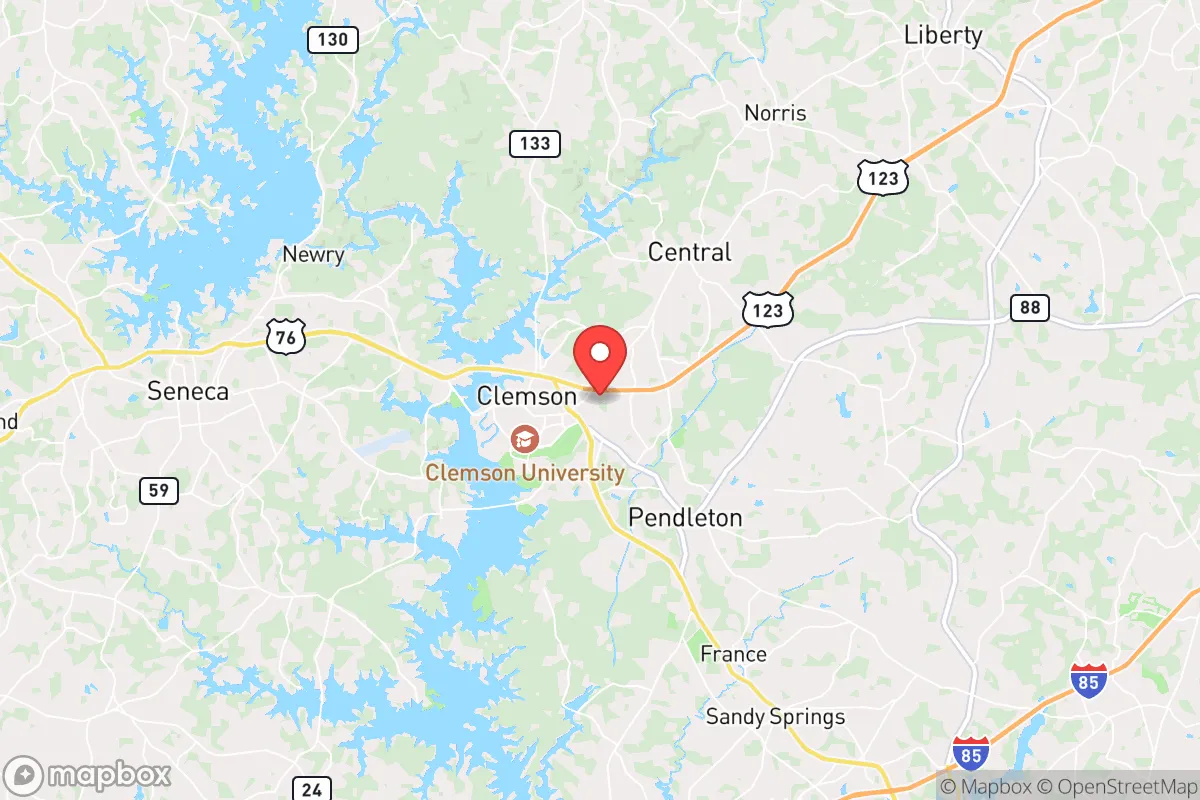
District shown is the primary district for this city’s centroid. Cities may span multiple districts.
Local Political AnalysisPolitical Analysis of Clemson, SC
Clemson, South Carolina, sits in the heart of Pickens County, and for a long time, this area was as reliably conservative as the red clay it’s built on. The Cook PVI rating of R+21 tells you the baseline, but the real story is how that number feels on the ground. For decades, this was a place where folks minded their own business, the Second Amendment was a given, and the biggest political debate was about the football team. But over the last ten years, you’ve seen a slow creep—a shift that’s less about the county flipping blue and more about the university’s influence pushing a progressive agenda that doesn’t match the values of the people who’ve lived here their whole lives. The surrounding towns like Pendleton, Central, and even Seneca in Oconee County still hold a much more traditional line, but inside the Clemson city limits, the vibe is changing.
How it compares
If you drive ten miles west to Seneca or fifteen miles east to Easley, you’re in a different world politically. Those communities vote even more heavily Republican, and you don’t see the same kind of “diversity, equity, and inclusion” banners hanging in storefronts. The contrast is stark: Pickens County as a whole is deep red, but the city of Clemson itself is a blue dot in that sea, driven almost entirely by the university faculty and student body. The R+21 rating masks that internal split. What worries a lot of us is that the university’s administration—like so many others—has started pushing policies that feel less about education and more about social engineering. You’ve got mandatory DEI training, pronoun policies, and a general atmosphere where dissenting opinions on things like critical race theory or gender ideology get you labeled. That’s not the Clemson I grew up around, where the biggest concern was whether you could hunt on your own land without a dozen new regulations.
What this means for residents
For a family or a retiree looking to move here, the political climate means you have to pick your neighborhood carefully. The county government is still solid—taxes are low, property rights are respected, and the sheriff’s office doesn’t play games with overreach. But the city council and the university are a different story. You’ll see them push for things like “complete streets” initiatives that sound nice but often mean more government control over how you use your own property, or zoning changes that make it harder to run a small business without jumping through hoops. The real red flag is the school board. There’s been a quiet push to bring in curriculum that downplays American history and emphasizes social justice, and if you’re not paying attention, it’ll be standard before you know it. For now, the county still has a strong conservative majority, but the trajectory is concerning. If you value personal freedom—the right to speak your mind, keep your guns, and not have the government tell you how to live—you’ll want to keep an eye on local elections and get involved before the progressive wave from the university spills over into every aspect of daily life.
One thing that still sets Clemson apart in a good way is the strong sense of community around faith and family. You’ve got a lot of churches that are still the backbone of the area, and the local gun culture is alive and well—there’s a reason the shooting range in Pendleton is always busy. But the cultural battle lines are drawn. The university’s push for “sustainability” and “equity” often translates into higher fees and more bureaucracy, and you can feel the tension between the old-timers who just want to be left alone and the newcomers who want to “improve” everything. If you’re looking for a place where the government stays out of your business, Clemson still has that in the county, but the city itself is a warning sign of where things could go if we don’t stay vigilant. Keep your friends close, your powder dry, and your vote local.

State Political ClimatePolitical Climate in South Carolina
State Political AnalysisPolitical Environment in the State
South Carolina has long been a reliably red state, but the flavor of that conservatism has shifted noticeably over the past two decades. The state’s overall partisan lean remains solidly Republican at the presidential level — Donald Trump carried it by 11 points in 2024 — but the coalition driving that majority has evolved. The old-school, establishment-friendly GOP that dominated the 2000s has given way to a more populist, culturally conservative base energized by issues like parental rights, Second Amendment protections, and election integrity. At the same time, rapid in-migration, particularly into the coastal and Upstate metros, is injecting new political dynamics that could reshape the map over the next decade.
Urban vs. rural divide
The political geography of South Carolina is stark. The rural Lowcountry, Pee Dee, and Midlands regions — places like Orangeburg, Florence, and Walterboro — vote overwhelmingly Republican, often by 30-40 point margins. These areas are the backbone of the state’s red majority. The urban centers tell a different story. Charleston has become a Democratic stronghold, driven by a mix of transplants, younger professionals, and a growing minority population; the city itself voted nearly 70% for Biden in 2020. Columbia, home to the state university and a large state government workforce, leans blue but is more moderate than Charleston. Greenville is the fascinating outlier — a rapidly growing Upstate city that remains reliably Republican, though its suburbs like Simpsonville and Greer are even more conservative than the urban core. The real battleground is the suburban ring around Charleston — places like Mount Pleasant and Summerville — where transplants from blue states are slowly shifting precincts from +20 R to +5 R. If you’re moving here for a conservative environment, the Upstate and rural areas are your safest bet; the coast is trending purple.
Policy environment
South Carolina’s policy posture is broadly conservative, with a few notable wrinkles. The state has a flat income tax rate of 6.2%, which is being phased down to 6.0% by 2026, and no state-level property tax on vehicles. Sales tax is 6% at the state level, with local options pushing it to 8-9% in some counties. The regulatory climate is business-friendly, with a right-to-work law and a low unionization rate (around 2.5%). On education, the state passed a universal school voucher program in 2023 — the Education Scholarship Trust Fund — which allows families to use state funds for private school tuition, homeschooling expenses, or tutoring. This was a major win for parental rights advocates. Healthcare policy is more mixed: the state did not expand Medicaid under the ACA, keeping government out of that space, but hospital consolidation has driven up costs in rural areas. Election laws have tightened: voter ID is required, absentee ballot drop boxes were restricted in 2021, and the state moved to a closed primary system for Republicans. Overall, the policy environment leans toward limited government, but the tax burden is moderate compared to true low-tax states like Florida or Tennessee.
Trajectory & freedom
The trajectory over the past five years has been toward more personal freedom in several key areas, though not without pushback. On gun rights, South Carolina became a permitless carry state in 2024, allowing law-abiding adults to carry concealed firearms without a permit — a significant expansion of Second Amendment liberty. On parental rights, the 2023 Parents’ Bill of Rights (H. 3728) requires schools to notify parents of any medical or mental health services offered to their children and prohibits instruction on sexual orientation or gender identity in K-5 classrooms. This was a direct response to overreach by school districts in Charleston and Richland County. On medical autonomy, the state passed a near-total abortion ban in 2023 (the Fetal Heartbeat Act), protecting unborn life after six weeks. However, there are concerning trends: property taxes have crept up in fast-growing counties like Greenville and Beaufort as local governments struggle to fund infrastructure for new arrivals. And the state’s Freedom of Information Act has been weakened in recent years, with exemptions for law enforcement records and economic development deals. On balance, South Carolina is moving in a freer direction on cultural and Second Amendment issues, but the fiscal freedom picture is more mixed — new residents should expect higher local taxes than the state’s reputation suggests.
Civil unrest & political movements
South Carolina has not seen the level of civil unrest seen in larger states, but there have been flashpoints. The Confederate flag removal from the Statehouse grounds in 2015, following the Charleston church shooting, was a watershed moment that exposed deep cultural divides — rural conservatives largely opposed the removal, while urban and suburban residents supported it. More recently, the Moms for Liberty movement has been highly active in Lexington and York County, organizing school board takeovers and pushing back against critical race theory and LGBTQ curriculum. On the left, the Indivisible network has a presence in Charleston and Columbia, organizing protests against the abortion ban and for expanded voting access. Immigration politics are less heated than in border states, but Greenville County saw a controversy in 2023 over a proposed “sanctuary city” resolution that was quickly defeated. Election integrity remains a live issue: the 2020 election in South Carolina was smooth, but the state GOP has pushed for further restrictions on mail-in voting, and a 2024 law requires signature verification for all absentee ballots. A new resident should expect a politically engaged but generally orderly environment — the kind of place where political disagreements are real but rarely boil over into the streets.
Projection
Looking ahead 5-10 years, South Carolina’s political future hinges on in-migration. The state is adding about 90,000 new residents per year, many from high-tax, high-regulation states like New York, California, and Illinois. These transplants tend to be more moderate or even left-leaning on cultural issues, even if they moved for economic reasons. The Charleston metro and the Myrtle Beach area are the primary landing zones, and both are trending purple. The Upstate, anchored by Greenville and Spartanburg, is attracting a more conservative wave of migrants — many from the Midwest and Northeast who are explicitly seeking a red state environment. The rural areas will remain deeply red but are losing population, which will reduce their electoral weight. The most likely scenario is that South Carolina stays Republican at the state level for the next decade, but the margin narrows. The state legislature will remain firmly in GOP hands due to gerrymandering, but the governor’s race and presidential margins could tighten to single digits by 2032. For a conservative moving here now, the window of maximum political alignment is probably the next 5-7 years — after that, expect more competitive elections and more policy battles over school choice, taxes, and Second Amendment rights.
For a new resident, the bottom line is this: South Carolina is still a solidly conservative state where your rights to keep and bear arms, choose your children’s education, and live without heavy government interference are well-protected. But the political winds are shifting, especially along the coast. If you want the most durable conservative environment, look at the Upstate — Greenville, Spartanburg, or Anderson — or the rural Lowcountry. If you’re drawn to the coast, understand that Charleston and its suburbs are becoming more politically mixed, and you’ll need to be engaged in local politics to keep the culture from drifting left. The state’s trajectory is toward more freedom on cultural issues but more pressure on taxes and property rights as growth accelerates. It’s a good place to put down roots if you’re willing to stay involved.
* Values derived from national, state, county, city and local statistics and may differ in a specific area. Last updated: 2026-04-30T01:18:24.000Z
Narrative content on this page is AI-generated and may contain mistakes. Verify any details that matter before acting on them.
ReloMaps may earn a commission from affiliate links at no extra cost to you.

