Photo: Wikipedia
Demographics of Clive, IA
Affluence Level in Clive, IA
An upper-middle-class area. Household wealth, education levels, and homeownership run ahead of national benchmarks.
People of Clive, IA
The people of Clive, Iowa, today form a highly educated, predominantly white suburban community of 18,776 residents, with a notable and growing Hispanic minority and a smaller but established East and Southeast Asian presence. The city’s character is defined by its role as a family-oriented, upper-middle-class enclave within the Des Moines metro, where 59.5% of adults hold a college degree and the foreign-born population stands at 8.4%. Distinctive identity markers include a strong emphasis on public safety, top-rated school districts, and a built environment of planned subdivisions and golf-course communities that attract professionals and executives seeking low-crime, high-amenity living.
How the city was settled and grew
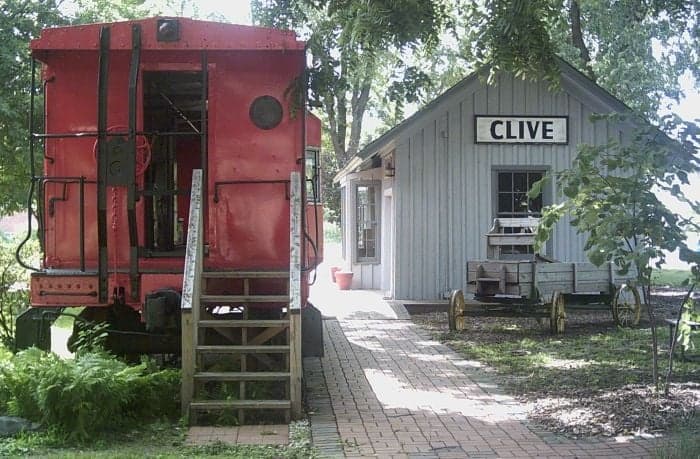
Clive was not a pioneer-era settlement but a late-19th-century railroad stop named after a railroad attorney, incorporated in 1925 with fewer than 200 residents. Its early population was overwhelmingly native-born white, drawn by the Chicago, Rock Island and Pacific Railroad and the surrounding agricultural economy. The first residential cluster formed around the original rail depot and the intersection of what is now University Avenue and 86th Street, an area still referred to as Old Town Clive. Through the 1950s, growth remained slow, limited to a few dozen farm families and railroad workers. The city’s real population story begins after 1960, when the post-war suburban boom reached western Polk County. The construction of Interstate 80/35 and the expansion of Des Moines’ white-collar economy triggered the first major wave: young families and corporate transferees, almost entirely white, who built out subdivisions like Westfield and Greenbrier in the 1960s and 1970s. These neighborhoods remain predominantly white and older today, with many original owners still in residence.
Modern era (post-1965)
The 1965 Hart-Cellar Act had a delayed but measurable effect on Clive. Unlike older urban cores, Clive did not receive a large immigrant wave in the 1970s or 1980s. Instead, the city’s foreign-born population grew gradually, driven by two distinct streams. The first was a wave of East and Southeast Asian professionals—primarily of Chinese, Korean, and Vietnamese ancestry—who arrived in the 1990s and 2000s, recruited by Des Moines-area insurance and financial firms. These families concentrated in newer, higher-end subdivisions such as Walnut Creek and Shady Oaks, drawn by the West Des Moines Community School District’s strong academic reputation. The second and larger stream has been Hispanic in-migration, which accelerated after 2010. Hispanic residents now make up 12.4% of Clive’s population, up from roughly 5% in 2000. This growth is driven by both domestic relocation from other U.S. states and direct immigration from Mexico and Central America, with families settling in more affordable, older housing stock in neighborhoods like Fox Creek and along the University Avenue corridor. The Black population, at 5.0%, is smaller and more dispersed, with no single dominant neighborhood. The Indian-subcontinent population remains negligible at 0.2%, reflecting Clive’s lack of the tech-sector anchor that draws South Asian professionals to other suburbs. Overall, the city’s white share has declined from 90% in 2000 to 76.0% today, but the change has been gradual and largely driven by Hispanic growth rather than white flight.
The future
Clive’s population is trending toward greater diversity, but the pace is moderate and the pattern is one of assimilation rather than tribalization. Hispanic families are increasingly moving into previously all-white subdivisions like Westfield as older homeowners sell, and second-generation Hispanic residents are attending college at rates approaching the city average. The East and Southeast Asian community, while small, is highly integrated and concentrated in the same school attendance zones as white professionals. No single ethnic enclave has formed, and Clive lacks the ethnic retail corridors or religious institutions that anchor separate communities in larger cities. The foreign-born share, at 8.4%, is stable and unlikely to spike dramatically given the city’s high housing costs and limited rental stock. Over the next 10 to 20 years, Clive will likely become slightly more Hispanic and slightly less white, but will remain a predominantly white, college-educated suburb. The key demographic risk is not ethnic tension but generational turnover: as the large cohort of aging white homeowners in Greenbrier and Old Town downsizes or passes away, the city will need to attract younger families—of any background—to maintain its tax base and school enrollment.
For a conservative-leaning individual or family moving in now, Clive is a stable, low-crime suburb where demographic change is happening slowly and without conflict. The city’s character is not shifting toward a multicultural urban hub but toward a slightly more diverse version of its current self—still family-focused, still highly educated, and still dominated by single-family homes and good schools. The practical implication is that newcomers will find a community that values order, safety, and property values, with a population that is gradually broadening in background but not in political or cultural outlook.

* Values derived from national, state, county, city and local statistics and may differ in a specific area. Last updated: 2026-04-23T04:09:26.000Z
Narrative content on this page is AI-generated and may contain mistakes. Verify any details that matter before acting on them.
ReloMaps may earn a commission from affiliate links at no extra cost to you.

