Photo: Wikipedia
Demographics of Cloudcroft, NM
Affluence Level in Cloudcroft, NM
A below-average socioeconomic profile. Incomes, home values, and educational attainment trail the U.S., with higher poverty and unemployment.
People of Cloudcroft, NM
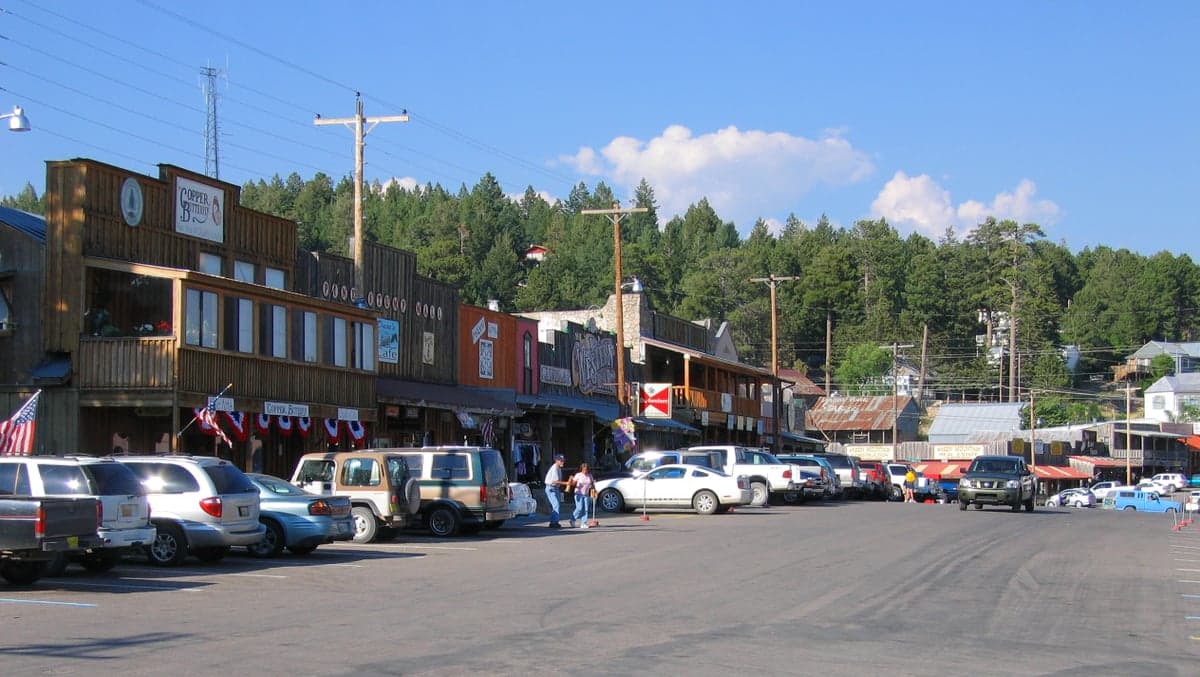
Cloudcroft, New Mexico, is a small, tight-knit mountain village of 1,275 residents, characterized by a predominantly White population (77.5%) and a significant Hispanic community (22.4%), with no foreign-born residents. Its people are defined by a blend of Anglo-American heritage and deep-rooted Hispanic lineage, creating a culturally homogeneous but politically and socially conservative atmosphere. The village’s identity is shaped by its history as a railroad-era resort and a U.S. Forest Service outpost, giving it a distinctive character that is more aligned with the rural West than with the rest of Otero County.
How the city was settled and grew
Cloudcroft’s human history begins not with Spanish colonization or Native American settlement, but with the arrival of the railroad in the late 19th century. Founded in 1898 as a summer retreat for the El Paso and Northeastern Railroad, the village was deliberately built as a high-altitude escape from the desert heat. The original population was a mix of Anglo railroad executives, engineers, and their families who constructed summer cottages in what is now the Old Town district, centered around the historic Lodge and Pavilion. Simultaneously, Hispanic laborers from the nearby Tularosa Basin and Mescalero Apache Reservation were drawn to the area for construction and service work, settling in the Upper Canyon area and along what is now Burro Avenue. The U.S. Forest Service established a presence in the 1910s, bringing a wave of government employees who built homes in the Forest Service Addition neighborhood. By the mid-20th century, Cloudcroft had stabilized as a small, seasonal community of roughly 500 people, with the railroad’s decline in the 1940s shifting the economy toward tourism and federal land management.
Modern era (post-1965)
After the 1965 Immigration and Nationality Act, Cloudcroft saw virtually no new foreign-born immigration—the 2024 data shows a 0.0% foreign-born share, a figure that has held steady for decades. Instead, the modern era has been defined by domestic in-migration, primarily from Texas and other parts of the Southwest. Retirees and second-home buyers, attracted by the cool summers and small-town atmosphere, began purchasing properties in the Sleepy Grass subdivision and the Pines area during the 1970s and 1980s. This wave was overwhelmingly White and middle-to-upper income, drawn by the village’s reputation as a quiet, safe haven. The Hispanic population, which had been present since the founding, remained concentrated in the older neighborhoods like Upper Canyon and Burro Avenue, while newer Anglo arrivals settled in the more recently developed subdivisions. The 2024 racial data—77.5% White, 22.4% Hispanic, with no Black, Asian, or Indian residents—reflects this bifurcated pattern: a largely White, affluent enclave in the newer subdivisions, and a working-class Hispanic community in the historic core. The college-educated share of 30.3% is notably high for a village this size, driven by the influx of educated retirees and remote workers.
The future
Cloudcroft’s population is heading toward further homogenization, not diversification. The 0.0% foreign-born rate and the absence of any Black, Asian, or Indian communities suggest that the village is not a destination for new immigrant groups. Instead, the trend is toward an aging, predominantly White population, with the Hispanic community likely plateauing or slowly declining as younger generations move to larger cities like Alamogordo or Las Cruces for employment. The village’s strict zoning and limited buildable land—much of it within the Lincoln National Forest—constrain new housing development, keeping population growth minimal. Over the next 10–20 years, Cloudcroft will likely remain a small, culturally stable community, with the Sleepy Grass and Pines subdivisions becoming increasingly Anglo and affluent, while the Upper Canyon and Burro Avenue areas retain their Hispanic character. The village is not tribalizing into distinct ethnic enclaves so much as solidifying existing patterns, with little pressure for change from external migration.
For someone moving in now, Cloudcroft offers a stable, predictable demographic environment—a place where the population is not growing or diversifying, but rather aging in place. The village is becoming a quieter, more exclusive mountain retreat, with a social fabric that values continuity over change. New residents should expect a community that is overwhelmingly White and Hispanic, with no significant immigrant presence, and a culture that is deeply rooted in its railroad and Forest Service history.

* Values derived from national, state, county, city and local statistics and may differ in a specific area. Last updated: 2026-05-28T19:04:18.000Z
Narrative content on this page is AI-generated and may contain mistakes. Verify any details that matter before acting on them.
ReloMaps may earn a commission from affiliate links at no extra cost to you.

