Photo: Wikipedia
Demographics of Columbia, TN
Affluence Level in Columbia, TN
A middle-class area roughly in line with national averages across income, home values, education, and employment.
People of Columbia, TN
The people of Columbia, Tennessee today number roughly 44,000, forming a community that is predominantly white (67.7%) with a significant Black minority (15.6%) and a growing Hispanic population (11.8%). The city’s character is rooted in its historic role as a county seat and manufacturing hub, giving it a practical, working-class identity rather than a suburban bedroom-community feel. With only 23.9% of adults holding a college degree and a foreign-born population of just 2.8%, Columbia remains a largely native-born, middle-American city where family ties and local industry still shape daily life.
How the city was settled and grew
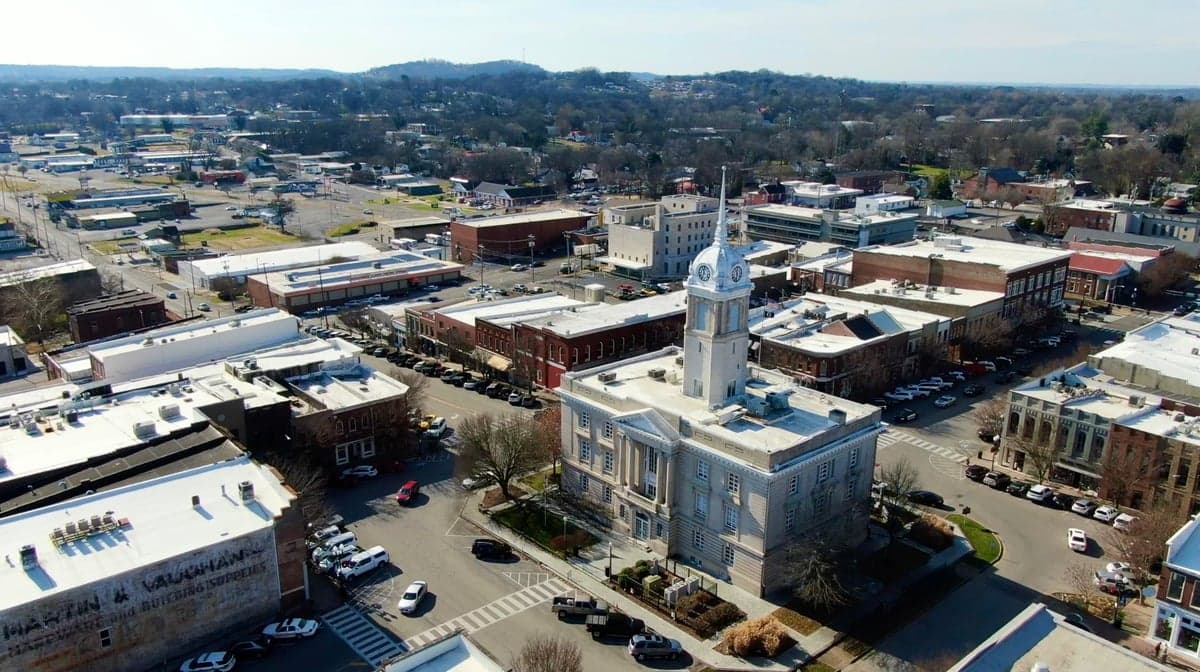
Columbia was founded in 1807 as the seat of Maury County, drawing its first settlers from Virginia, North Carolina, and Kentucky via the Cumberland River and the Natchez Trace. These early arrivals were primarily of English, Scots-Irish, and German stock, attracted by fertile limestone soils ideal for tobacco and later cotton plantations. The city’s antebellum wealth, built on enslaved Black labor, is visible today in the historic River Side District, where Greek Revival mansions line West 7th Street, built by planter families who dominated local politics. After the Civil War, freedmen established the Green Street Bottom neighborhood (now often called the Green Street area), a tight-knit Black community centered around churches and small businesses that persisted through Jim Crow. The late 19th and early 20th centuries brought a second wave: German and Irish immigrants who worked in the city’s new phosphate mines and flour mills, settling in the West End near the railroad depot. By 1950, Columbia’s population was roughly 75% white and 25% Black, with almost no foreign-born residents—a pattern that held until the 1970s.
Modern era (post-1965)
The post-1965 period reshaped Columbia’s demographics in two distinct phases. First, the 1970s and 1980s saw white flight from Nashville’s urban core push middle-class families south along U.S. 31, creating new subdivisions like Highland Park and Bent Creek on the city’s northern and eastern edges. These areas remain overwhelmingly white and owner-occupied, with home values 15-20% above the city median. Second, the 1990s brought the first significant Hispanic migration, driven by jobs at the Saturn (now General Motors) plant in nearby Spring Hill and at Columbia’s own Mueller Brass and Dana Corporation factories. Hispanic residents, now 11.8% of the population, concentrated in the South Jackson Street corridor and parts of the East End, where rental housing and proximity to industrial jobs made settlement practical. The Black population, meanwhile, has remained stable at roughly 15-16% since 1990, with the historic Green Street area still a cultural anchor but many families dispersing into newer subdivisions like Raintree Estates. East and Southeast Asian residents (0.6%) are a tiny presence, mostly professionals tied to the GM supply chain, and Indian-subcontinent residents are statistically zero—underscoring how little high-skilled immigration has reached Columbia compared to Nashville’s suburbs.
The future
Columbia’s population trajectory points toward gradual diversification, but not rapid change. The Hispanic share is likely to grow from 11.8% toward 15-18% over the next decade, driven by continued manufacturing employment and lower housing costs than Williamson County. However, the foreign-born share (2.8%) will remain low because most Hispanic growth comes from U.S.-born children, not new arrivals. The white share will continue a slow decline from 67.7% as the white population ages and younger white families move to newer exurban developments in Spring Hill and Thompson’s Station. The Black share is expected to hold steady, as Columbia offers little to attract new Black in-migration from larger cities. The city is not tribalizing into distinct ethnic enclaves—neighborhoods like Highland Park and Bent Creek remain nearly all-white, while the South Jackson corridor is becoming a mixed Hispanic-and-white area rather than a barrio. For a conservative-leaning newcomer, this means moving into a city that is still culturally and politically mainstream American, with a growing Hispanic presence that is assimilating into local schools and churches rather than forming separate institutions. The next 10-20 years will see Columbia become slightly more diverse, slightly more suburban, and slightly less tied to its historic manufacturing base—but it will remain a solidly middle-American, family-oriented city where most residents share a common language and civic calendar.
For someone moving in now, Columbia offers a stable, affordable alternative to Nashville’s escalating costs and cultural flux. The population is becoming modestly more Hispanic but remains overwhelmingly native-born and English-speaking, with a conservative political tilt that reflects its working-class roots. The city is not a melting pot or a collection of ethnic enclaves—it is a traditional Southern county seat that is slowly absorbing new groups without losing its essential character.

* Values derived from national, state, county, city and local statistics and may differ in a specific area. Last updated: 2026-05-01T08:10:29.000Z
Narrative content on this page is AI-generated and may contain mistakes. Verify any details that matter before acting on them.
ReloMaps may earn a commission from affiliate links at no extra cost to you.

