
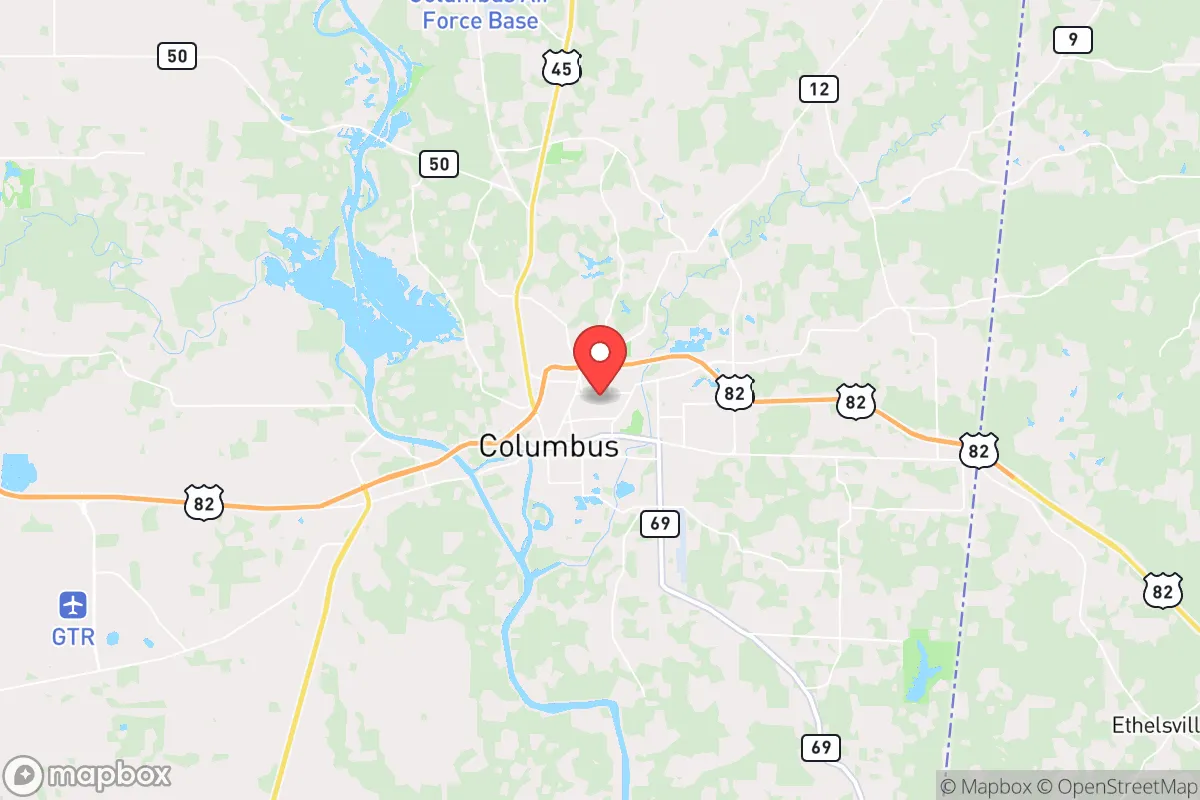
Photo: Wikipedia
Personal Sovereignty in Columbus, MS
Viable for self-reliance. Generally workable, though some barriers may limit total independence.
What does Personal Sovereignty tell us?
Personal Sovereignty measures your capacity for self-reliance and independence with minimal government friction. Higher scores mean fewer barriers between you and the way you want to live... but it assumes you have the space you need and good neighbors.
What does this tell us?
Personal Sovereignty measures your capacity for self-reliance and independence with minimal government friction. Higher scores mean fewer barriers between you and the way you want to live... but it assumes you have the space you need and good neighbors.
State Policy
Energy independence: Importer (50% of energy produced in-state)
Personal Liberty
Homesteading

Personal Liberty Analysis
Columbus, Mississippi, offers a notably high degree of personal sovereignty compared to many parts of the country, particularly for those who prioritize minimal government interference in daily life. The city sits in a state that consistently ranks among the most freedom-friendly in the nation, with a legal and cultural environment that leans heavily toward individual autonomy, self-defense rights, and limited regulatory burdens. For a single individual or family approaching relocation from a survivalist or prepper mindset, Columbus presents a strategic balance of small-city accessibility and a legal framework that largely leaves you alone to live as you see fit, provided you aren't causing harm to others.
Tax burden and regulatory posture: How much government reaches into your wallet and property
Mississippi's tax structure is one of the most favorable in the country for those seeking to keep more of what they earn. The state has a flat income tax rate of 4.0% on all taxable income over $5,000, and there are ongoing legislative efforts to phase it out entirely. Property taxes in Lowndes County, where Columbus sits, are remarkably low—typically around 0.6% to 0.8% of assessed value, which means a $200,000 home might carry an annual tax bill of roughly $1,200 to $1,600. There is no state-level tax on Social Security benefits, and military retirement income is fully exempt. Sales tax in Columbus is 7.0% (state plus local), which is moderate but not oppressive. The regulatory posture at the state level is explicitly pro-business and anti-red tape. Mississippi is a right-to-work state, and there are no state-level occupational licensing requirements for many trades that would be burdensome elsewhere. Zoning in Columbus is relatively light compared to larger metro areas, though the city does have a zoning code. For those looking to operate a home-based business, store supplies, or keep a modest workshop, the city's enforcement tends to be complaint-driven rather than proactive. The overall message from the state and local government is clear: they are not looking to extract maximum revenue or micromanage your property.
Self-defense and gun law specifics: What you can carry, where, and without what permits
Mississippi is a constitutional carry state, meaning that as of 2016, any law-abiding adult 18 or older can carry a concealed firearm without a permit. This is a foundational sovereignty issue for many preppers and conservatives. There is no state-level requirement to register firearms, no waiting periods for purchase, and no magazine capacity restrictions. The state preempts local gun ordinances, so Columbus cannot enact its own stricter rules than what state law allows. Stand Your Ground laws are fully in effect—there is no duty to retreat before using deadly force if you are lawfully present and believe it is necessary to prevent death or great bodily harm. Castle Doctrine protections extend to your vehicle and workplace, not just your home. For those who want a permit for reciprocity when traveling, the Mississippi Enhanced Permit is available and recognized in over 35 states. The legal climate for self-defense is among the most permissive in the Southeast, and local law enforcement in Columbus generally respects these rights. There are no red flag laws or extreme risk protection orders on the books in Mississippi, which is a significant consideration for those concerned about government overreach into firearm ownership.
Self-reliance and homesteading viability: Lot sizes, zoning, and off-grid feasibility
For those looking to reduce dependence on supply chains and municipal systems, Columbus and its surrounding areas offer genuine opportunities. Within the city limits, standard residential lots range from a quarter-acre to half-acre, but many neighborhoods have larger parcels, especially on the outskirts. The city's zoning code allows for keeping chickens and small livestock on residential lots in many districts, though you'll want to verify specific HOA covenants if they exist. Outside the city limits in Lowndes County, zoning is virtually nonexistent, and you can find acreage for $3,000 to $6,000 per acre depending on proximity to town. Off-grid living is legally feasible in the county—there are no state laws prohibiting rainwater collection, composting toilets, or solar panel installation. Mississippi has strong solar access laws that prevent HOAs from banning solar panels outright. The climate allows for year-round gardening, and the growing season stretches from March through November. Water rights are favorable: landowners have the right to drill a well for personal use without a permit in most cases, though you should check with the Mississippi Department of Environmental Quality for specific well depth regulations. The main practical limitation is that Columbus is in a region with occasional drought conditions, so rainwater storage is a wise investment. For those serious about self-reliance, the area provides a legal and practical foundation that is hard to beat in the eastern half of the country.
Personal liberties: Parental rights, medical autonomy, speech, and property
Mississippi has some of the strongest parental rights laws in the nation. The state does not recognize any form of parental alienation as a basis for removing custody, and parents have explicit legal authority to direct their children's education, medical care, and religious upbringing. There are no state-level vaccine mandates for school attendance—parents can claim a religious or philosophical exemption with minimal paperwork. Medical autonomy is similarly robust: Mississippi has no state-level mask mandates, no vaccine passports, and no emergency health orders that can override individual consent without a court order. The state legislature passed laws in 2023 prohibiting any government entity from requiring a COVID-19 vaccine as a condition of employment or service. Free speech protections are strong, with no hate speech laws that criminalize political or religious expression. Property rights are constitutionally protected, and eminent domain for private economic development is restricted—the state does not allow the seizure of land to transfer to another private entity for tax revenue purposes. The legal culture in Columbus and Mississippi generally respects the principle that your home, your body, and your family are your own domain, and the government's role is limited to protecting those boundaries from infringement by others.
Overall, Columbus offers a sovereignty profile that ranks in the top tier of American cities for those who prioritize personal autonomy, self-defense, and minimal government interference. The combination of constitutional carry, low taxes, light regulation, strong parental rights, and viable homesteading options creates an environment where a determined individual or family can build a life largely on their own terms. Compared to the regulatory-heavy environments of the Northeast, West Coast, or even much of the Midwest, Columbus represents a strategic relocation choice for those who see the trajectory of the country as moving toward greater government overreach and want to position themselves in a jurisdiction that pushes back. The main trade-off is that you are in a small city with limited economic diversity and a slower pace of life—but for many preppers and conservatives, that is precisely the point.

* Values derived from national, state, county, city and local statistics and may differ in a specific area. Last updated: 2026-04-30T13:53:31.000Z
Narrative content on this page is AI-generated and may contain mistakes. Verify any details that matter before acting on them.
ReloMaps may earn a commission from affiliate links at no extra cost to you.

