
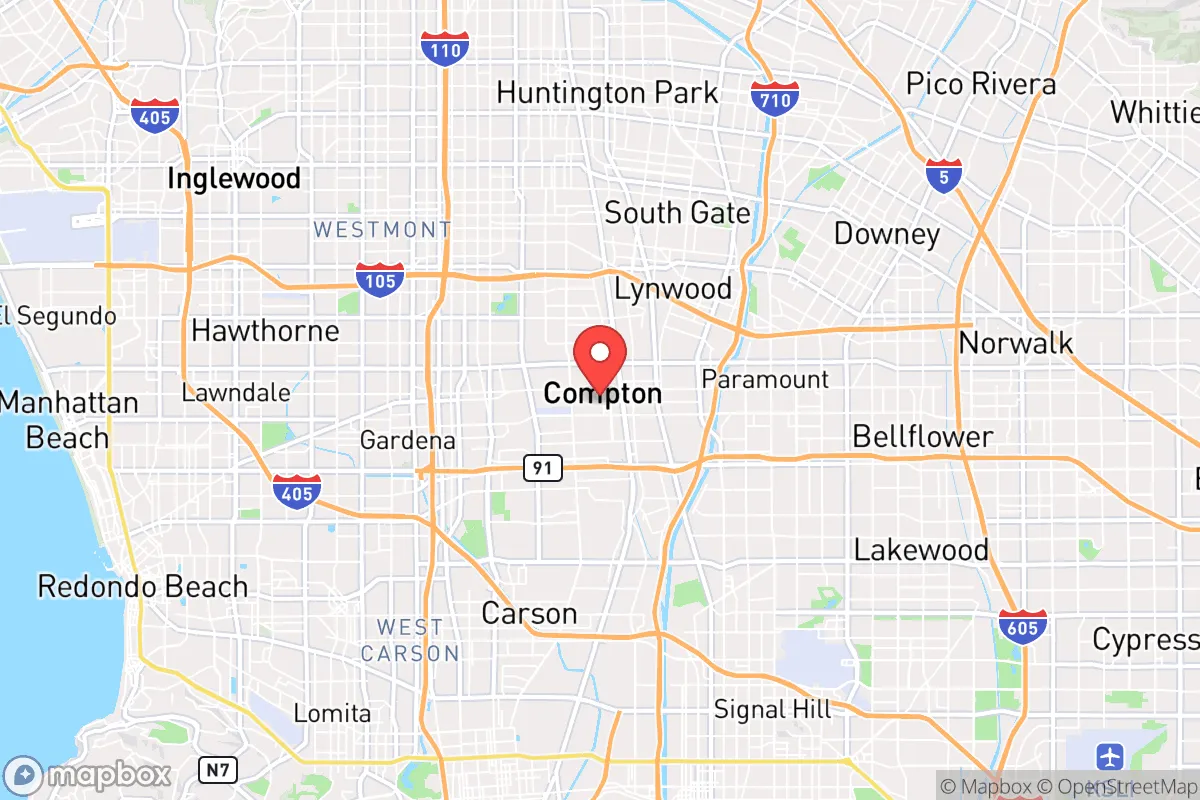
Photo: Wikipedia
Personal Sovereignty in Compton, CA
Moderate friction. Expect trade-offs in some aspect of personal liberty and independence.
What does Personal Sovereignty tell us?
Personal Sovereignty measures your capacity for self-reliance and independence with minimal government friction. Higher scores mean fewer barriers between you and the way you want to live... but it assumes you have the space you need and good neighbors.
What does this tell us?
Personal Sovereignty measures your capacity for self-reliance and independence with minimal government friction. Higher scores mean fewer barriers between you and the way you want to live... but it assumes you have the space you need and good neighbors.
State Policy
Energy independence: Importer (33% of energy produced in-state)
Personal Liberty
Homesteading

Personal Liberty Analysis
Compton, California presents a challenging environment for personal sovereignty, where state-level policies heavily constrain individual autonomy in taxation, self-defense, and property use, while local conditions further complicate self-reliance. As a densely urbanized city in Los Angeles County, Compton offers limited room for the kind of independent, low-regulation lifestyle that many freedom-oriented relocators seek. The regulatory posture is decidedly heavy-touch, with California’s progressive governance creating a framework where personal choices in housing, business, and daily life are subject to extensive oversight. For those prioritizing maximum personal freedom, Compton ranks low compared to states like Texas or Arizona, but understanding the specific constraints can help readers decide if the trade-offs align with their priorities.
Tax burden and regulatory posture in Compton and California
California imposes one of the heaviest tax burdens in the nation, and Compton residents feel this acutely. The state’s top marginal income tax rate of 13.3% applies to high earners, while the state sales tax rate is 7.25%, with local add-ons pushing the combined rate in Compton to 10.25% as of 2025. Property taxes are capped at 1% of assessed value under Proposition 13, but annual increases are limited to 2%, which provides some predictability for long-term homeowners. However, the overall cost of living in Compton is about 35% higher than the national average, driven largely by housing and taxes. Regulatory burdens are significant: California’s California Environmental Quality Act (CEQA) can delay or block development projects, and the state’s strict labor laws, including a $16.50 minimum wage (2025), increase business costs. For a self-reliant individual, this means less disposable income and more bureaucratic hurdles for starting a home-based business or renovating property. The regulatory environment is best described as heavy-touch, with the state actively intervening in housing, energy, and land use decisions.
Self-defense and gun law specifics in Compton
California’s gun laws are among the most restrictive in the United States, and Compton operates under this framework with no local exceptions. The state requires a Firearm Safety Certificate (FSC) to purchase any firearm, a 10-day waiting period for all gun purchases, and a background check through the California Department of Justice. As of 2024, California’s “may-issue” concealed carry regime was replaced by a “shall-issue” system following the Supreme Court’s Bruen decision, but the state still imposes stringent requirements: applicants must complete 16 hours of training, pass a live-fire test, and demonstrate “good cause” beyond mere self-defense, though the standard has loosened. In practice, obtaining a concealed carry permit in Los Angeles County, which includes Compton, remains difficult and time-consuming, with approval rates below 10% in some years. The state also bans “assault weapons” and high-capacity magazines (over 10 rounds), and has a strict liability law for unsafe storage. For self-defense, Compton residents face a paradox: the city has a violent crime rate roughly 2.5 times the national average (per FBI data), yet legal access to firearms for protection is heavily restricted. Stand-your-ground laws do not exist in California; instead, the state imposes a “duty to retreat” in public spaces before using deadly force, unless the person is in their home (Castle Doctrine applies). This legal environment significantly limits personal sovereignty in self-defense decisions.
Self-reliance and homesteading viability in Compton
Homesteading and off-grid living are nearly impossible within Compton’s urban footprint. The city’s median lot size is approximately 5,000 to 6,000 square feet, typical of older suburban development, but most properties are fully built out with single-family homes, leaving little room for substantial gardening or livestock. Zoning codes in Compton are governed by Los Angeles County’s Title 22, which restricts agricultural uses in residential zones: keeping chickens is allowed with a permit and limit of 4 hens (no roosters), but goats, pigs, or larger livestock are prohibited in R-1 zones. Backyard beekeeping is permitted with registration, but water rights are fully regulated by the state, and rainwater harvesting is legal but limited to 5,000 gallons per property without a permit. Off-grid energy is heavily restricted: California’s building codes require grid-tied solar systems for new construction, and disconnecting from the utility grid is effectively illegal due to health and safety codes. The city’s water supply comes from the Metropolitan Water District, and well drilling is not feasible in this urbanized area. For those seeking self-reliance through food production or energy independence, Compton offers minimal viability. The regulatory environment actively discourages homesteading, with permits required for even minor structural changes, and the high cost of land (median home price around $650,000 as of 2025) makes acquiring larger parcels prohibitive.
Personal liberties in Compton: parental rights, medical autonomy, speech, and property
Personal liberties in Compton are shaped by California’s progressive legal framework, which often prioritizes state authority over individual choice. Parental rights are relatively strong in some areas: California allows parents to homeschool under a private school affidavit, and there is no mandatory vaccination requirement for school attendance (though unvaccinated children can be excluded during outbreaks). However, the state’s expansive child welfare laws give social workers broad discretion to investigate families, and California’s “gender identity” laws require schools to affirm a child’s chosen gender identity without parental notification, which some families view as an infringement on parental authority. Medical autonomy is limited: California has strict vaccine mandates for healthcare workers and schoolchildren (though exemptions exist), and the state’s public health emergency powers were used extensively during COVID-19, including mask and vaccine mandates. The state also criminalizes the sale of raw milk for human consumption and restricts access to certain alternative treatments. Free speech is protected under the First Amendment, but California has laws against “hate speech” that can be enforced in public spaces, and local ordinances in Compton may restrict leafleting or public gatherings without permits. Property rights are constrained by California’s rent control laws (AB 1482 caps annual rent increases at 5% plus inflation) and strict eviction protections, which limit a landlord’s ability to manage their property. For homeowners, the California Coastal Commission and local zoning boards have significant say over renovations and additions. Overall, personal liberties in Compton are moderate to low compared to less regulated states, with the state asserting authority in healthcare, education, and property use.
In summary, Compton’s personal sovereignty environment is heavily constrained by California’s high taxes, restrictive gun laws, and dense regulatory framework, making it a poor fit for those prioritizing maximum autonomy. The city’s urban character and state-level policies limit self-reliance options, from homesteading to off-grid living, while personal liberties in medical decisions and property use are subject to significant oversight. For a conservative-leaning relocator seeking independence, Compton ranks low relative to areas like rural Texas or Idaho, where lower taxes, looser gun laws, and fewer zoning restrictions prevail. However, for those who value California’s climate, job market, or cultural amenities, understanding these sovereignty trade-offs is essential for making an informed decision. The area is best suited for individuals who accept a high degree of state involvement in exchange for other benefits, rather than those seeking a light-touch, self-reliant lifestyle.

* Values derived from national, state, county, city and local statistics and may differ in a specific area. Last updated: 2026-08-13T19:15:11.000Z
Narrative content on this page is AI-generated and may contain mistakes. Verify any details that matter before acting on them.
ReloMaps may earn a commission from affiliate links at no extra cost to you.

