
Photo: Wikipedia
Political ClimatePolitical Climate in Compton, CA
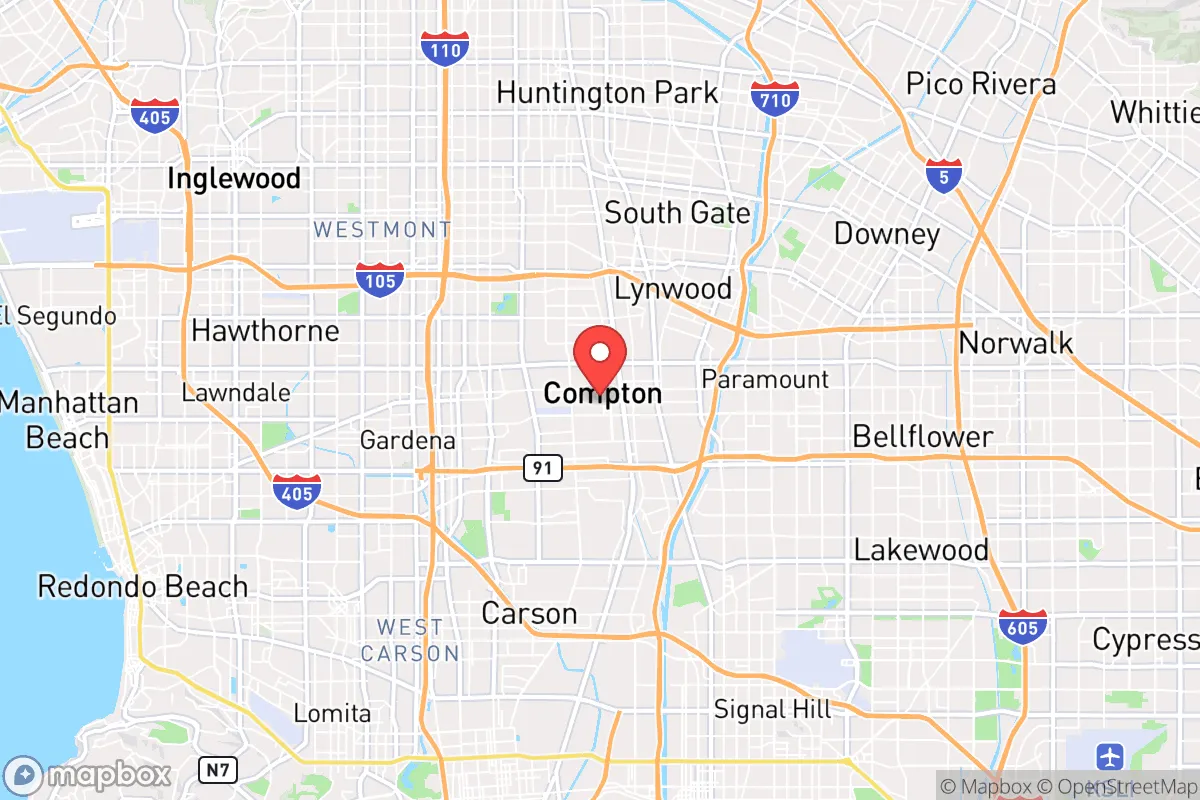
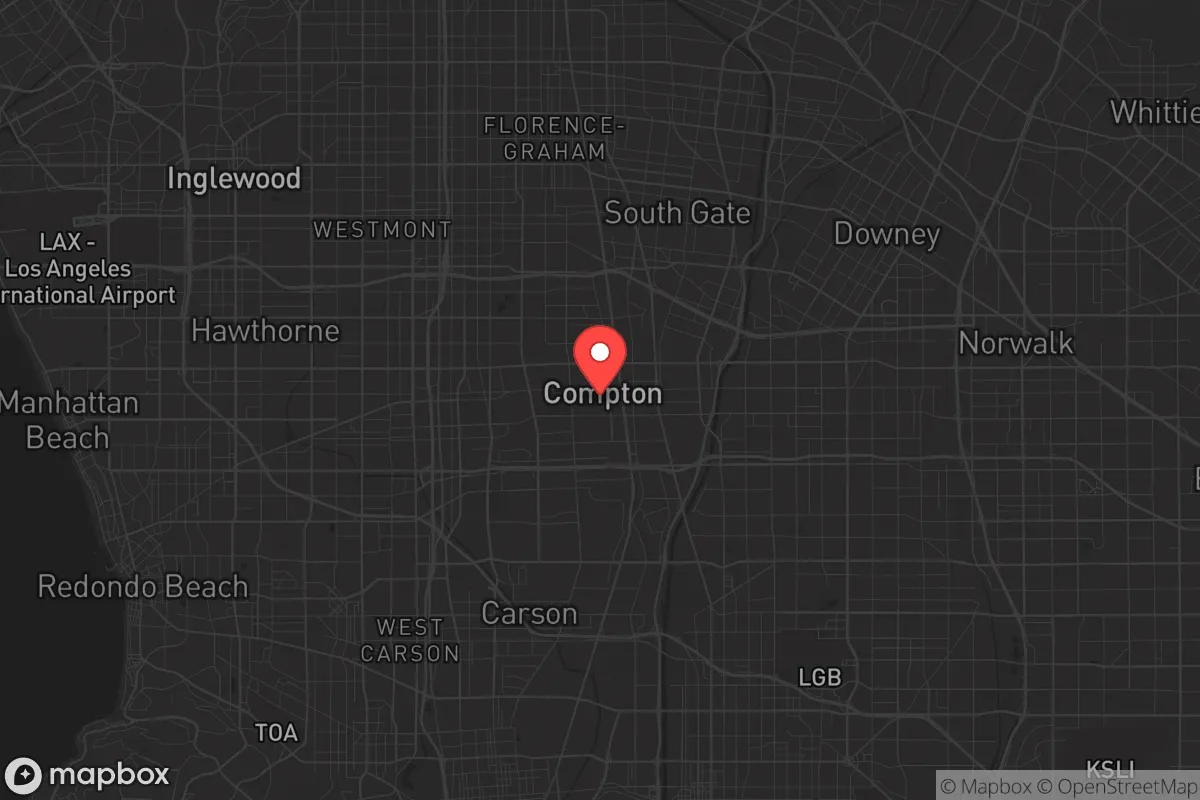
District shown is the primary district for this city’s centroid. Cities may span multiple districts.
Local Political AnalysisPolitical Analysis of Compton, CA
Compton is one of the most reliably Democratic strongholds in the entire country, carrying a Cook Partisan Voting Index (PVI) of D+27. That means the district votes about 27 points more Democratic than the national average, which is a deeper shade of blue than almost anywhere else in Southern California. If you’ve been around long enough, you remember when the city was even more isolated politically, but the shift has been toward a solid, unshakable Democratic majority. In the 2024 presidential election, the precincts here broke for the Democratic candidate by margins that often exceeded 85%, making it one of the most lopsided voting blocs in Los Angeles County. The trajectory is not toward moderation; if anything, the younger, more activist voters coming in are pushing the needle further left, especially on housing and policing issues.
How it compares
To understand how deep blue Compton is, you have to look at the surrounding patchwork. Nearby cities like Long Beach and Carson are also Democratic, but they have more internal diversity—Long Beach has a significant moderate and even conservative-leaning Asian American and Pacific Islander population, while Carson has a stronger union-based Democratic machine. South of Compton, the city of Lynwood is similarly D+ territory, but not quite as lopsided. Head north or west into Inglewood or Hawthorne, and you’ll find a slightly more competitive environment, though still safely Democratic. The real contrast is with places like Torrance or the Palos Verdes Peninsula, which are just a 15-minute drive away but vote Republican or lean Republican in local races. That geographic proximity to conservative areas makes Compton’s political identity even more pronounced—it’s a blue island in a region that’s already blue, but surrounded by pockets of red that remind you how polarized the county is.
What this means for residents
For liberal residents, Compton is about as comfortable as it gets. You’ll find city council meetings where the dominant language is about tenant protections, police reform, and investment in public schools—issues that resonate deeply here. Progressive candidates rarely face serious primary challenges from the right; the real fights are between different wings of the Democratic Party, often split along generational or activist lines. For conservative residents, life is more about keeping your head down politically. You won’t see many yard signs for Republican candidates, and if you’re openly conservative, you might feel socially isolated in local civic spaces. That said, the city’s political machine is pragmatic—it delivers services and fights for state and federal funding, which benefits everyone regardless of party. The practical reality is that property taxes, business regulations, and school funding are all shaped by the same Democratic supermajority that controls Sacramento, so local politics is more about implementation than ideological battles.
Culturally, Compton’s political identity is inseparable from its history as a Black-majority city that has become increasingly Latino. That demographic shift has changed the conversation around immigration, housing, and economic development. You’ll hear Spanish at city council meetings as often as English, and the local Democratic clubs reflect that coalition. One distinctive policy outcome is the city’s aggressive push for rent control and tenant protections, which goes further than state law requires. Another is the heavy investment in youth programs and community-based policing alternatives, funded by state grants and local measures. If you’re moving here, understand that the politics are not just about voting blue—they’re about a community that expects its government to be active, visible, and responsive to the working-class families that make up the majority of residents. That’s the real story of Compton’s political climate: not just a number on a chart, but a living, breathing expectation that the city hall is there to serve the people who live in the flats, not the investors or developers.

State Political ClimatePolitical Climate in California
State Political AnalysisPolitical Environment in the State
California is a deeply blue state where Democrats hold every statewide office and supermajorities in both legislative chambers, but the reality on the ground is far more complex than the national headlines suggest. The state’s overall partisan lean has been solidly Democratic for three decades, with no Republican winning statewide office since 2006. However, the 10-20 year trajectory shows a slow but measurable rightward shift in inland areas and the Central Valley, even as coastal metros pull harder left — creating a state that is simultaneously more polarized and more internally divided than ever.
Urban vs. rural divide
The political map of California is a story of two states. The coastal corridor from San Francisco down through Los Angeles and San Diego generates the vast majority of Democratic votes — these metros are among the most liberal in the nation, with San Francisco’s Board of Supervisors often pushing policies to the left of the state party. In contrast, the Central Valley and inland empire lean conservative: Bakersfield and Fresno reliably vote Republican, and Orange County — once a GOP stronghold — has flipped purple and now sends Democrats to Congress in several districts. The real action is in the exurbs and smaller cities: Redding in the north is deeply red, while Palm Springs and Santa Barbara are liberal enclaves surrounded by conservative ranch country. The divide isn’t just geographic — it’s cultural, economic, and growing sharper every cycle.
Policy environment
California’s policy environment is defined by high taxes, heavy regulation, and expansive government services. The state has a progressive income tax with rates up to 13.3%, one of the highest in the nation, and a state sales tax that can exceed 10% in some cities. Property taxes are capped by Proposition 13, which keeps annual increases low but creates inequities for new buyers. The regulatory posture is aggressive: California sets its own vehicle emissions standards, mandates renewable energy targets, and has some of the strictest environmental review laws in the country (CEQA). Education policy is centralized in Sacramento, with the state controlling curriculum and funding formulas — local school boards have less autonomy than in many other states. Healthcare is heavily regulated, with a state-run exchange (Covered California) and ongoing efforts toward a single-payer system. Election laws are among the most accessible in the nation: same-day registration, no-excuse mail-in voting, and automatic voter registration are standard. For a conservative relocator, the practical effect is higher costs and less local control, balanced by strong public services and infrastructure investment.
Recent policy direction
The last five years have seen California accelerate leftward on several fronts, with notable legislation that directly affects daily life. On gun and self-defense law, the state has passed some of the nation’s strictest measures: SB 2 (2023) bans carrying firearms in most public places, and AB 1598 (2024) allows private citizens to sue gun manufacturers — a direct copy of Texas’s abortion law structure. Parental and education rights have been a flashpoint: AB 1955 (2024) prohibits school districts from requiring parental notification when a child changes gender identity, effectively overriding local school board decisions. On speech and privacy, the California Age-Appropriate Design Code Act (2022) imposes strict data privacy rules on platforms used by minors, while the state’s broad anti-SLAPP law protects free speech in litigation. Medical and bodily autonomy is fully protected: abortion and gender-affirming care are legal and shielded from out-of-state prosecution. Property rights remain constrained by rent control laws (AB 1482 caps annual increases at 5% plus inflation) and the California Coastal Commission’s broad permitting authority. Taxation has not increased at the top rate recently, but a new wealth tax proposal (Assembly Bill 259) is being debated for 2025. Voting and ballot access expanded further with universal mail-in ballots made permanent after COVID. For a relocator weighing liberties, the tradeoff is clear: California prioritizes personal autonomy on medical and social issues while restricting it on property, firearms, and parental rights.
Civil unrest & political movements
California has a long history of political activism, and recent years have been no exception. The 2020 George Floyd protests were among the largest and most destructive in the state, particularly in Los Angeles and Oakland, where property damage and looting led to ongoing debates about policing and public safety. On the right, the “Recall Newsom” movement in 2021 gathered over 1.6 million signatures and forced a special election — though Newsom survived easily, the effort showed organized conservative energy exists even in deep-blue territory. Immigration politics are a constant flashpoint: California is a “sanctuary state” under SB 54, which limits local law enforcement cooperation with federal immigration authorities, and the state has sued the Trump administration multiple times over border policies. Secession rhetoric — the “Calexit” movement — flares up periodically but has never gained serious traction; more notable is the quiet but persistent talk of splitting the state into three or more parts, which appeared on the ballot as Proposition 9 in 2018 and failed. Election integrity controversies have been less intense than in swing states, but the 2020 and 2022 cycles saw scattered disputes over mail-in ballot deadlines and signature verification. A new resident would notice the visible homelessness crisis in every major city, which has become a political flashpoint between progressive “housing first” advocates and more conservative “law and order” factions.
Projection
Over the next 5-10 years, California’s political trajectory points toward continued Democratic dominance at the state level, but with growing internal friction. Demographic shifts are working in two directions: the state’s Latino population, historically a reliable Democratic bloc, is showing signs of rightward movement in the Central Valley, while coastal white liberals are becoming more progressive. In-migration patterns are negative — more people leave California for Texas, Arizona, and Nevada than move in — and those leaving tend to be moderate and conservative, which further concentrates the remaining electorate on the left. The practical result is that the state will likely pass more progressive legislation on housing, healthcare, and climate, while rural and inland areas will continue to feel disenfranchised. A new resident moving in now should expect higher taxes, more regulation, and a political culture that is increasingly activist and litigious — but also a state with robust public services, strong environmental protections, and a social safety net that is unmatched in most of the country.
For a conservative-leaning individual or family considering California, the bottom line is this: you will be in the minority politically, and state policy will often conflict with your values on taxes, guns, education, and parental rights. However, the state is not a monolith — there are conservative communities in the Central Valley, inland empire, and far north where you can find like-minded neighbors and local representation. The key is choosing your city carefully: Bakersfield and Redding feel politically different from San Francisco and Los Angeles, even though they share the same governor and legislature. If you value personal autonomy on medical and social issues, strong environmental protections, and a vibrant economy, California can still work for you — just know that you’ll be paying a premium for it, both in taxes and in cultural friction.
* Values derived from national, state, county, city and local statistics and may differ in a specific area. Last updated: 2026-08-13T19:15:11.000Z
Narrative content on this page is AI-generated and may contain mistakes. Verify any details that matter before acting on them.
ReloMaps may earn a commission from affiliate links at no extra cost to you.

