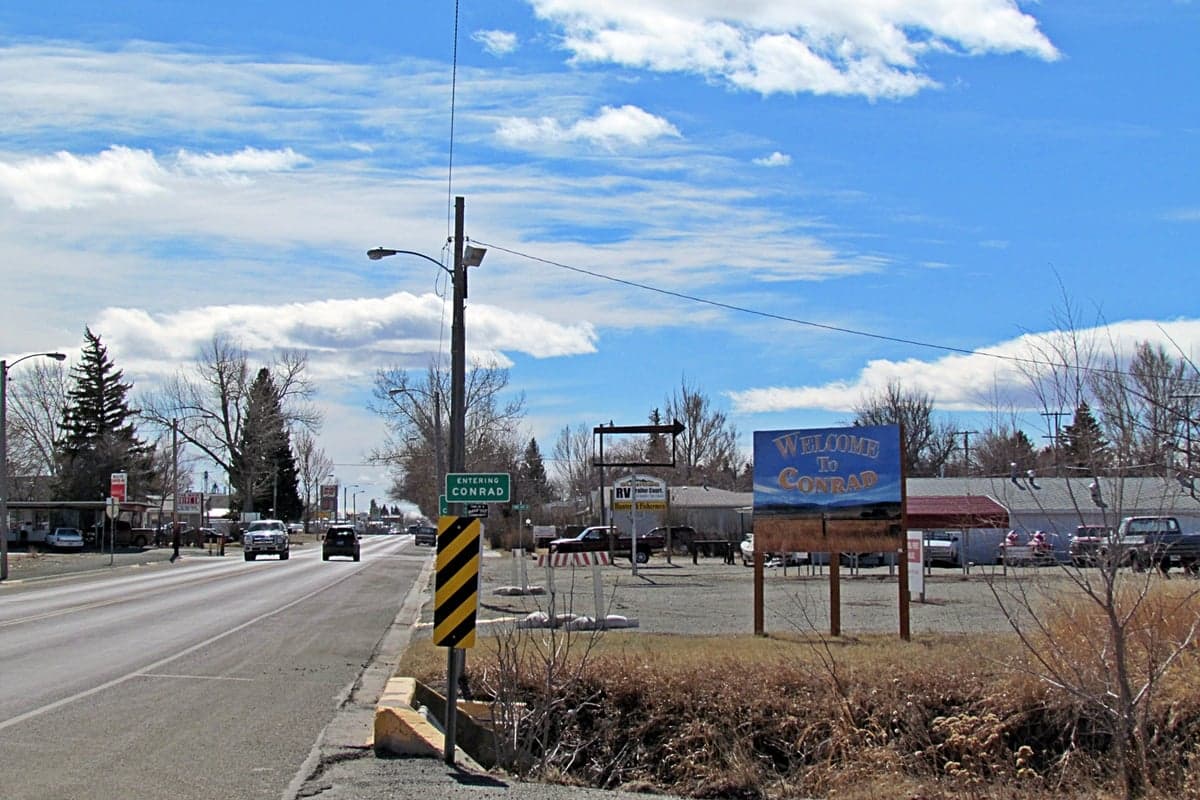
Photo: Wikipedia
Demographics of Conrad, MT
Affluence Level in Conrad, MT
A low-income area with significant economic hardship. Household wealth and educational attainment are well below national averages.
People of Conrad, MT
The people of Conrad, Montana today number 2,553, forming a tight-knit, predominantly white community with a strong agricultural and energy-sector identity. The city is notably homogeneous: 90.1% of residents identify as white, with a foreign-born population of just 0.4% and a Hispanic share of 2.3%. This is a place where generational roots run deep, and the population is characterized by its stability, conservative values, and a quiet, self-reliant character shaped by the surrounding prairie and the Marias River valley.
How the city was settled and grew
Conrad was founded in 1905 as a railroad town on the Great Northern Railway line, named after William Conrad, a local rancher and businessman. The original population was drawn by the promise of homesteading under the Enlarged Homestead Act of 1909, which offered 320 acres to settlers willing to farm the semi-arid land. The first wave of settlers were primarily of Northern European stock—Norwegians, Swedes, Germans, and Canadians—who arrived between 1905 and 1920. These families built the Original Townsite, the historic core centered around Main Street and the railroad depot, where many of the original wood-frame homes and brick storefronts still stand. A second wave of homesteaders, including a smaller number of Irish and English immigrants, settled in the North Side district, an area of modest bungalows and larger lots that developed between 1910 and 1930. The city’s growth was fueled by wheat farming, cattle ranching, and later, the discovery of oil in the Kevin-Sunburst field in the 1920s, which brought a transient population of roughnecks and drillers who lived in temporary camps on the town’s eastern fringe, an area now known as East Conrad. By 1950, the population had stabilized at around 1,800, and the city’s character as a service center for the surrounding agricultural and energy industries was firmly set.
Modern era (post-1965)
After the 1965 Hart-Cellar Act, Conrad saw virtually no immigration-driven demographic change. The foreign-born share has remained below 1% for decades, and the city’s racial composition has stayed overwhelmingly white. The modern era has been defined by domestic in-migration from other parts of Montana and the rural Midwest, driven by employment in the oil and gas fields of the Williston Basin and the nearby Tiber Dam project. These new arrivals, often younger families and skilled tradespeople, have concentrated in the South Hill neighborhood, a subdivision of ranch-style homes and newer builds that expanded in the 1970s and 1980s. The West End, a district of larger homes on acre lots developed in the 1990s and 2000s, has attracted professionals and retirees, including some from out of state seeking lower taxes and a slower pace. The Hispanic population, while small at 2.3%, is primarily composed of seasonal agricultural workers and their families, many of whom live in rental housing near the grain elevators on the city’s southern edge. There is no significant Black, Asian, or Indian-subcontinent population in Conrad, and no distinct ethnic enclaves beyond the historic Northern European core.
The future
The population of Conrad is projected to remain stable or decline slightly over the next 10–20 years, mirroring trends across rural Montana. The city is not homogenizing further—it is already near the demographic ceiling of homogeneity—but it is also not tribalizing into distinct enclaves. The small Hispanic population is likely to grow modestly as agricultural labor demands persist, but assimilation into the broader white community is the norm, with no separate Hispanic neighborhood emerging. The primary demographic pressure is out-migration of young adults seeking education and jobs in larger cities like Great Falls or Billings, which is offset by in-migration of retirees and remote workers attracted by low housing costs and a conservative political climate. The Original Townsite is seeing a slow revival as some historic homes are renovated, while the North Side remains stable with aging homeowners. The South Hill and West End will likely absorb most new construction, if any occurs. The foreign-born population is expected to remain negligible.
Conrad is becoming a quieter, older, and more stable version of itself—a place where the population is not diversifying but is instead consolidating around its agricultural and energy roots. For someone moving in now, this means joining a community where neighbors know each other, schools are small, and the pace of life is dictated by the seasons and the commodity markets, not by urban trends. It is a place for those who value continuity over change.

* Values derived from national, state, county, city and local statistics and may differ in a specific area. Last updated: 2026-04-19T09:59:41.000Z
Narrative content on this page is AI-generated and may contain mistakes. Verify any details that matter before acting on them.
ReloMaps may earn a commission from affiliate links at no extra cost to you.

